
By Kris Chou — Product Manager
Originally published September 26, 2026 · Updated October 11, 2026
Use finished vanity dimensions, wall limits and your preferred inset.
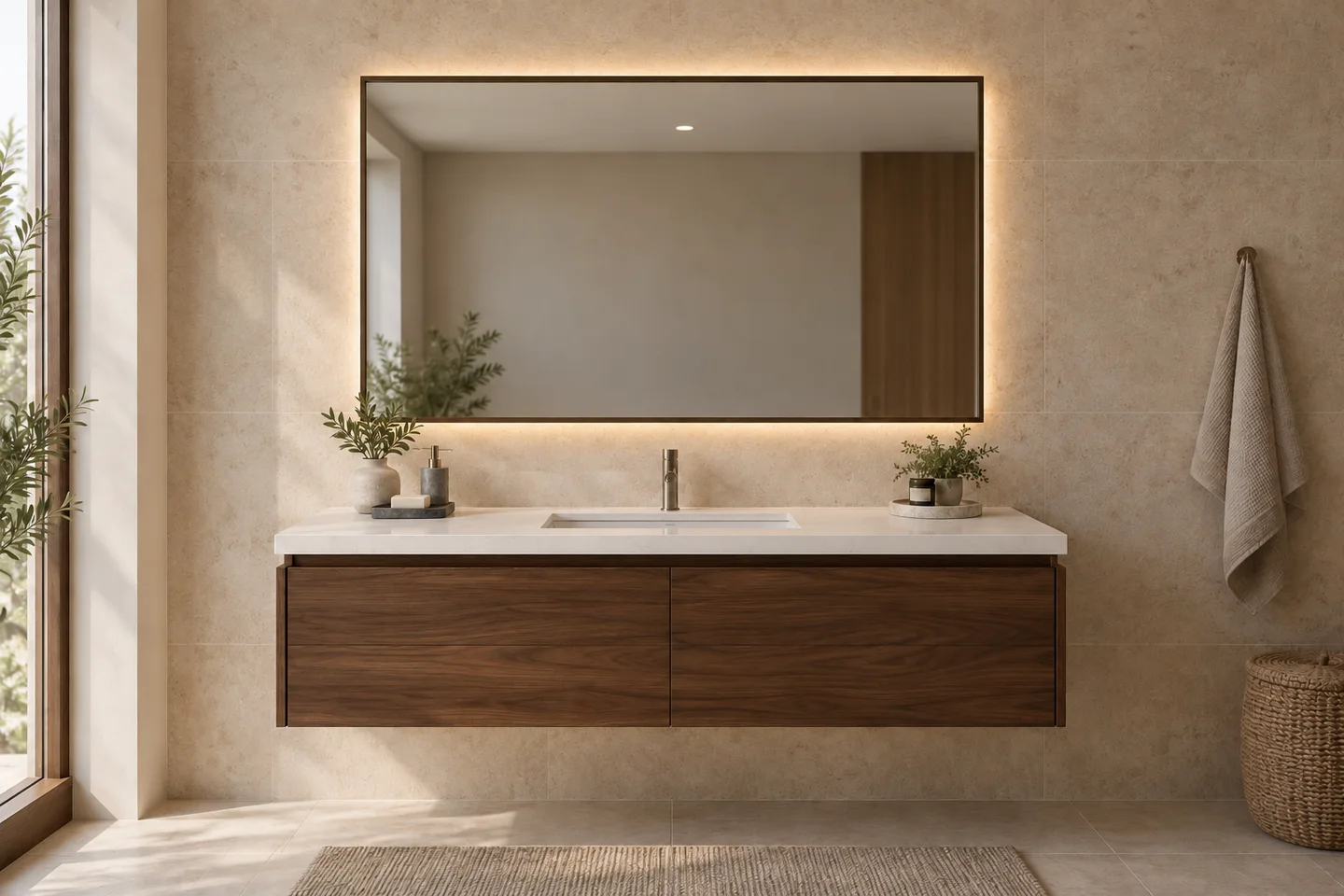
On this page
Best Mirror Sizes for a 48-Inch Vanity
Start with the condition that matters most in your bathroom, then compare the shortlisted sizes on a measured elevation.
| Your layout or preference | Sizes to compare first |
|---|---|
| Centered single basin | 40- and 42-inch outside widths |
| Side sconces or nearby wall features | 36, 38 or 40 inches, after measuring the fixtures |
| Broader reflection on an open wall | 42 or 44 inches |
| Slim frame or frameless appearance | 42 or 44 inches, subject to wall and mounting limits |
| Round mirror | 34-, 36- or 38-inch diameter; check height as well |
| Offset basin or a return wall | Size and position from the basin center and measured wall boundaries |
| Compact double basin | Compare one wide mirror with two basin-aligned mirrors |
These are design comparisons, not a list of available models or permission to install a given size.
Compare exact widths on the same 48-inch vanity
Choose an outside width. The horizontal proportions below are drawn to scale; mirror height is schematic.
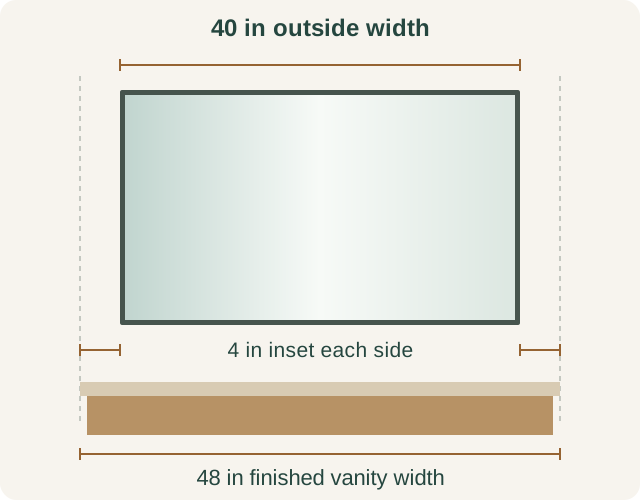
40 in mirror · 4 in inset per side
Inset = (48 − outside mirror width) ÷ 2. This is not wall or fixture clearance. Frame and lighting borders may reduce reflective area.
View six 3D appearance concepts (not to scale)
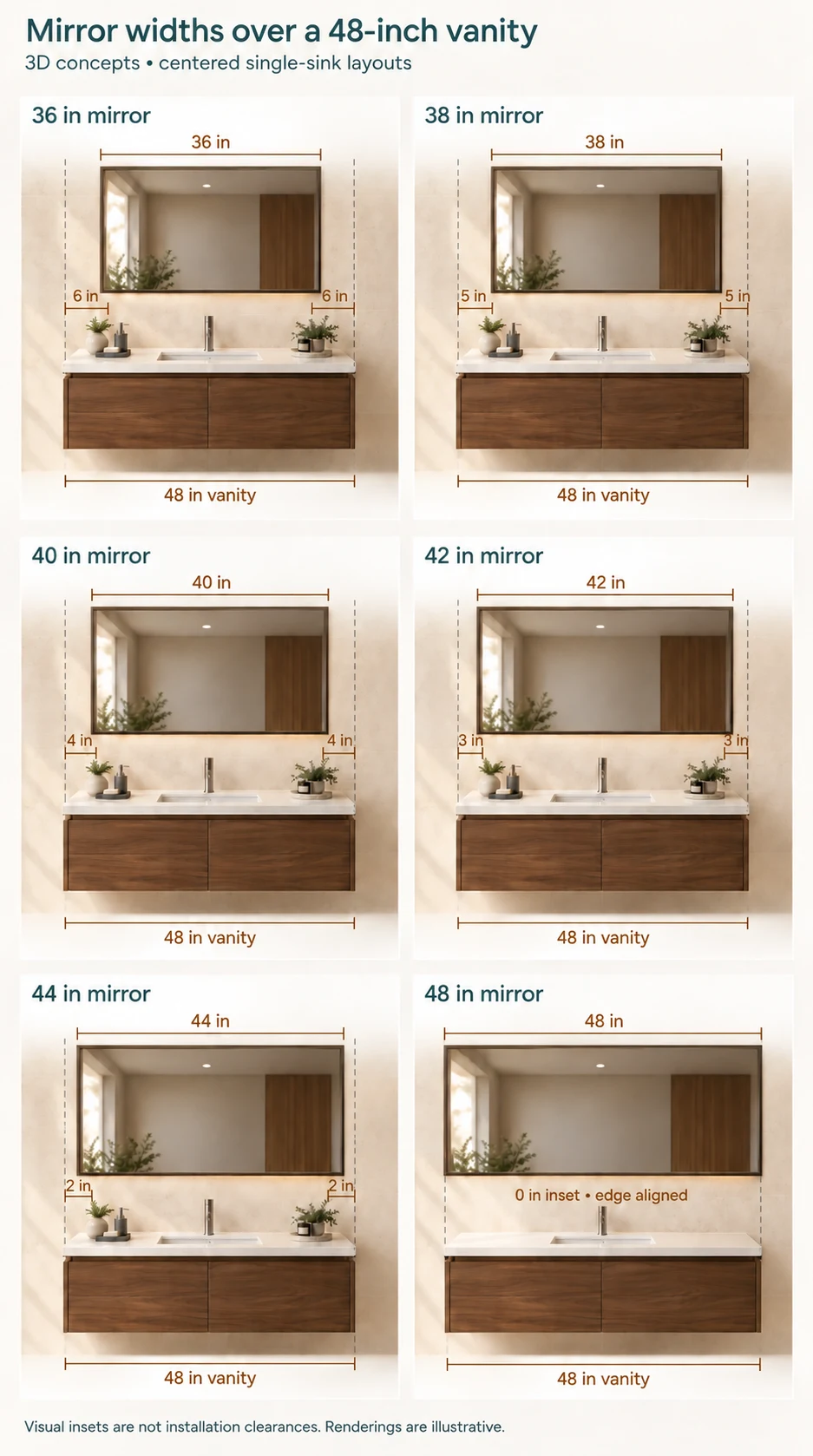
What the width numbers mean
For a mirror centered on an exactly 48-inch finished vanity:
Visual inset from each vanity edge = (48 − overall mirror width) ÷ 2.
| Overall mirror width | Visual inset from each vanity edge | Width / vanity | Visual effect |
|---|---|---|---|
| 36 in | 6 in | 75.0% | More open space above the vanity edges |
| 38 in | 5 in | 79.2% | A lighter composition |
| 40 in | 4 in | 83.3% | Balanced starting comparison |
| 42 in | 3 in | 87.5% | Fuller coverage |
| 44 in | 2 in | 91.7% | Nearly full width |
| 48 in | 0 in | 100.0% | Deliberate edge-aligned design |
Visual inset is not installation clearance. The calculation does not locate a side wall, sconce, outlet or mounting obstruction. If the countertop is wider than its nominal cabinet size, use the measured finished width instead of 48.
Check your size with the calculator
Use the Bathroom Mirror Size Calculator to compare a preliminary width from your finished vanity, preferred inset and wall measurements. Enter usable height separately and select the basin layout and mirror shape.
For example, a 48-inch vanity with a preferred 3-inch inset on each side gives 48 − 3 − 3 = 42 inches before other limits are applied. A different input can produce a different result. The 40- and 42-inch starting options are editorial guidance; the calculator applies your chosen measurements. Neither replaces a product drawing or site check.
40 vs. 42 vs. 44-Inch Mirrors
A 40-inch mirror is a useful first layout to test over a centered single basin. Its 4-inch visual inset on each side gives the mirror a clear relationship with the vanity without approaching its full width.
A 42-inch mirror reduces each inset to 3 inches. Compare it with 40 inches when you want a broader reflection and have an open wall. Check the actual reflective width if a frame or illuminated border occupies part of the face.
A 44-inch mirror leaves 2 inches per side. It can work with a slim frame or frameless design, but wall trim, outlets and installation access need particular attention. A narrow visual inset does not tell you whether a fixture will fit beside the mirror.
Percentage rules are visual references, not sizing requirements. A 40-inch mirror is 83.3% of a 48-inch vanity; 42 inches is 87.5%, and 44 inches is 91.7%. All exceed 80%, which shows why a fixed 70–80% rule cannot decide the layout. Use the finished vanity, basin alignment, usable wall, frame and lighting together.
Three starting briefs—not confirmed product models
Choose a planning example to prepare your inquiry. These are hypothetical configurations, not stock sizes or completed projects. 3D concept images illustrate appearance only; use the written dimensions for planning.
Rectangular LED
42 × 32 in
3 in per side on a centered 48 in vanity.
Confirm illuminated border, power location and mounting.
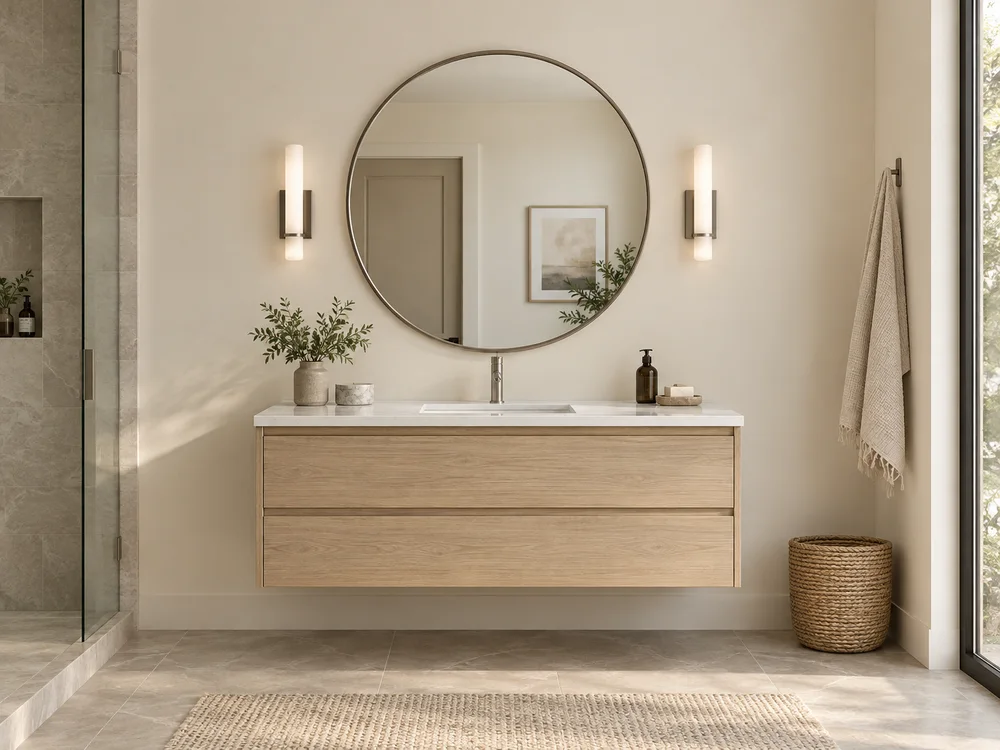
Round mirror
Ø36 in
6 in per side on a centered 48 in vanity.
Diameter is 36 in. Check reflection and adjacent fixtures.
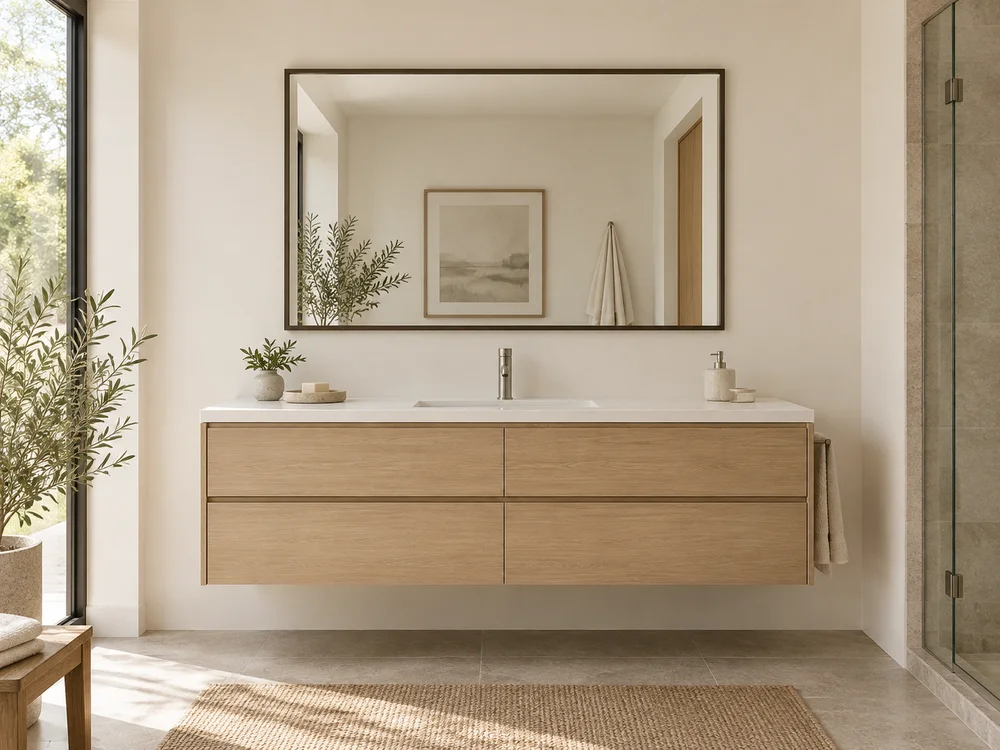
Metal-framed mirror
44 × 32 in
2 in per side on a centered 48 in vanity.
Outside frame size, not clear glass. Frame face and depth remain TBC.
Round, Rectangular, Oval or Arched Mirrors?
Rectangular mirrors provide the largest face area within a given rectangular outside boundary. They are useful when broad reflection is the priority, although the frame and lighting border still affect the usable glass.
For a round mirror, compare diameters of approximately 34–38 inches, with 36 inches as a useful first layout. A circle's diameter sets both its width and height. A 38-inch circle therefore needs 38 inches of vertical space before any additional installation allowances, even if it fits comfortably across the wall. Curved edges also reduce reflection near the corners of its bounding box.
Oval mirrors can emphasize height or width depending on orientation. Compare both outside dimensions and the viewing area where the user stands. Arched mirrors require a full-height measurement to the crown of the arch, especially beneath an overhead light.
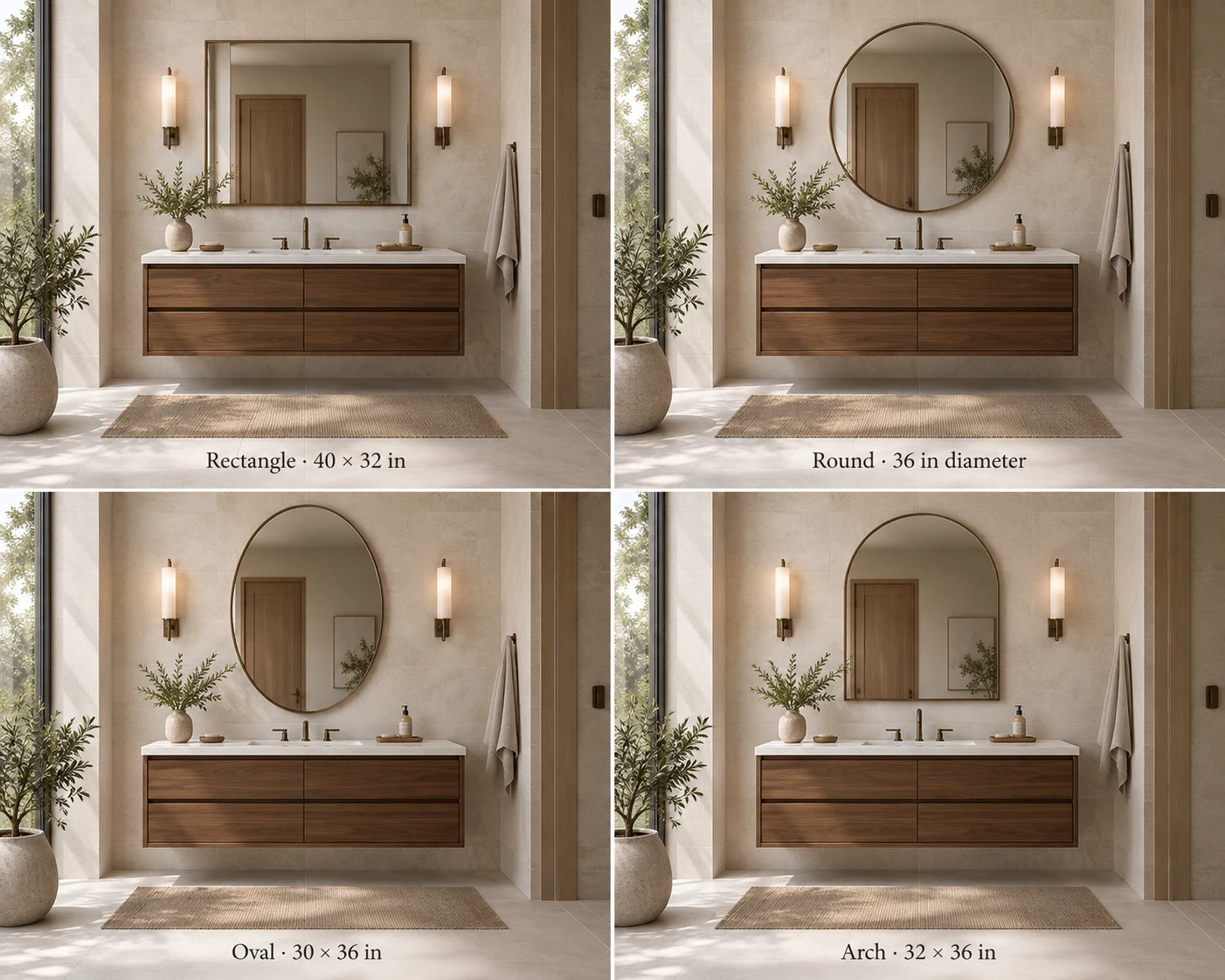
For product directions, explore custom round bathroom mirrors, oval bathroom mirrors or arched bathroom mirrors, then confirm the selected model's full dimensions.
One Mirror or Two for a 48-Inch Double Vanity?
A compact double vanity needs a basin-centerline check before a mirror-width calculation. One wide mirror provides continuous reflection across both basins. A pair gives each basin its own mirror, but only if the panels align with the actual standing positions.
Here are two hypothetical width allocations, measured from the left edge of an exactly 48-inch vanity:
| Pair | Width allocation | Mirror centers from the left vanity edge |
|---|---|---|
| Two 18-inch mirrors | 4 + 18 + 4 gap + 18 + 4 = 48 in | 13 and 35 in |
| Two 20-inch mirrors | 2 + 20 + 4 gap + 20 + 2 = 48 in | 12 and 36 in |
The arithmetic fits in both cases, but the mirror centers differ. Neither pair is automatically correct for your basins. The center gap and outer insets are illustrative design choices, not fixture or installation clearances.
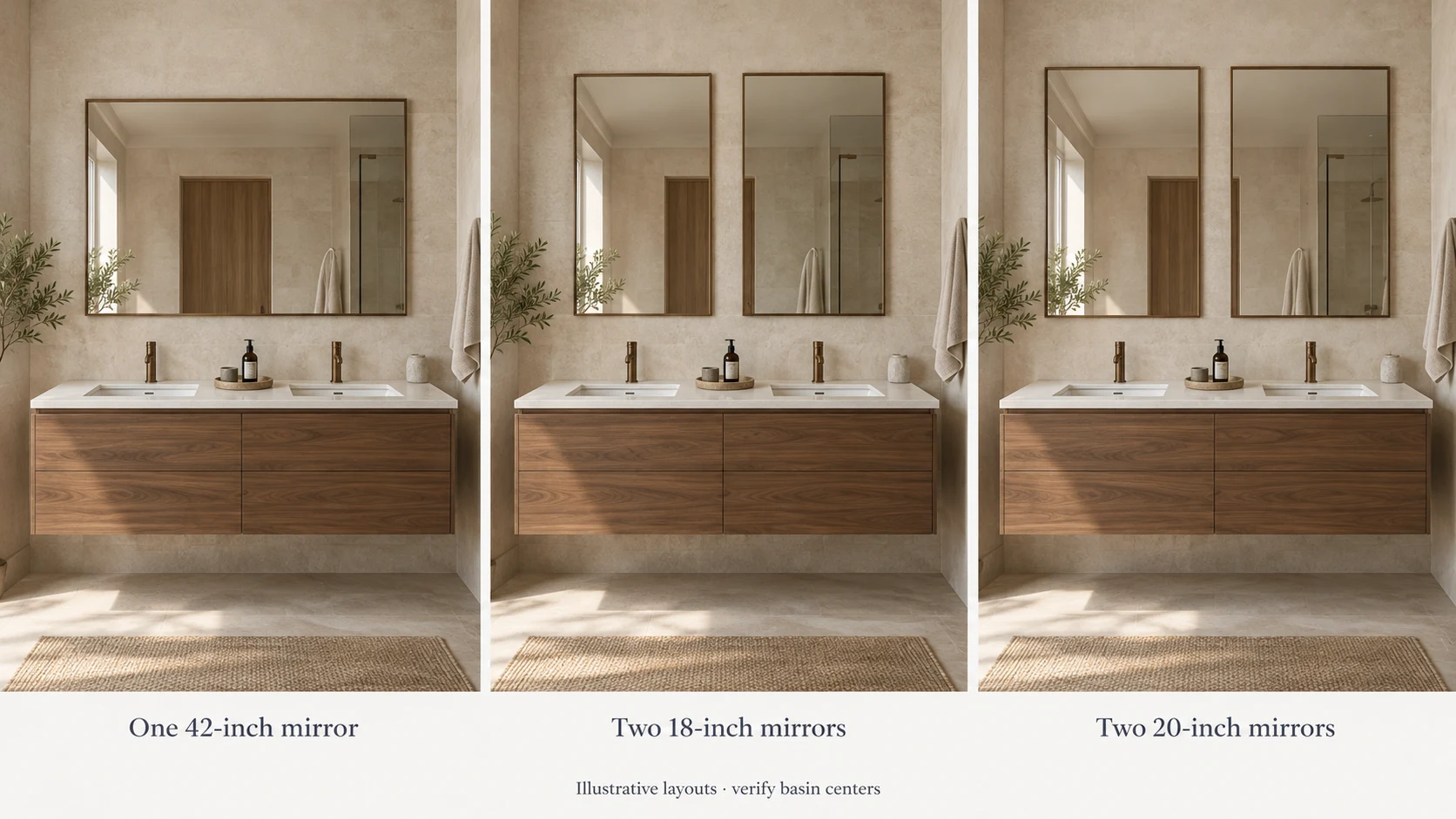
Put the basin centers, mirror outlines, frames and lights on one elevation. If a pair cannot align comfortably, compare a single wide mirror rather than forcing two panels into the available width.
How Tall Should a Mirror Be Over a 48-Inch Vanity?
A height around 30–36 inches is a useful comparison range for many layouts, not a specification derived from vanity width. Establish the mirror's bottom position around the faucet and backsplash, then check the space below the light or other obstruction. Confirm that the resulting reflective area works for the people using the sink.
| Example outside size, width × height | What changes in the comparison |
|---|---|
| 40 × 30 in | Wider horizontal emphasis |
| 40 × 32 in | Two more inches of height at the same width |
| 40 × 36 in | Taller face within the same side insets |
| 42 × 32 in | More width with moderate height |
| 42 × 36 in | More coverage in both directions |
| 44 × 36 in | Broad face with only 2-inch centered vanity insets |
These size combinations are planning examples, not a statement of OJMirror stock availability.
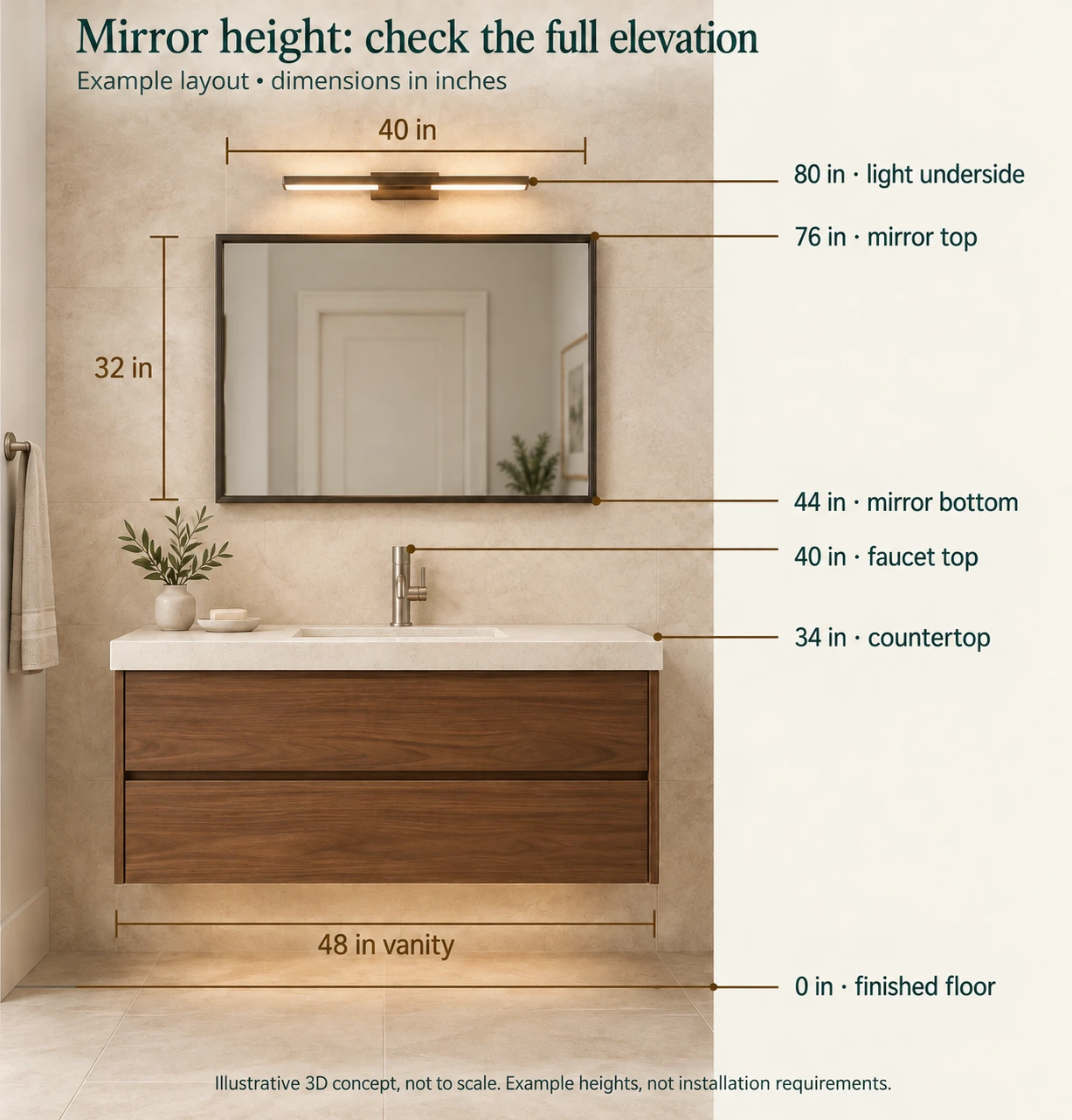
As a hypothetical measurement exercise, if the distance from your selected mirror-bottom position to the upper permitted limit is 34 inches, a 36-inch-tall mirror will not fit. A 30- or 32-inch option remains worth comparing, subject to mounting access and viewing height. The 34 inches here is assumed to be usable space after the required fixture and mounting allowances have been established.
Mirror Width, Available Wall and Side Sconces
Visual inset and wall space are different measurements
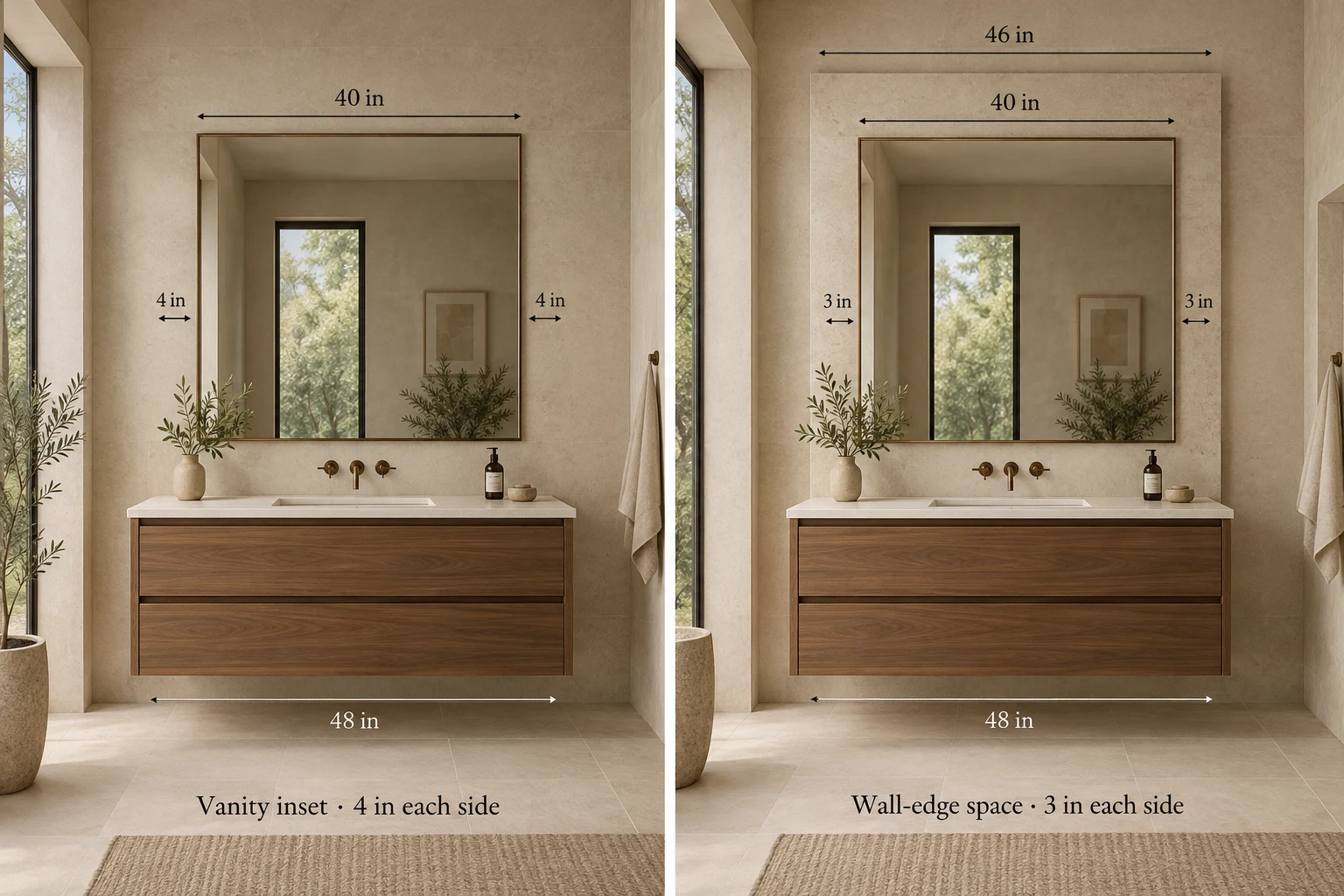
A centered 40-inch mirror has a 4-inch visual inset from each edge of a 48-inch vanity. If the clear wall above is only 46 inches wide and shares the same centerline, the geometric space from the mirror to each wall boundary is just 3 inches:
Vanity inset: (48 − 40) ÷ 2 = 4 inches.
Wall-edge space: (46 − 40) ÷ 2 = 3 inches.
The 3-inch result still does not establish a safe or sufficient installation gap. Fixtures, mounting access and product instructions can reduce the usable space further. When wall and vanity centers differ, measure the left and right sides individually.
What Size Mirror Fits a 48-Inch Vanity With Two Side Sconces?
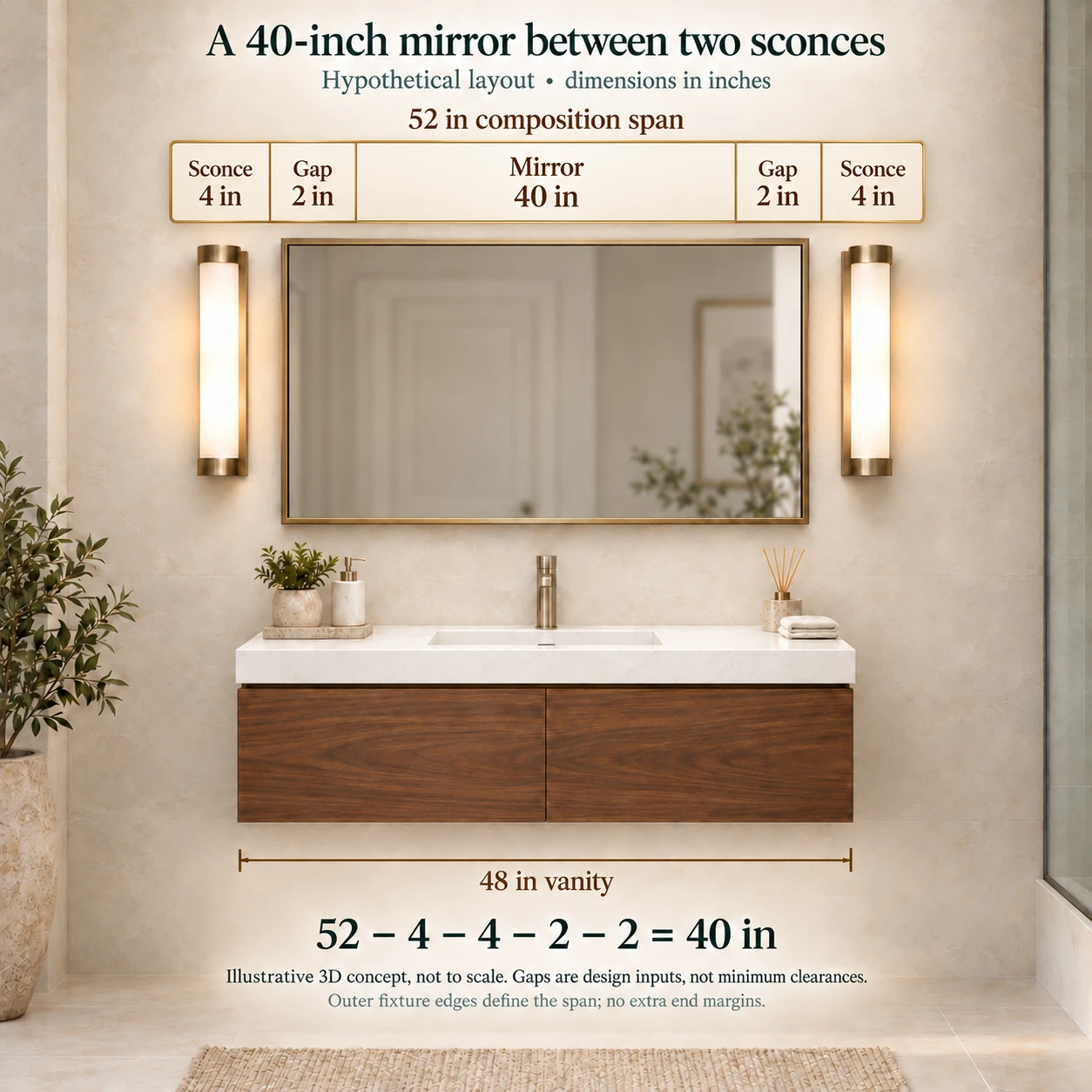
Consider a hypothetical 52-inch usable composition span, a 4-inch-wide sconce at each side, and a chosen 2-inch space between each sconce and the mirror. If the outer fixture edges define that span:
52 − 4 − 4 − 2 − 2 = 40 inches
A 40-inch outside mirror width is a candidate for the next layout check. Its visual inset from a centered 48-inch vanity is 4 inches per side, while the chosen mirror-to-sconce space is 2 inches. Those are different measurements.
If 52 inches instead describes the full wall and you need margins beyond the fixtures, subtract those margins too. Verify actual fixture positions, backplate size, projection and the clearances specified for the products.
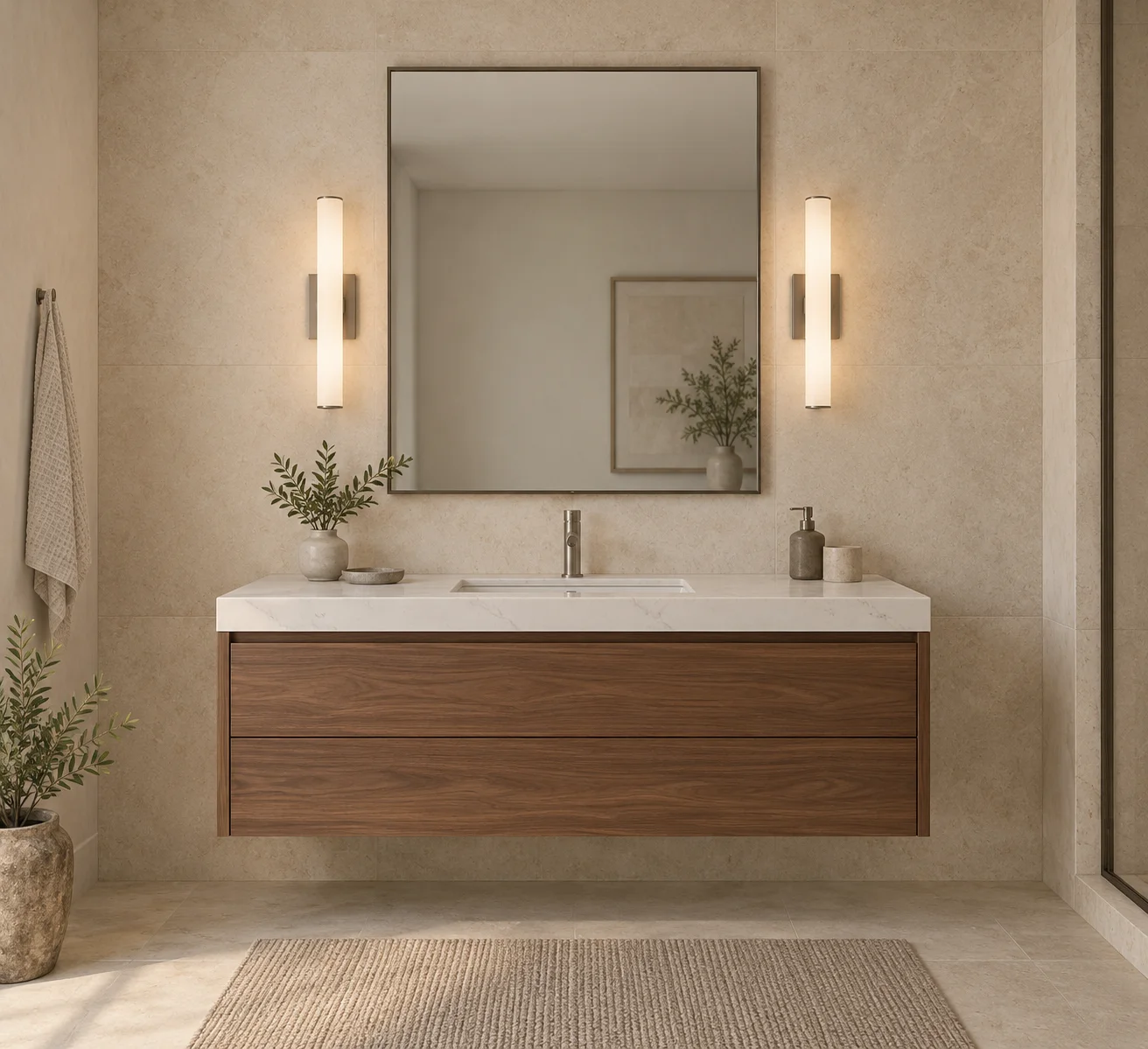
Sconces occupy space beyond their mounting centers. Record each fixture's body width, height, wall projection and manufacturer-specified spacing. Draw those dimensions beside the full mirror outline before deciding whether 36, 38 or 40 inches is narrow enough.
Integrated mirror lighting can change the wall arrangement, but it does not automatically replace all bathroom lighting. Review the selected product's lighting performance and electrical arrangement against the room's requirements.
What if the basin is off center?
For a hypothetical 48-inch vanity with a basin center 22 inches from the left edge, a 40-inch mirror centered on that basin extends from 2 to 42 inches. Its vanity-edge insets are therefore 2 inches left and 6 inches right, not 4 and 4. Centering the same mirror on the vanity gives 4-inch insets, but moves its center 2 inches to the right of the basin.
Compare both outlines with the user's standing position and the measured wall. Basin alignment, comfortable reflection and the surrounding composition all matter; an equal-inset formula cannot settle an offset layout.
How to Measure Before Ordering
The product name may refer to the cabinet while the finished countertop is slightly wider. Begin with the installed or approved finished dimensions, then record the wall separately.
- Finished vanity: measure the countertop at its widest finished point, including relevant fillers and adjacent millwork.
- Wall boundaries: locate returns, trim, tile transitions, tall cabinets, outlets and switches above the vanity.
- Centerlines: measure each basin and faucet from a consistent reference edge. Mark the vanity center separately.
- Vertical limits: record the faucet top, backsplash top, light underside and proposed mirror bottom.
- Product envelope: add the full outside size, reflective area, mounting direction, rear components and any required access space from the selected drawing.
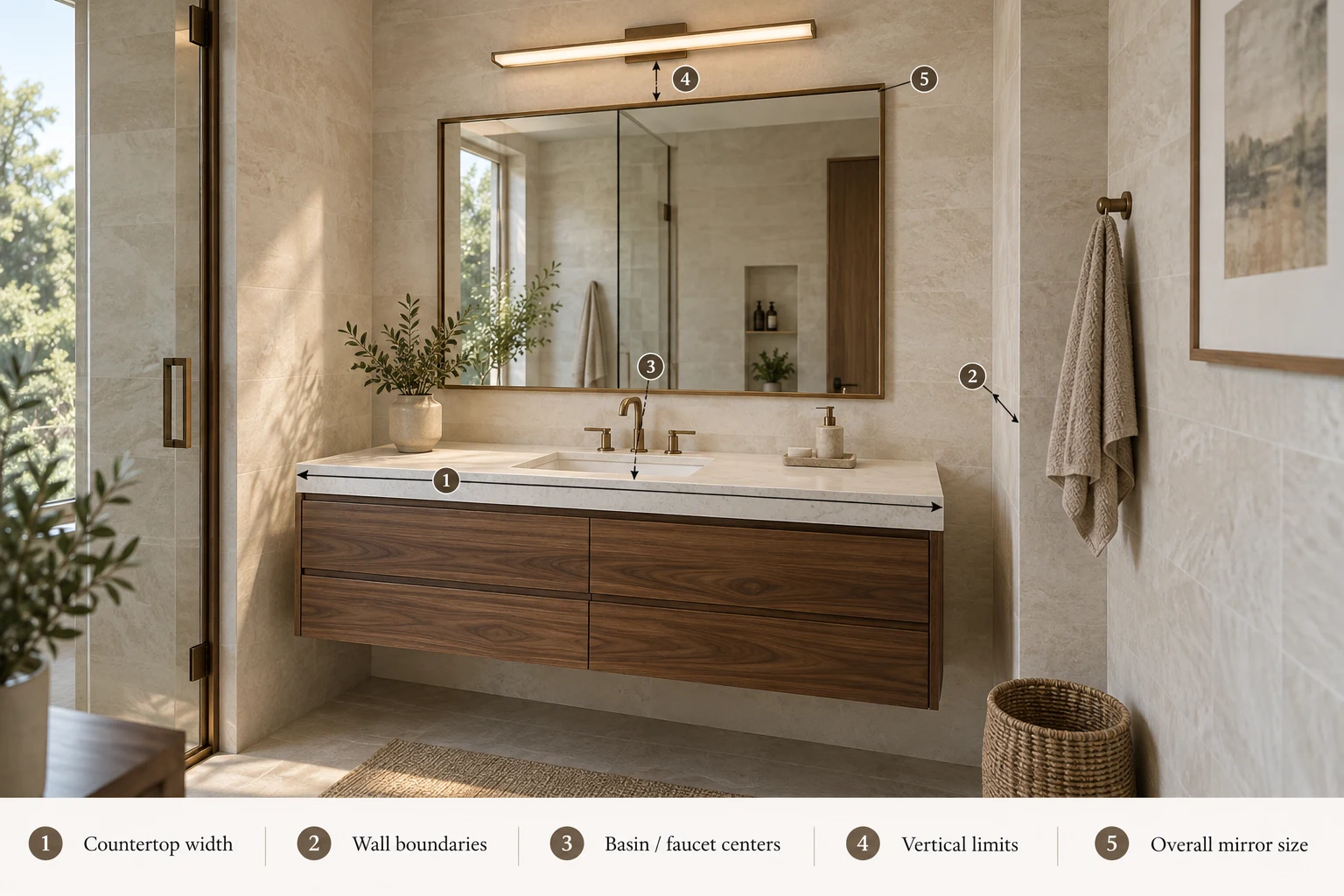
Use a full-size paper template or low-tack tape to compare the shortlisted outlines on the wall. Stand at the basin and check the reflection, then review the same dimensions on the elevation before placing the order.
LED and Framed Mirror Sizing Considerations
For a project order, the mirror needs to be treated as a complete product envelope. Glass, frame, rear housing, mounting cleat and cable exit can all affect the installation. Final details vary with the selected construction and market.
Overall width versus reflective width
A hypothetical mirror with an overall width of 40 inches and a non-reflective frame covering 1 inch on each side has approximately 40 − 1 − 1 = 38 inches of visible reflective width. This assumes uniform coverage in a front elevation. An inset light band or another frame design may produce a different relationship.
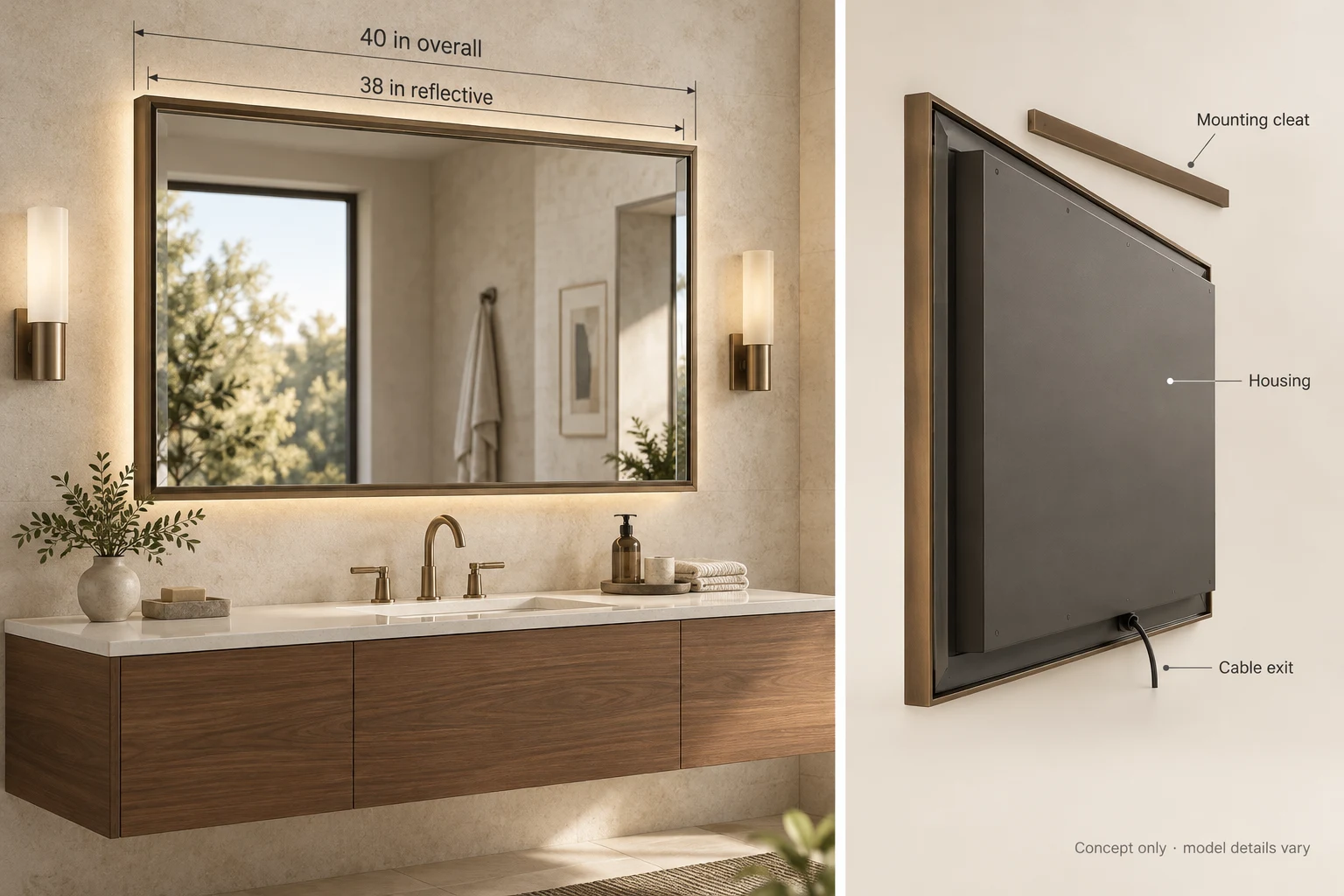
From a preliminary size to a drawing review
A width label alone leaves several questions unanswered. For custom bathroom vanity mirrors, identify these dimensions on the current model drawing:
| Drawing information | What it resolves |
|---|---|
| Model, revision and full outside width × height | Which construction and size are being reviewed |
| Exposed reflective area and frame or light-band coverage | How much reflection remains within the outside dimensions |
| Total depth, rear housing and required wall gap | Product projection and space behind the glass |
| Mounting points, cleat and installation movement | Fixing locations, wall support and access |
| Cable exit, power location and controls | Coordination with the room's electrical layout |
Do not transfer a housing depth, fixing position or electrical arrangement from a similar-looking mirror. Tie each approved configuration to its room type and vanity schedule so that a size selected for one layout is not copied into a room with different basins or lights.
Common Mirror Sizing Mistakes
| Mistake | Better approach |
|---|---|
| Measuring only the cabinet | Use the finished countertop and measure the wall separately |
| Assuming every basin is centered | Locate the actual basin centerline from a reference edge |
| Treating visual inset as fixture clearance | Check wall boundaries, fixture bodies and product instructions |
| Ignoring frame or light-band coverage | Compare outside dimensions and exposed reflective area |
| Choosing height from vanity width | Check vertical limits and the users' reflection |
| Dividing vanity width in half for two mirrors | Check both mirror centers against both basin centers |
| Treating a planning size as an approved product | Confirm the model, drawing revision and installation conditions |
Frequently Asked Questions
Does a 40-inch mirror work with a 48-inch vanity?
Yes. It creates a 4-inch visual inset on each side when centered on an exactly 48-inch finished vanity. It is a useful starting comparison for a single basin, provided the wall, lighting and reflective area work with the layout.
Is a 42-inch mirror a good size for a 48-inch vanity?
It can be. A centered 42-inch mirror creates 3-inch vanity-edge insets and a fuller appearance than a 40-inch mirror. Check the actual wall boundaries and lighting before choosing the extra width.
Is a 44-inch mirror too big for a 48-inch vanity?
Not necessarily. It leaves 2-inch visual insets and can suit a slim frame or frameless design on an open wall. The small insets do not establish installation clearance, so confirm surrounding fixtures and mounting access.
Can a 48-inch mirror go over a 48-inch vanity?
Yes, as an intentional full-width composition. Verify the exact outside dimensions, countertop width, wall accuracy, nearby finishes and installation method. A nominal 48-inch label on both products does not guarantee their edges will align.
Is a 36-inch mirror wide enough for a 48-inch vanity?
It can be, especially when side sconces or wall features favor a narrower mirror. Its 6-inch centered visual insets create a lighter composition. Check the reflective width from the basin rather than judging only the space at the vanity edges.
What size round mirror works over a 48-inch vanity?
Compare approximately 34–38 inches in diameter, starting with 36 inches. Check the same dimension vertically: a round mirror may fit across the wall but be too tall between the faucet and overhead light.
Should a 48-inch double vanity use one mirror or two?
Either can work. A single mirror offers continuous reflection, while two mirrors need to align with the actual basin centers and clear nearby fixtures. A width-allocation calculation alone does not confirm that a pair fits the users' positions.
Should the mirror be centered over the sink or the vanity?
For a centered basin, the centerlines coincide. With an offset basin, compare basin-centered and vanity-centered outlines at full size. Choose the position that provides comfortable reflection and works with the measured wall and lighting; unequal side insets may be appropriate.
Does mirror size include the frame?
Use the complete outside dimensions, including the frame, when checking fit. Catalog terminology can vary, so confirm whether a quoted size is glass size or overall size. Request the exposed reflective dimensions separately when a frame or light band occupies part of the face.
How This Guide Was Developed
The width comparisons use an exactly 48-inch finished vanity and a centered mirror unless an example explicitly states otherwise. Insets are calculated from overall outside width. They do not represent wall clearance, mounting tolerance or minimum spacing around fixtures.
The size ranges are editorial starting comparisons, not survey results, building-code requirements or a statement of product availability. The size tables and written calculations use the stated dimensions. All 3D comparisons are illustrative, not scale drawings. The 3D scenes illustrate appearance and are not measured installation records or approved product models.
Final dimensions, electrical arrangements and mounting requirements must be confirmed against site measurements and the selected construction's current drawing.
Request a Custom Mirror Size Review
Start with 40 and 42 inches for a centered single basin, then adjust the shortlist to suit the wall, fixtures and reflection. For a project order, send the information already available:
- a vanity schedule, elevation or dimensioned site sketch;
- finished vanity width, wall boundaries, basin centers and vertical limits;
- preferred mirror size, shape, frame and lighting;
- quantity by room type and destination market.
Request a custom mirror size review. Include the sizing or coordination question you need resolved. Dimensions, mounting and electrical details remain subject to the selected model drawing and project requirements.
Planning a larger single-basin vanity? See our mirror sizing guide for a 60-inch single vanity for wall-width, sconce and offset-sink examples.
