CRUISE & MARINE / PROJECT MIRRORS

Custom Cruise Ship Bathroom Mirrors & Marine LED Mirrors

Comfort at sea. In every reflection.

Plan cabin bathrooms, suites and shared spaces around the right mirror. Explore illuminated mirrors, framed designs and shipboard mirror cabinets for newbuild and refit projects. Start with a product direction, then send your room schedule, dimensions and lighting brief for review. For replacements, include existing fixing and cable positions so fit can be assessed before repeat quantities are agreed.

Custom dimensionsNewbuild & refitDrawing-led review
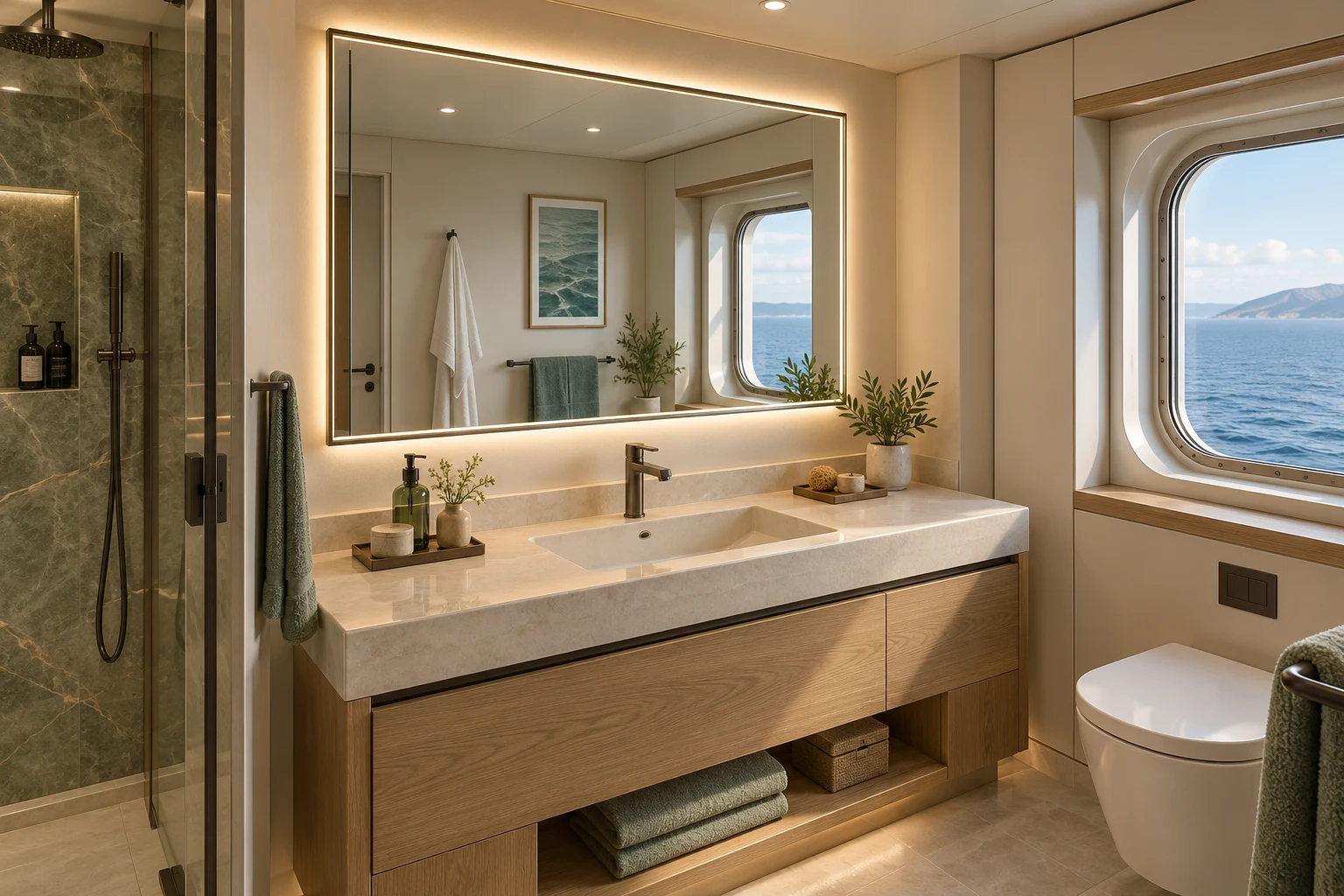
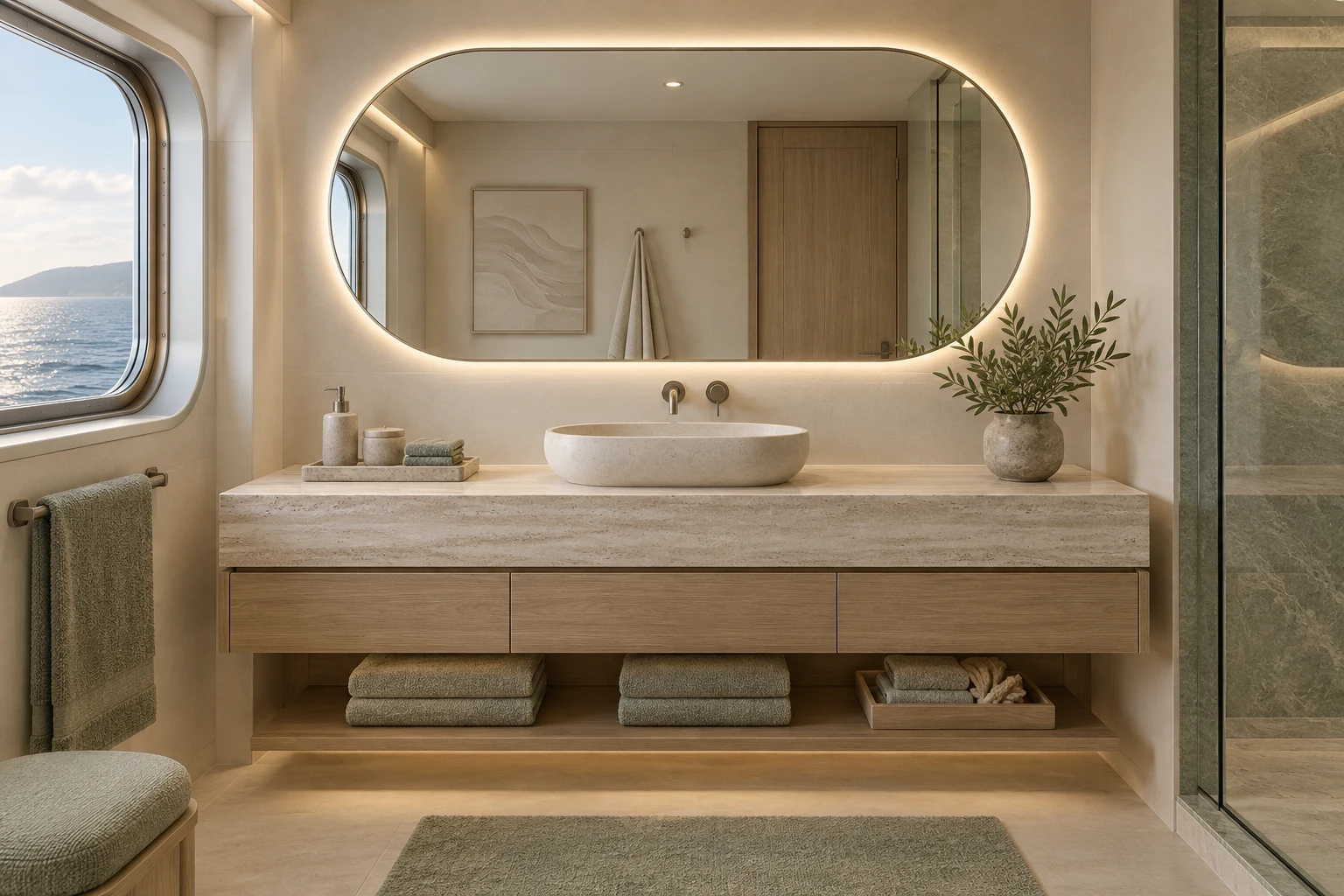
Illuminated mirror above a cruise cabin bathroom vanity
Project-first planning

Drawing-led mirror supply for marine interiors

For shipyards, marine interior contractors, designers and purchasing teams, the starting point is a coordinated specification: mirror geometry, lighting, mounting, finish, documentation and delivery scope. Newbuild and refit projects need different inputs, but both benefit from an approved reference before repeat production.

This page covers interior bathroom and dressing applications. Suitability for the intended location and required documentation depend on the selected assembly and project review. Identify exterior, salt-spray or steam exposure separately.

01 / Onboard spaces

Mirrors for Cruise Ship Cabins, Suites & Public Areas

Begin with the person using the mirror. Then translate that experience into dimensions, light, controls and clearances that the project team can review.

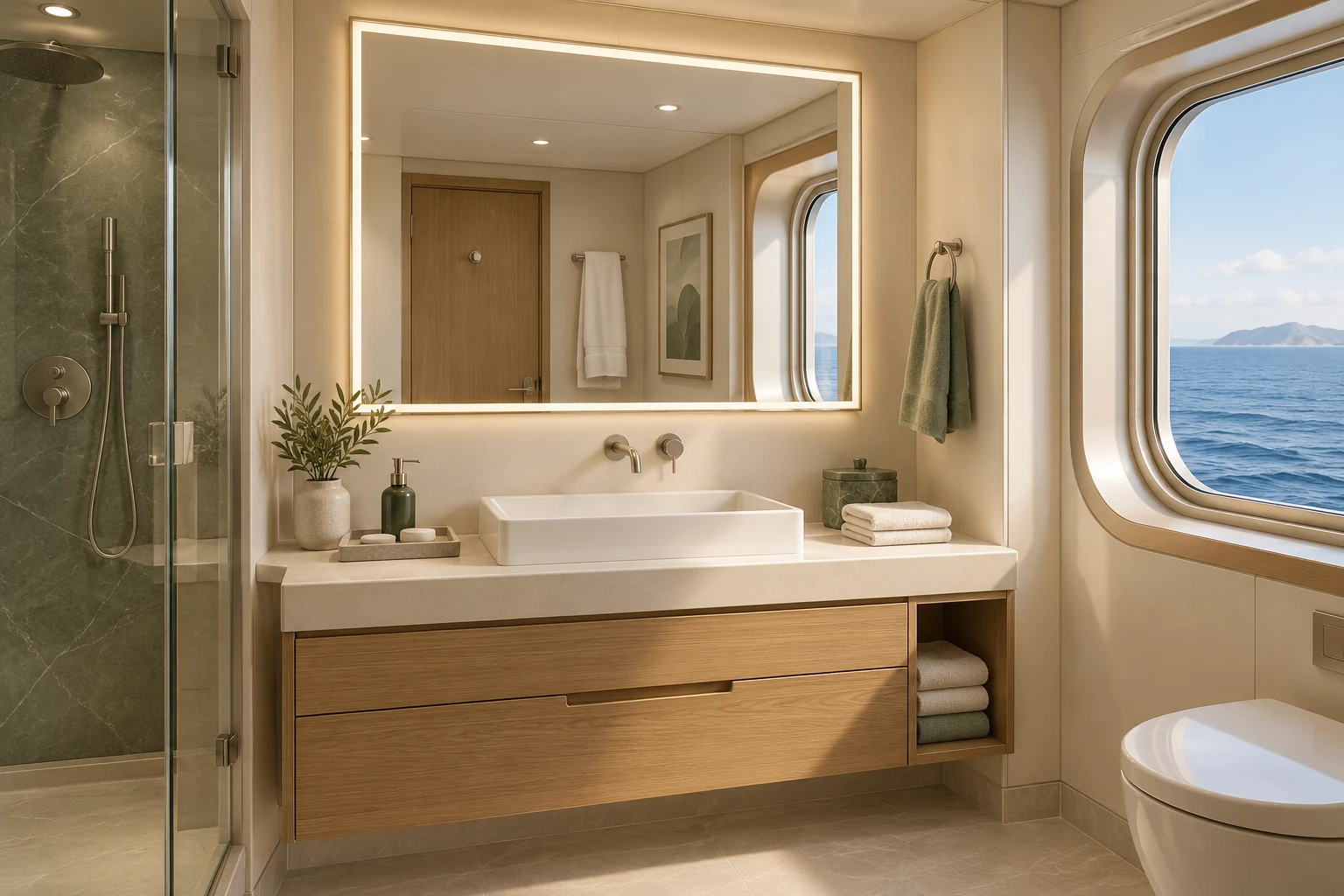
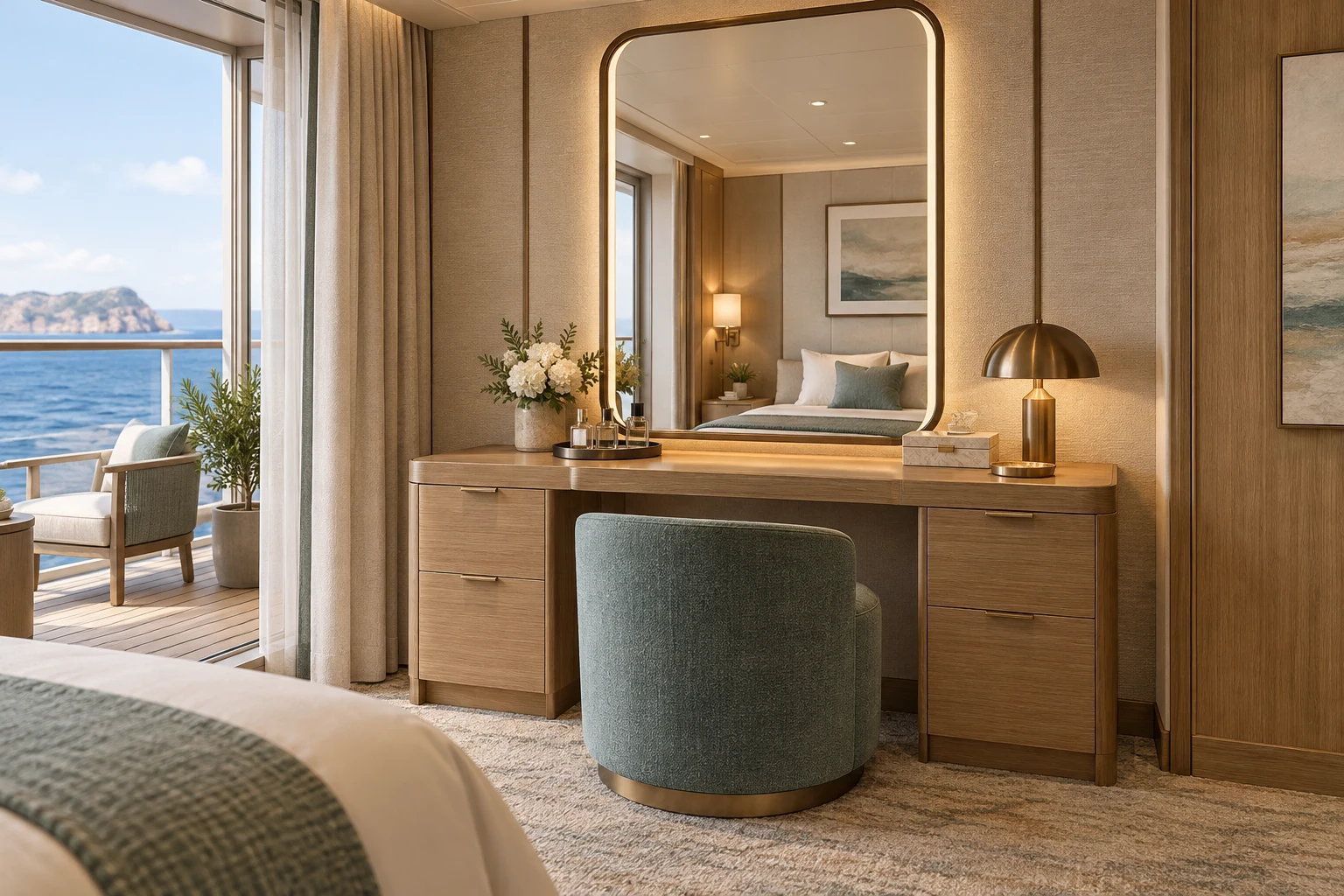
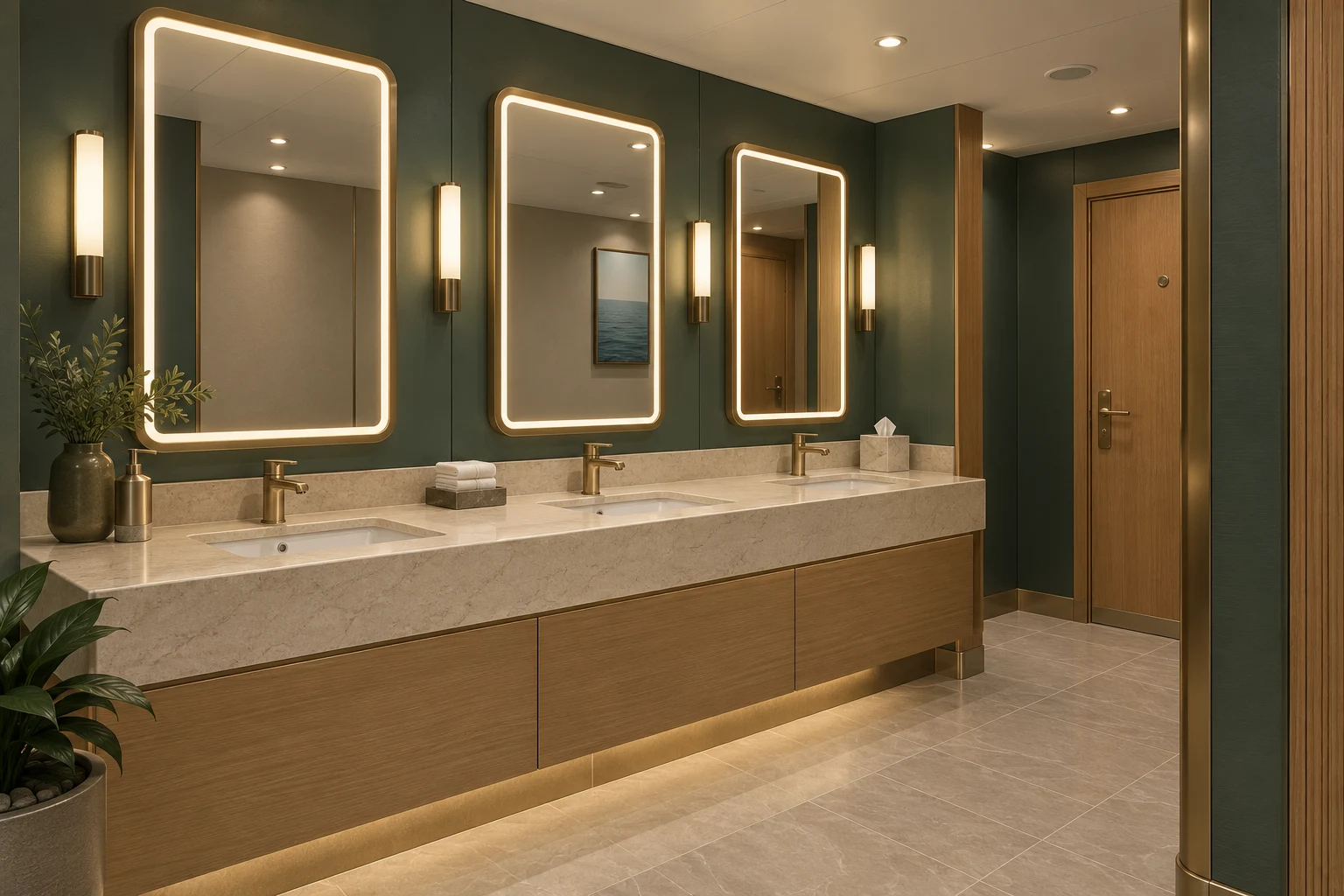
Concept renderings illustrate interior design directions; they are not photographs of completed vessel projects.

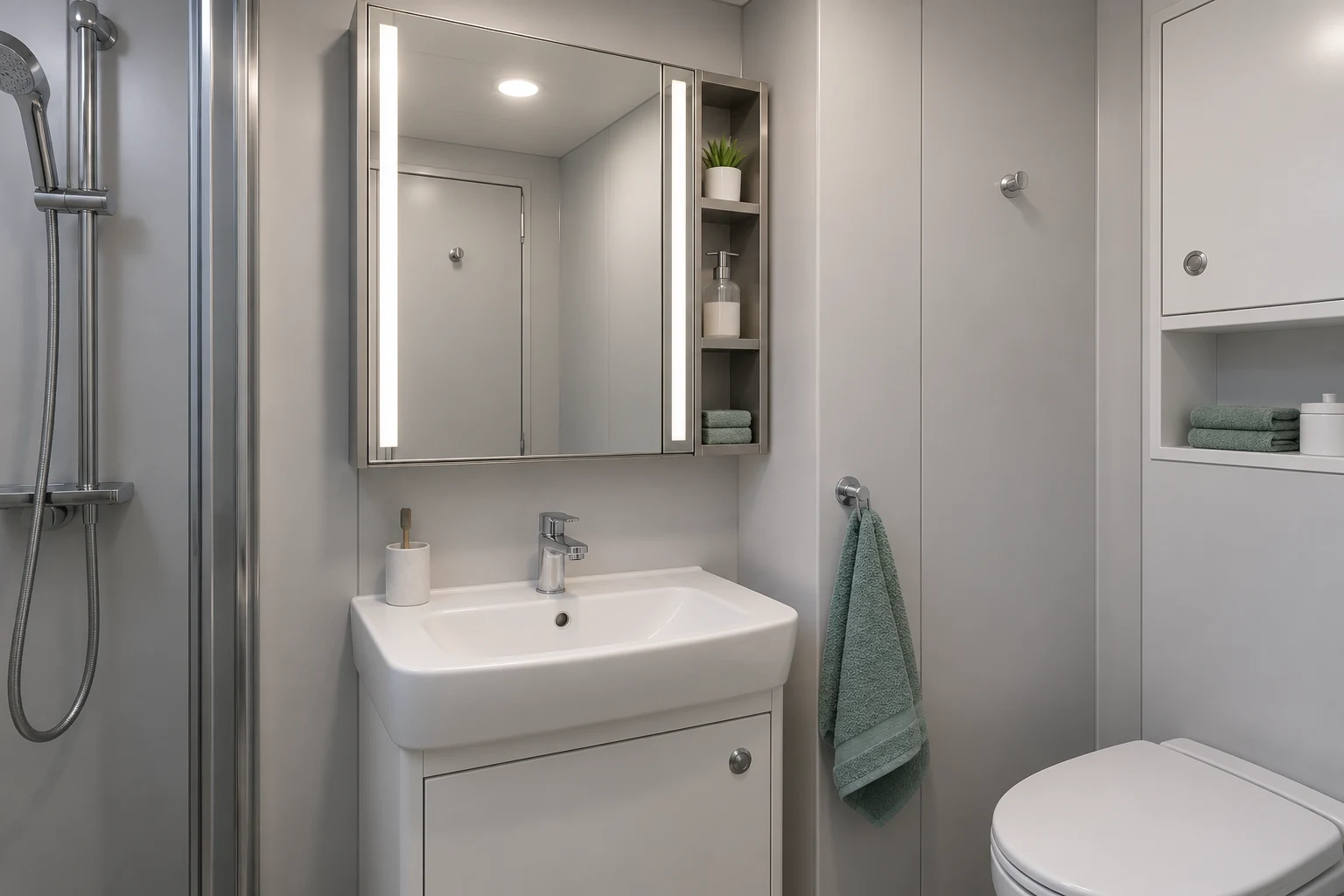
Cruise Ship Bathroom Mirrors for Compact Cabins

Cruise Ship Bathroom Mirrors for Compact Cabins

Give guests a clear view for shaving and everyday grooming, with controls they can reach without leaning awkwardly over the basin. A compact room should still feel familiar and comfortable during the morning routine.

Consider front lighting where the mirror contributes to face illumination. Backlighting can create a softer wall glow, but its suitability for grooming should be reviewed with the complete room lighting. Coordinate the mirror with basin center line, tap height, shower-screen swing and adjacent storage.

Drawing inputs: finished width × height × depth, wall construction, cable exit and left-/right-hand room variants. Check standing sightlines and the removal route in the cabin mock-up.

Suite & Dressing Mirrors

Suite & Dressing Mirrors

Make preparing for dinner a relaxed part of the stay. Review the mirror from the actual dressing chair as well as a standing position, with the intended stool, desk and wardrobe in place.

Portrait, framed and full-length designs address different needs. Agree whether bathroom and dressing lighting operate independently; approve frame color and sheen against physical room-finish samples.

Drawing inputs: seated eye level, usable reflection area, furniture clearance, control reach and door swing.

Public Washroom Mirrors

Public Washroom Mirrors

Provide a comfortable place for a quick refresh between onboard activities. Align mirror positions with basin bays so guests can use their own reflection without leaning into the neighboring station.

Individual mirrors simplify unit identification; a continuous visual arrangement requires careful joint and wall-tolerance coordination. Compare replacement access, cleaning routines and the consequences of one unit being out of service.

Drawing inputs: basin module spacing, joint locations, dispenser clearance, segment references and handling dimensions.

Spa & Wellness Mirrors

Spa & Wellness Mirrors

Let the calm continue after a treatment. Review the transition from treatment-room light to grooming light, avoiding an abrupt bright reflection while keeping the task visible.

Identify whether the mirror sits in a dry changing area, at a basin or near steam. These locations should not be treated as having the same exposure. Consider the surrounding lights, cleaning products and control accessibility together.

Drawing inputs: location-specific exposure, lighting scene, switch relationship and accessible component position.

Crew Mirrors & Shipboard Mirror Cabinets

Crew Mirrors & Shipboard Mirror Cabinets

Make the small routines before and after a shift straightforward. A clear reflection, reachable essentials and an unobstructed door opening matter more than adding functions that reduce usable storage.

A simple illuminated mirror may suit a shallow wall bay; a mirrored cabinet may suit a storage-led brief. Review shelf supports, door retention and internal depth with the vessel team rather than treating domestic cabinet hardware as automatically suitable.

Drawing inputs: stored-item sizes, usable shelf depth, door handing, nearby obstructions and maintenance access.

02 / Mirror collection

Choose Your Marine Mirror Configuration

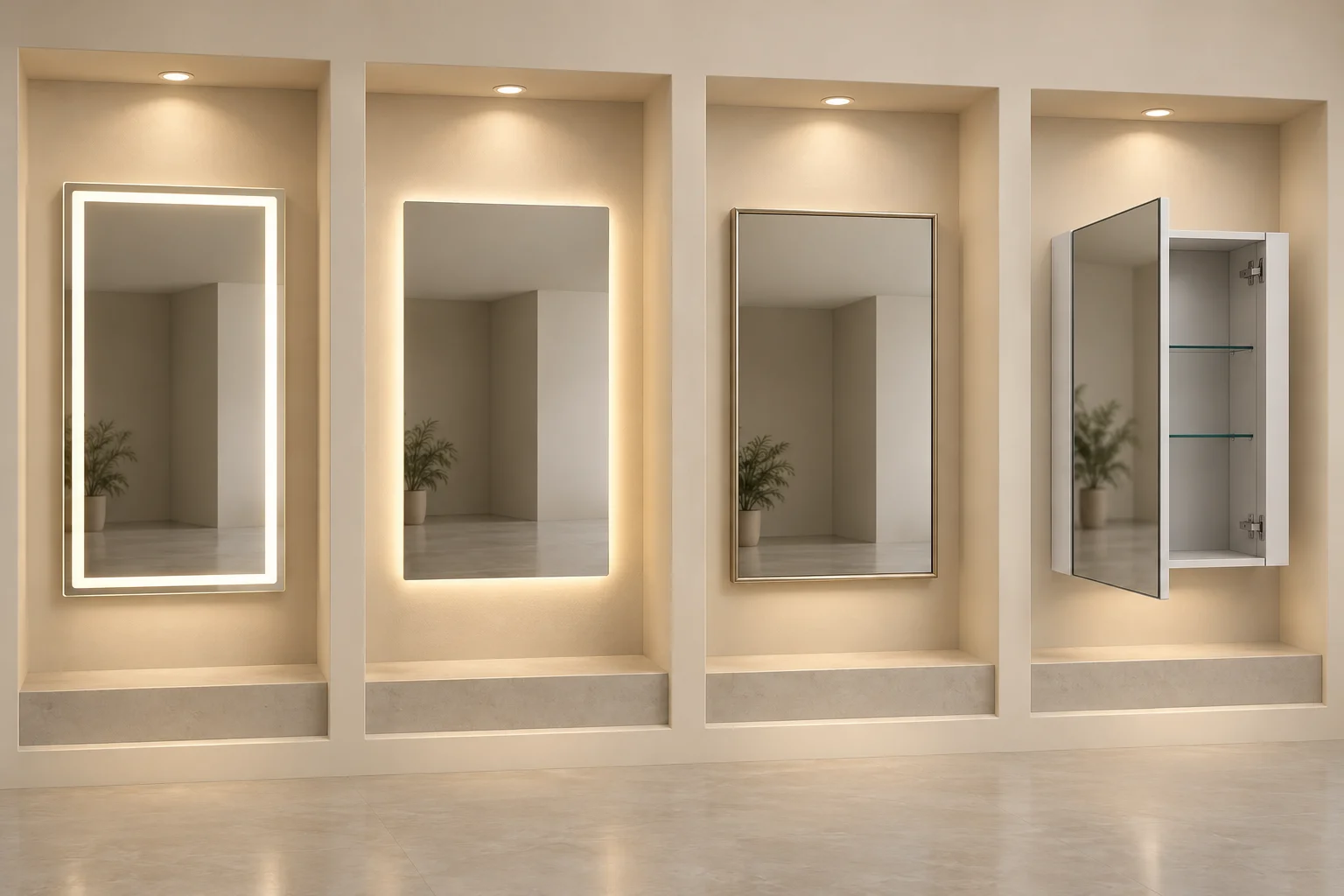
Compare four starting directions for interior projects. These are design options, not a list of pre-approved marine models. Your quotation should identify the proposed construction, dimensions and supporting documents.

3D comparison of a front-lit mirror, backlit mirror, champagne framed mirror and open single-door mirrored cabinet
Concept rendering. Left to right: front-lit, backlit, framed and mirrored cabinet. Appearance does not establish marine approval.
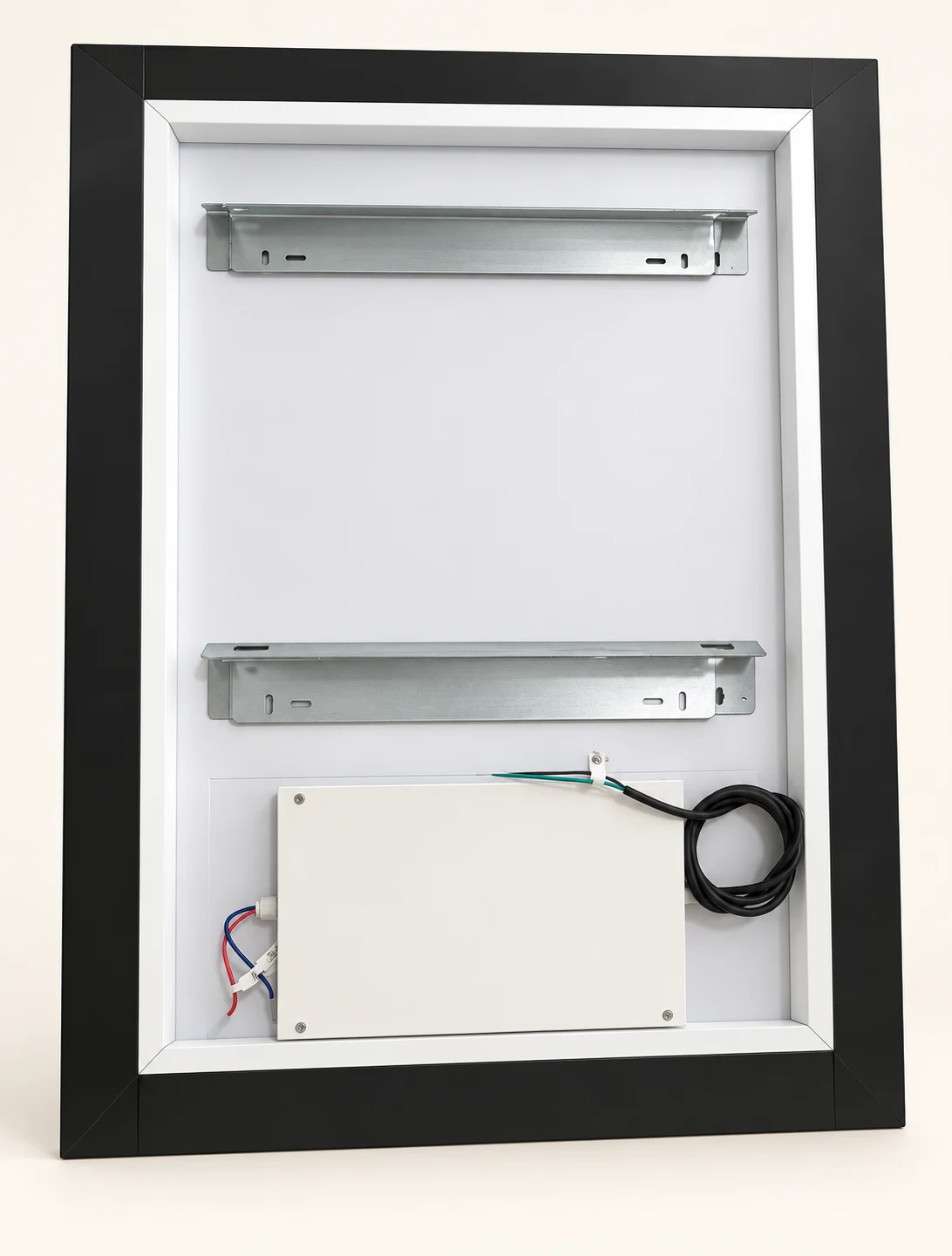
Reference-based rear-view rendering of a mirror with a white inner frame, two horizontal mounting rails, a lower electrical enclosure and a coiled cable at the right
Reference-based 3D rendering. Dimensions, fixing details and electrical specifications follow the approved project drawings.

Review the Front, Rear & Side Together

A front elevation establishes the visible design. The rear view identifies mounting and electrical interfaces. The side view establishes projection and service space. Request all three when assessing fit; the visible glass size alone cannot define an interchangeable replacement.

03 / Specification planning

Custom Mirror Specifications for Marine Interiors

Use this schedule to turn a room concept into a comparable inquiry. It is a request checklist, not a standard product specification. Mark unknown items TBC and keep requested values separate from supplier-confirmed values.

Specification What to put in the request What to confirm for the selected assembly
Mirror type Front-lit, backlit, framed, non-lighted or cabinet Product reference and configuration revision
Dimensions Width × height × overall depth; portrait/landscape; units Drawing dimensions, tolerances, corner radius and assembly weight
Mirror glass Desired thickness, edge treatment and backing Proposed glass and backing specification
Frame Material direction, visible face width, depth and color reference Material grade, profile, joint detail and approved finish sample
Lighting Task/ambient purpose, desired color temperature, output and CRI Available values, light pattern and evidence for the selected configuration
Dimming & controls Wall/mirror controls, room-system interface, power-return behavior Driver/control compatibility and agreed operating sequence
Electrical Vessel supply voltage and frequency; connection and wiring brief Rated input, total load, driver details and connection drawing
Ingress protection Installation location and required rating, if specified Applicable assembly rating and supporting document scope
Demister Required clear area, switching relationship and run cycle Pad location, coverage, power and approved control behavior
Mounting Wall construction, backing, proposed brackets and retention Fixing layout, loads, fasteners, access and installer acceptance
Safety features Safety backing and project-defined retention requirements Exact materials, coverage, limitations and applicable evidence
Cabinet Recess/opening, handing, shelf layout and stored-item sizes Usable internal space, hinges, closures and shelf retention
Documentation Required drawings, component information and test reports Availability, model coverage, revisions and unresolved items
Packaging Receiving location, room references and shipment groups Protection, package dimensions, labels and packing list
Commercial scope Quantity by reference, destination and required receiving date Price basis, exclusions, sample cost, timing and delivery terms

Send a Room Schedule, Not Just a Total Quantity

Room reference Space Mirror direction W × H × D Quantity Open decisions
Your reference Cabin bathroom Front-lit / backlit TBC; state mm or inches TBC Supply, controls, backing
Your reference Suite dressing Framed / illuminated TBC TBC Finish, seated sightline
Your reference Crew bathroom Mirror / cabinet TBC TBC Door handing, retention

These rows are a blank inquiry example, not stock models or completed project data. Identify handed variants separately even when the visible mirror size is identical.

04 / Materials & safety

Materials, Safety & Marine Project Requirements

Define Exposure Before Choosing Materials

Record moisture, cleaning chemicals, ventilation and any direct salt or steam exposure. Review the complete assembly: glass edges, frame joints, fasteners, backing, electrical enclosure and interfaces between materials.

Aluminum and stainless-steel frame directions can be discussed against the design brief. A metal name or decorative finish does not establish corrosion performance for the whole mirror. Specify the proposed material and surface process, then agree what evidence is relevant to the actual location.

Make Safety Backing a Defined Request

If safety backing is required, request its material, coverage and relationship to the mirror coating, demister and mounting system. Review compatibility and the evidence requested by the project team. Do not treat a backing option as a substitute for the assessment of the complete installed assembly.

Specify the Document, Not Just the Rating

For any requested IP, corrosion, electrical or safety evidence, identify the exact model and revision, issuer, date, test conditions and assembly coverage. A driver document does not establish the performance of the complete mirror. Availability must be checked for your proposed configuration.

Use a Document Review Path

  1. Define the requirement: the owner's, shipyard's or appointed approval team's requirement for the exact location and assembly.
  2. Identify the proposed product: model/reference, drawing revision, materials, electrical components and mounting arrangement.
  3. Match the evidence: document issuer, date, scope and model coverage; distinguish component documentation from assembly documentation.
  4. Record open items: list missing evidence or deviations and assign a responsible reviewer before production release.

Do not infer “marine certified” from a product category, a component marking or these illustrations. Agree the applicable approval route with the project team. Review OJMirror's Quality & Testing Information.

05 / Installation & access

Mirror Mounting, Installation & Maintenance

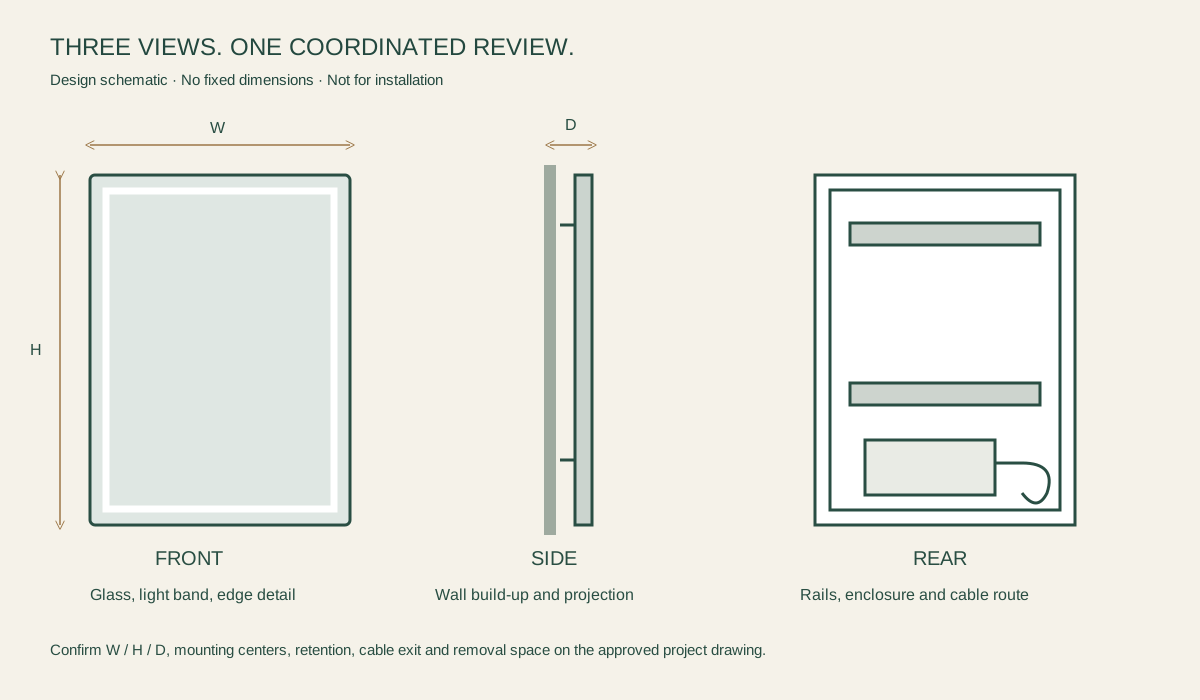
Read the Front, Side and Rear as One Assembly

Design schematic of front, side and rear mirror views showing width, height, projection, rails and lower electrical enclosure
Design schematic — not to scale and not an approved installation drawing. Open the sheet to inspect the labels; project dimensions and retention details require approval.

Front — W × H
Review overall width and height, visible glass and the light band.

Side — D
Review wall build-up, overall projection and removal space.

Rear — interfaces
Review mounting rails, enclosure and cable exit against the approved drawing.

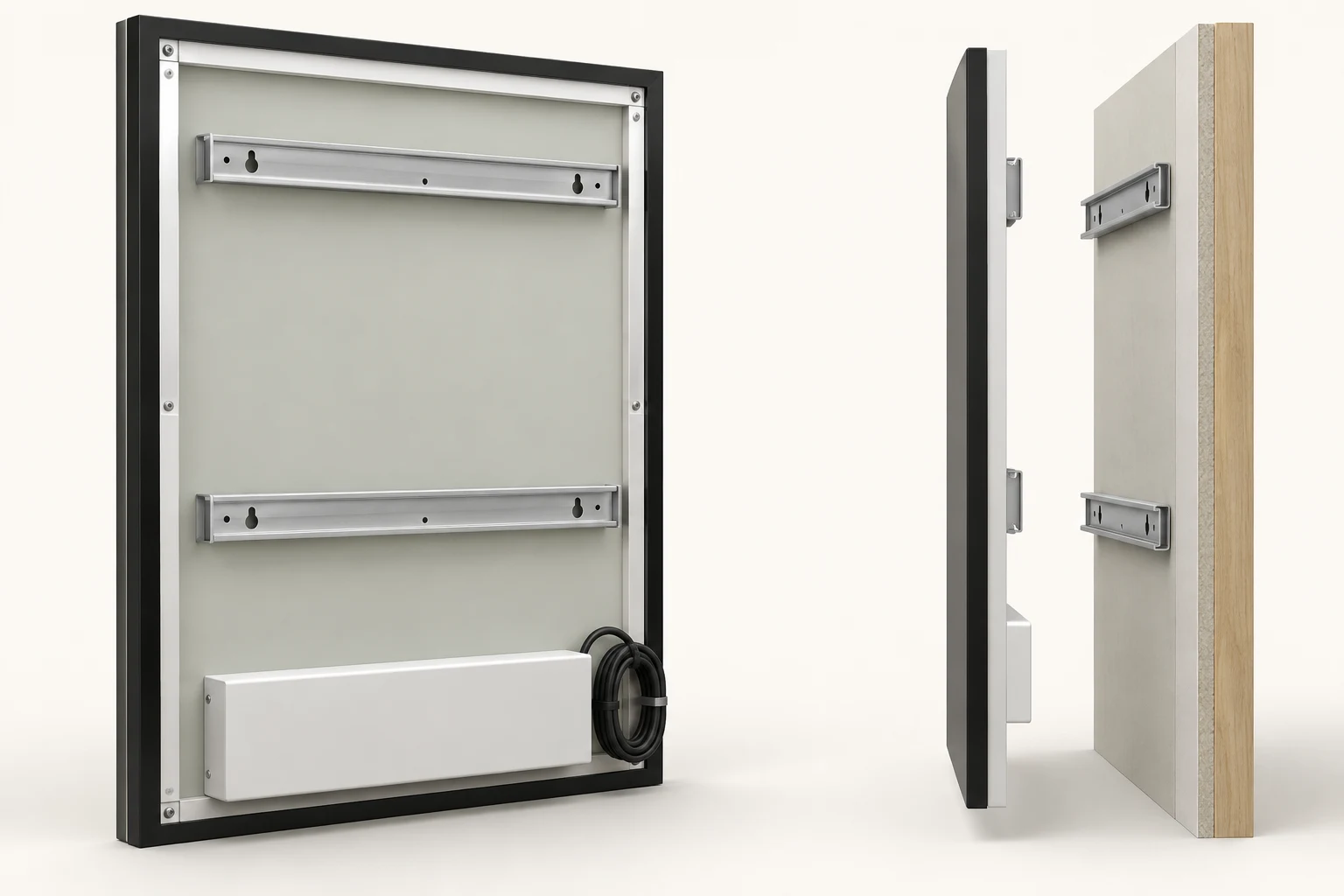
Coordinate the Wall Interface and Retention

Three-dimensional view of mirror rear components and a separated wall mounting interface
Concept rendering, not to scale. Confirm fixing positions, fasteners, loads and clearances on the project drawing.

The installation drawing should distinguish the finished wall from the structural backing. Record the proposed bracket, positive-retention arrangement where required, cable entry and method of accessing components. Have the responsible installation team review the wall interface and retention before fabrication.

Avoid making a decorative wall panel responsible for loads it has not been assessed to carry. The final fixing design must follow the actual wall build-up, assembly weight and project requirements.

Keep the Next Replacement in View

Interface Review question Handover record
Wall and fixing What substrate receives the fixing, and how is the assembly retained? Accepted wall section, bracket/fastener specification and mounting drawing
Electrical Can the supply be isolated and components accessed by the responsible personnel? Connection drawing, component references and service instructions
Removal Can the mirror be removed after the room is furnished? Clearance envelope, sequence and handling route
Cleaning Are proposed products and methods compatible with glass, edges and frame? Agreed care instructions
Replacement Which size, finish, control and driver revisions must match? Unit reference, revision and agreed spare-parts schedule

Review the complete service sequence in the room mock-up. A nominally removable mirror is not serviceable if furniture or ceiling finishes block its removal path.

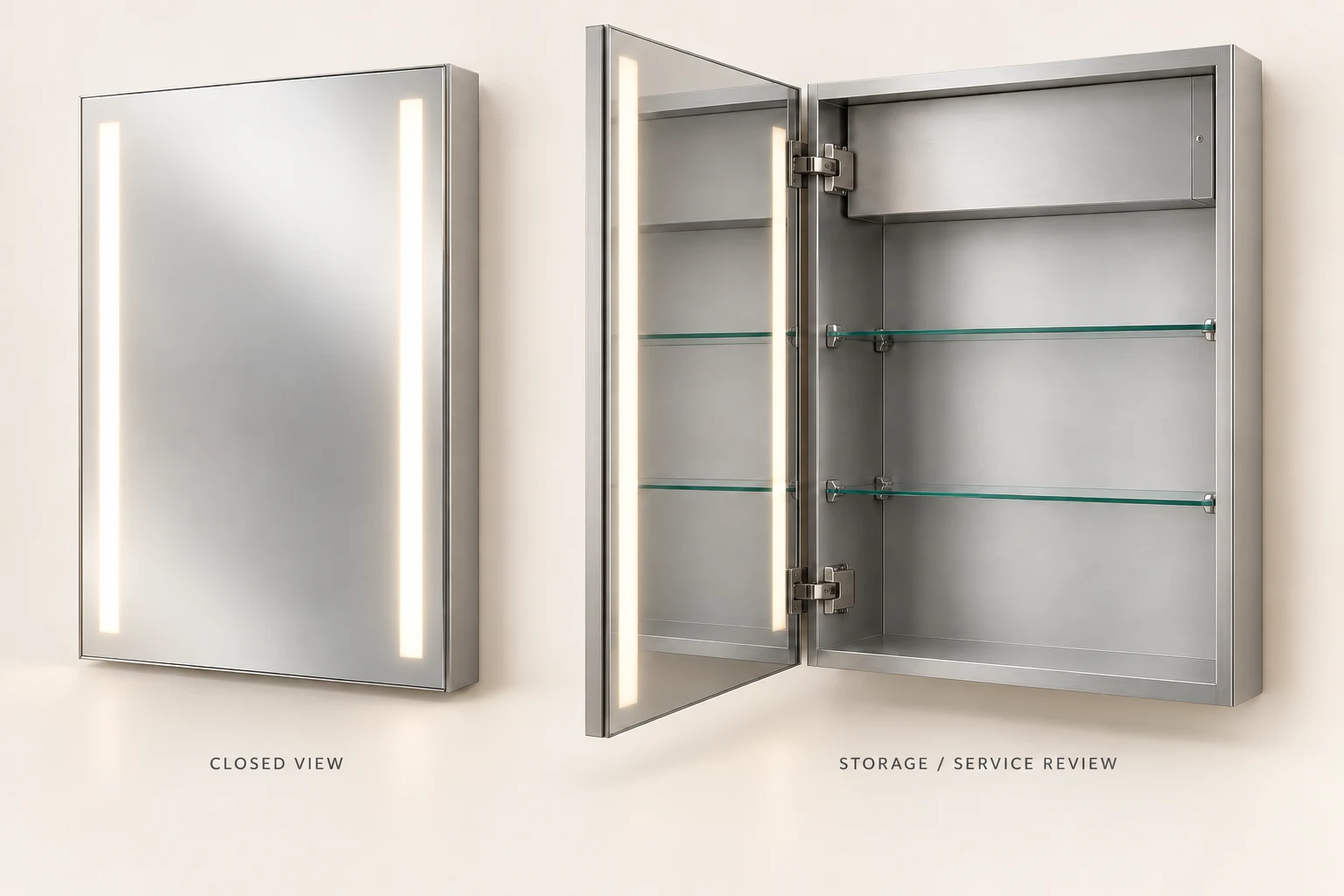
Cabinet Door Swing, Storage & Service Access

Mirrored cabinet shown closed and open with glass shelves and a separate upper service enclosure
Concept rendering. Confirm door construction, hinges, retention, shelf supports and electrical enclosure during technical review.
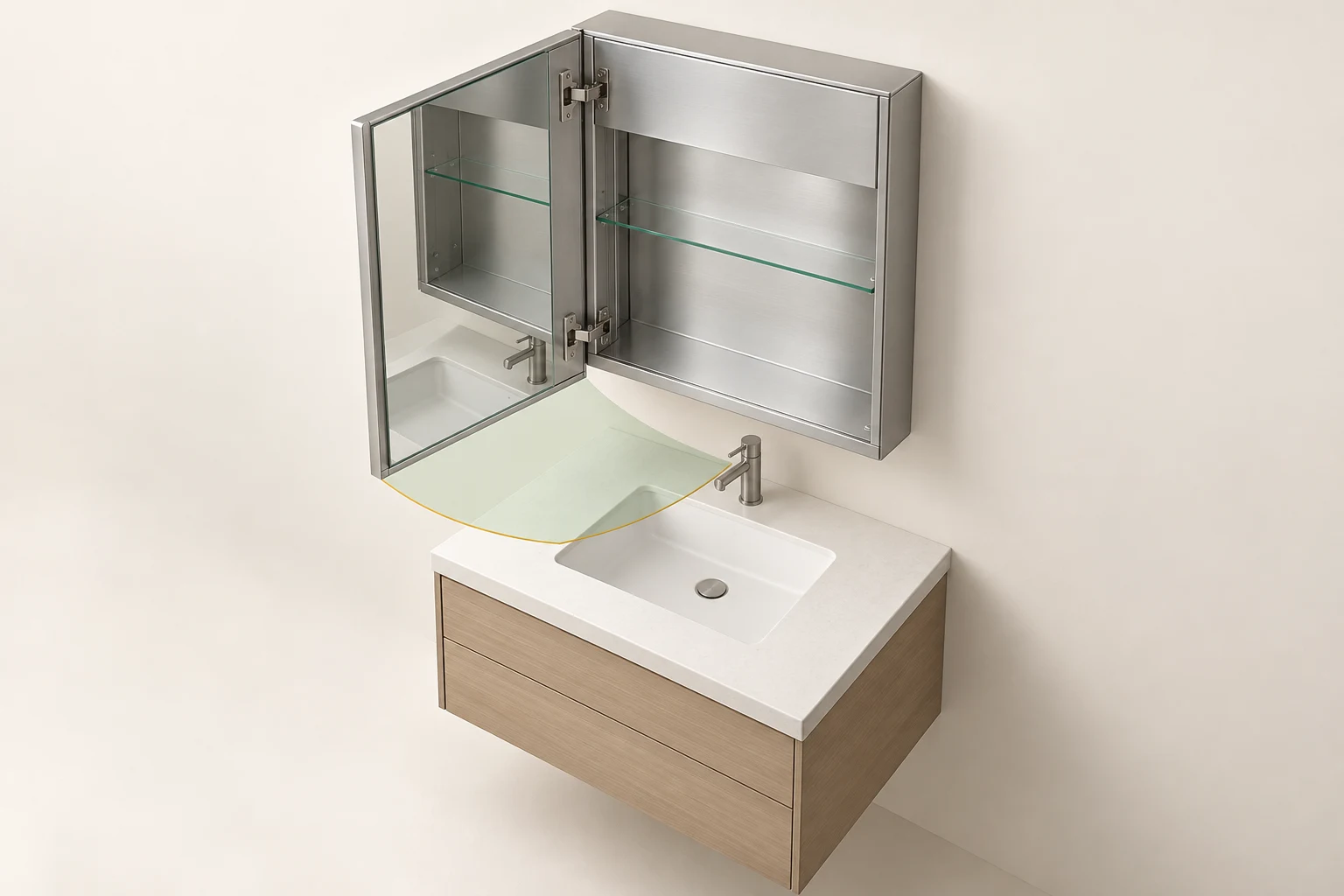
Three-dimensional mirrored cabinet with an open door and a highlighted clearance envelope above the basin

Check the open door against taps, adjacent shelves and shower fittings. Evaluate storage with the intended items in place. Define the door and shelf retention requirement with the vessel team, including how the selected hardware will be inspected and maintained. The illustrated open angle is a spatial-review example, not a specified hinge rating.

06 / Lighting & controls

Lighting, Demister & Control Decisions

For grooming, evaluate light on the face from both seated and standing positions. For ambience, examine wall glow with surrounding lights on and off. Compare color, visible uniformity and low-level operation in a representative room sample.

Define the demister's intended clear-view area, location and switching cycle. Agree demonstration conditions rather than treating “anti-fog” as a complete performance specification.

For dimming and switching, record what happens after power is restored, whether brightness memory is required and how the mirror interacts with wall controls. Mark each feature essential, optional or not required; request separately priced alternatives where appropriate.

07 / Project delivery

Cruise Ship Mirror Replacement, Refit & Newbuild

Decision Newbuild / cabin modules Refit / mirror replacement
Starting information Current room schedule, elevations and wall sections Measured opening, photographs and existing-unit information
Interfaces Develop wall, furniture and electrical interfaces together Identify which fixings, cable exits and finishes must remain
Variants Record room types, handed layouts and suite differences Survey actual differences between existing room groups
Sample review Check a representative cabin-module installation Trial the replacement in a representative existing room
Delivery planning Confirm module-factory, warehouse or vessel destinations Work backward from the agreed refit receiving window
Release condition Approved drawings, sample and configuration schedule Approved fit, retained-interface decisions and replacement references

A Controlled Route from Brief to Shipment

  1. Scope review: establish product references, quantities, intended locations and missing inputs.
  2. Technical alignment: resolve geometry, lighting, wall interface, materials and documentation responsibilities.
  3. Sample review: approve appearance, operation, fit and service access against agreed criteria.
  4. Production release: freeze the drawing and component references; review substitutions before use.
  5. Inspection and packing: agree inspection records, unit identification, protection and shipment grouping.

Timing depends on configuration, materials, quantity, document requirements, sample revisions and delivery scope. Confirm project dates in the quotation instead of assuming a universal lead time.

08 / Manufacturing support

Working with a Cruise Ship Mirror Manufacturer

Define the Supply Boundary in the Quotation

Separate mirror manufacture from vessel-side installation. Set out who owns the approved drawing, wall backing, fasteners, electrical connection, onboard fitting and final acceptance. Do not assume a product quotation includes site measurement, installation or class approval.

Match Evidence to Your Proposed Mirror

Use OJMirror's Project References as a starting point for discussion. Ask which reference is relevant to your product type and what authorized supporting material can be shared. A room count, image or project name should not be treated as proof of an identical supply scope.

For your proposed assembly, request the available manufacturing and inspection information: drawing revision, material/finish reference, sample review record, electrical details where applicable and packing identification. Confirm availability and relevance during technical review.

Procurement question Evidence to request
Will the product match the approved room design? Signed drawing, finish reference and sample decision record
Can repeat units be identified consistently? Unit reference, revision control and agreed inspection records
Is the proposed electrical configuration documented? Component schedule and applicable assembly information
Will packing match the receiving plan? Packing proposal, sample label and shipment grouping
Is a cited project comparable? Authorized project details, actual supply scope and genuine photographs

Explore Custom Mirror Manufacturing and Quality & Testing for related supplier information. These general pages do not replace configuration-specific approval.

Packaging for an Identifiable Handover

Agree protection around glass edges and exposed finishes, the hardware allocation and the receiving route. Group packages by the approved mirror reference, room type or installation phase as required by the receiving team.

A proposed label should identify project reference, mirror reference, drawing revision, room/zone or shipment group, quantity, package number and handling orientation where applicable. Match identifiers to the packing list. For spare units, record which original reference they replace.

Request packing photographs and agreed inspection records for the order.

09 / Questions answered

Marine Mirror FAQs

What information is needed for a cruise ship mirror quotation?

Send room types, quantities by mirror reference, dimensions or drawings, intended location, electrical brief, finish direction and required receiving date. Identify whether you need budget guidance or a quotation against drawings. Mark missing inputs TBC.

Can marine LED mirrors be customized in size and shape?

Custom geometry can be reviewed against the proposed construction, room interface and handling route. Submit width, height, overall depth, orientation and corner detail. Confirm feasibility, tolerances and mounting on the product drawing before approval.

Is front lighting or backlighting better for a cruise cabin bathroom?

Front lighting brings illumination toward the grooming position; backlighting emphasizes the wall around the mirror. The appropriate choice depends on the full lighting plan and the person using it. Review face shadows, glare and usable reflection in the room sample.

What materials should be specified for marine interiors?

Start with the actual exposure and cleaning routine. Define glass, frame material, surface finish, backing, fasteners and joints together, then request relevant supporting information for the proposed assembly. A finish name does not confirm suitability for every onboard location.

Are these mirrors automatically marine certified?

No. Certification must be checked for the specific product and installation. Provide the requirements set by the responsible approval team and review available documents against the exact model, construction and installation scope.

Can a replacement reuse the original fixing points?

That requires review of the existing wall, fixing positions, dimensions, weight and electrical interface. Matching the front dimensions does not guarantee interchangeability. Provide measured information and trial the proposed replacement before confirming repeat quantities.

What matters most when selecting a shipboard mirror cabinet?

Check usable depth, open-door clearance, shelf arrangement, retention and component access in the actual room. Specify handing and required hardware behavior; compare the reviewed configuration with the intended storage items and nearby fittings.

What voltage, IP rating and light output are available?

These values must be confirmed for the selected configuration. State the vessel supply, location and required performance in the inquiry, then request rated values and applicable supporting documentation. No single specification is implied for every product shown here.

Can one finish be used across different cabin mirror sizes?

Use one approved physical finish reference while identifying each profile and construction variant. Compare appearance under the intended room lighting. Changes in profile, material or process should be reviewed before acceptance.

What determines sample timing, delivery and replacement support?

Configuration complexity, material availability, quantity, evidence requirements, approvals and receiving arrangements all affect timing. Agree milestones in the quotation. Define replacement-unit references, service-component information and requested spare quantities before handover.

Project resources

A Clearer Brief. A More Useful Quotation.

Download the worksheet and drawing-review sheet before sending your request. These are planning tools, not a certified product catalogue.

Marine Mirror RFQ Checklist

A fill-in text worksheet for quantities, dimensions, electrical requests, documentation and receiving requirements. Unknown items can remain TBC.

Download editable checklist ↓

Three-View Drawing Review

A scalable front, side and rear design schematic showing the interfaces to resolve. No stock size or mounting load is implied.

Download design schematic ↓

START A PROJECT

Request a Cruise Ship Mirror Quote

Share the onboard spaces, drawings and estimated quantities. We will identify the next technical questions.

Start with what you have.

Choose a mirror direction and attach your available drawings. Missing dimensions or requirements can be marked TBC.

Accepted files: PDF, JPG, PNG, WebP, Word or Excel. For CAD files, please email info@ojmirror.com.
WhatsApp