
Custom Mirror RFQ Checklist: What to Send for a Clear Quote
Request a custom mirror quote with six essentials: intended use, finished dimensions, quantity, features, destination and timing. Add available drawings and mark undecided details. Use the checklist and email templates below to prepare your enquiry and compare supplier offers.
Already preparing a detailed RFQ? Jump to specifications, drawings or quote comparison.
Start with These Six Details
You do not need a complete engineering package to start a conversation. Along with your contact details, send the following information and identify anything still undecided.
| Information | What to include |
|---|---|
| Product reference or intended use | A model, reference image or description of where the mirror will be used |
| Dimensions and shape | Target finished width and height, or diameter; units; shape and orientation |
| Quantity breakdown | Quantity for each size, finish or configuration, with sample quantities shown separately |
| Main features and finish | Frame or edge preference, lighting direction and essential functions |
| Destination | Sales or installation country, plus delivery city or port when known |
| Target timing | Target shipment date and required arrival date, where known; identify any flexibility |
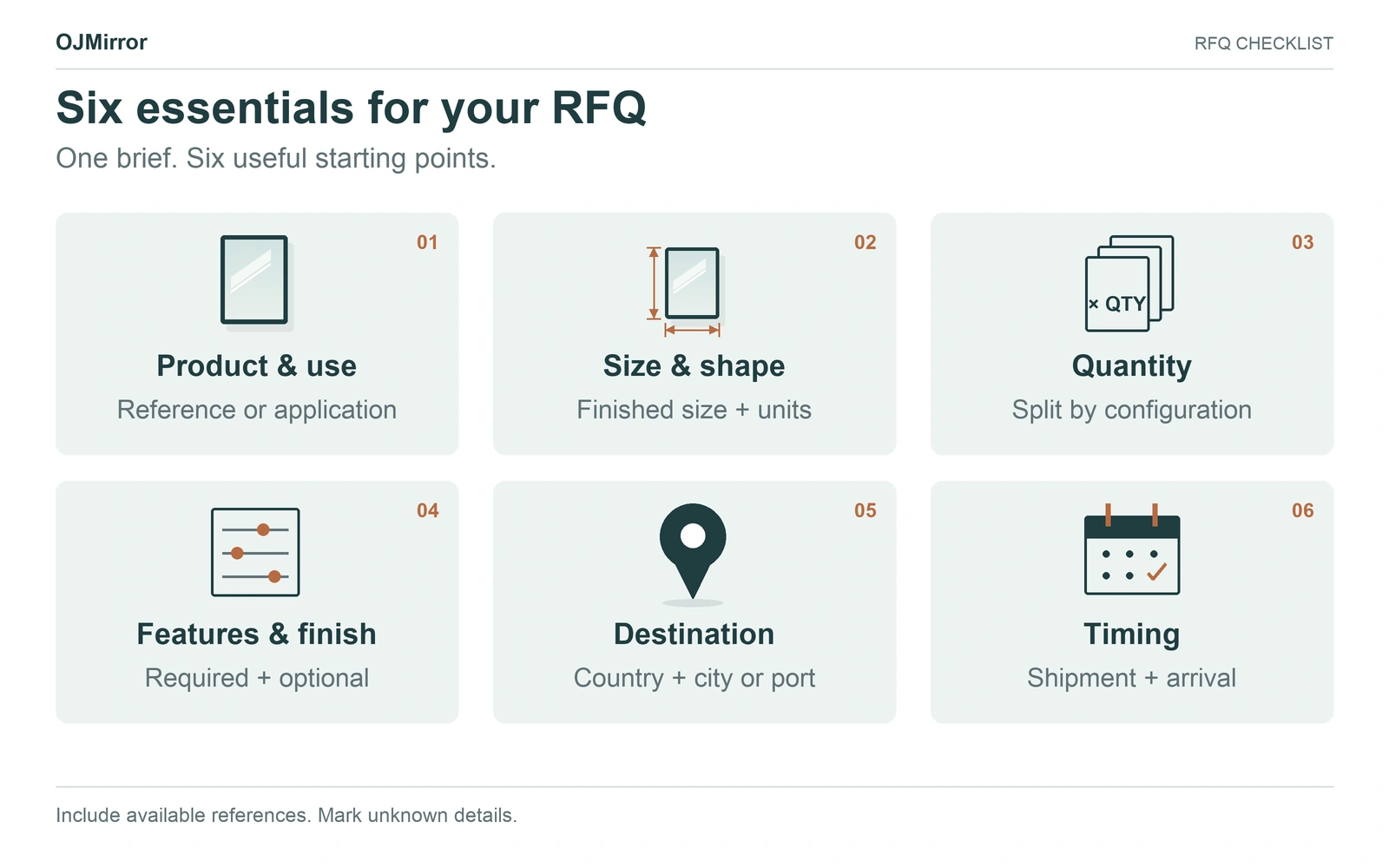
Use this overview to check your first enquiry. Add available drawings or reference images and identify open decisions.
Label preliminary measurements as estimates. If you do not know the glass thickness or lighting specification, write “Supplier recommendation requested” and describe the intended use. Ask the supplier to state its proposed configuration and pricing assumptions.
Use a clear status instead of leaving a field blank:
- To be confirmed: you have not decided yet.
- Supplier recommendation requested: you want a proposed solution with its pricing assumptions.
- Not required: you have decided to exclude the feature.
- Not applicable: the field does not apply—for example, lighting controls for a non-lighted mirror.
View examples of the four field statuses
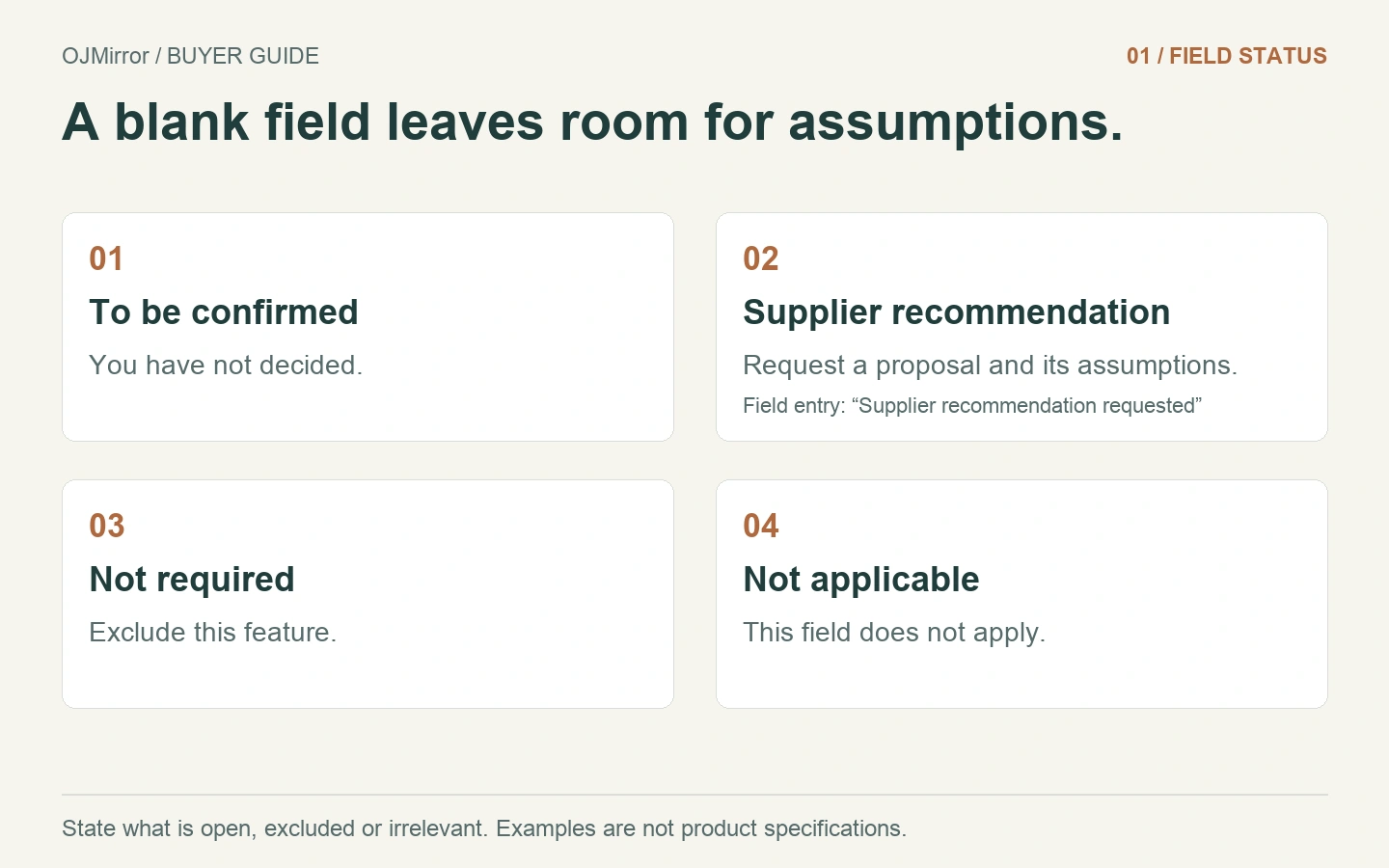
Use these statuses to explain what is still open and what has already been decided.
Copy This Custom Mirror RFQ Template
Choose the short enquiry for a first conversation, or the full RFQ for a detailed project quotation.
Short Enquiry: Six Essentials
Download the short enquiry (.txt)
Read the short enquiry template
Subject: Custom Mirror Enquiry — [Project / Company]
Hello,
Please review the following mirror requirements for an initial quotation:
- Product / use: [Model, reference image or intended application]
- Finished size / shape: [Width × height or diameter, units and orientation]
- Quantity: [Quantity for each size or configuration]
- Features / finish: [Required features, optional features and finish preference]
- Destination: [Country and delivery city or port]
- Timing: [Target shipment date and required arrival date, if known]
I have attached [drawings / reference images / available files]. Please identify any missing details and state your proposed specification and pricing assumptions. Mark undecided items for confirmation.
Thank you, [Name / Company / Email]
Full Project RFQ
Download the full RFQ email template (.txt)
Open the full RFQ email template
Complete the relevant fields and mark unknowns clearly. Put detailed specifications in an attached schedule rather than repeating them in the email.
Subject: Custom Mirror RFQ — [Project / Company] — [Quantity] — [Destination]
Hello,
Please quote the mirrors described below and in the attached schedule. Identify any missing information that affects your offer.
- Company and contact: [Company, contact person and email]
- RFQ reference and revision: [ID, date and revision]
- Quotation response requested by: [Date]
- Application and destination: [Use, country and delivery location]
- Quotation stage: [Budget estimate / detailed quotation]
- Product starting point: [Existing model / model with changes / new design; supplier model reference if known]
- Product schedule: [Buyer item IDs, finished dimensions, units and quantity per configuration; list samples and spares separately]
- Materials and finish: [Glass, edge, backing, frame and finish reference]
- Required features: [Lighting, controls, demister or other functions that must be included]
- Optional features: [Features to price separately]
- Electrical and documents: [Site power, connection, cable exit and project document requirements, where known]
- Installation: [Wall conditions, orientation, hardware and responsibility boundaries]
- Packaging and labels: [Distribution channel, labels, accessories and delivery batches]
- Delivery timing: [Target shipment date, required arrival date and flexibility]
- Samples and inspection: [Purpose, approval needs and required records]
- Attachments: [File names, item IDs and current revisions]
- Open questions: [Undecided details and recommendations requested]
Supplier Response Requested
Please respond against each buyer item ID and identify:
- Configuration: your model reference, drawing revision, included features, deviations and points still to be confirmed. Price alternatives and optional features separately.
- Commercial terms: unit prices and currency, MOQ basis, sample and development charges, payment milestones, quotation validity and after-sales terms.
- Packing estimate: units per carton, carton count, outer carton dimensions, net and gross weights, and total shipment volume. State units, measurement basis and any provisional figures.
- Delivery scope: the proposed trade term and named place, included costs and exclusions.
- Timing: sample, production and transport estimates; what starts each period; and decisions needed before confirming the order.
- Documents: availability and the exact model or configuration covered by each requested document.
Thank you,
[Name / Company]
Already have the six essentials? Send your brief to OJMirror. You can leave unresolved details marked for discussion.
Complete the Specification for Each Mirror Type
Use the sections that apply to your project: dimensions, materials, LED requirements, installation, packaging and samples.
Build a separate line for every configuration that needs its own price. Use buyer item IDs to connect the schedule, drawings and supplier replies. If starting from an existing model, include its reference and list the requested changes. You can explore custom mirror configurations before preparing the brief.
Identify Each Size, Quantity and Drawing Revision
Distinguish the finished outside size, visible mirror area, glass thickness and overall depth. For a framed mirror, the outside dimensions include the frame. If wall projection matters, record it separately: the installed projection may include mounting space behind the product.
Consider a framed mirror described only as “600 × 800 mm.” A quote based on glass size and one based on finished frame size describe different products, even though both repeat the same numbers. Label the dimension on the drawing before asking suppliers to price it.
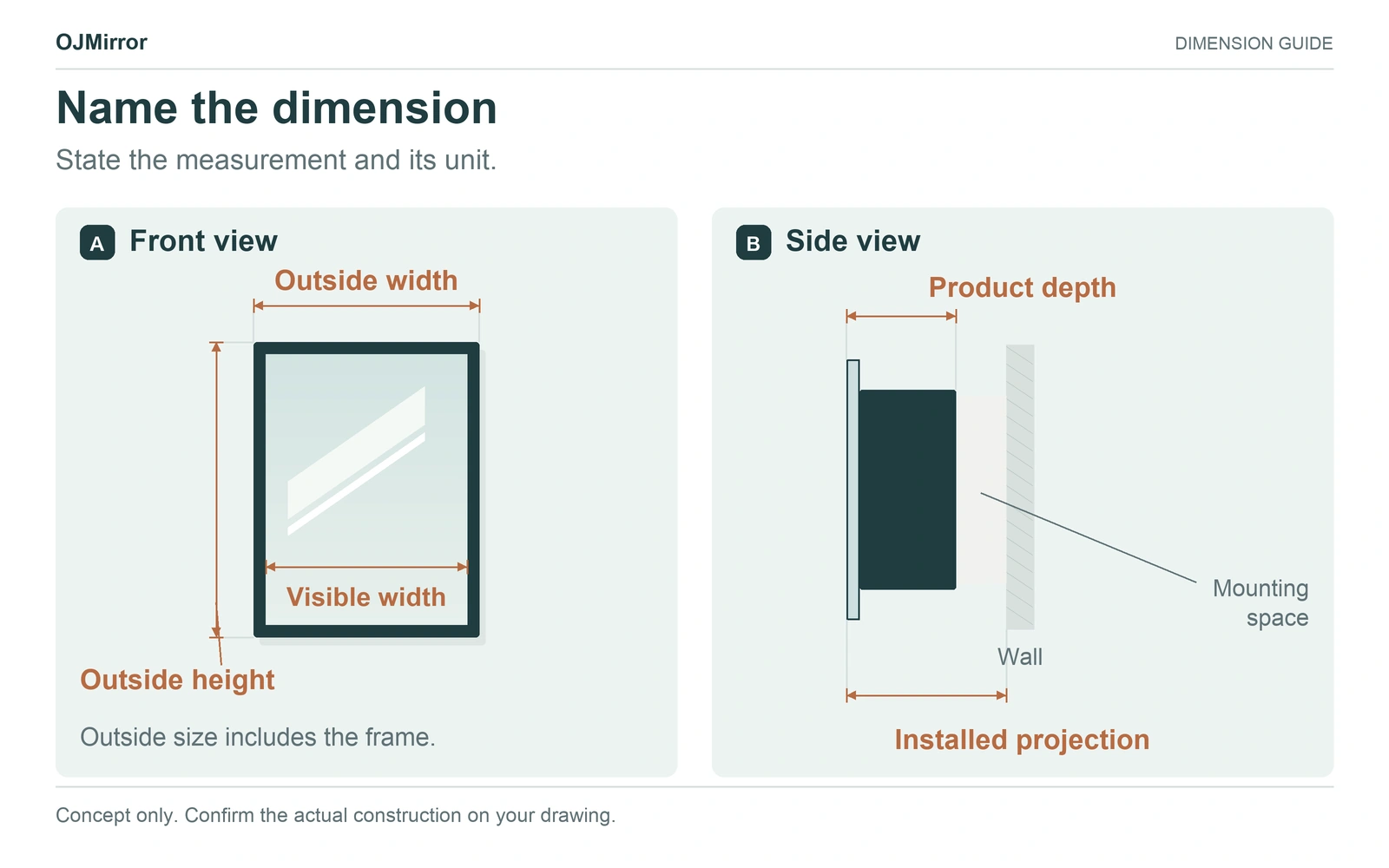
Dimension concepts only. Confirm the actual construction and measurements on the project drawing.
For round mirrors, give the outside diameter. For arches or irregular outlines, attach a dimensioned drawing or request drawing development; an inspiration photo does not define an exact curve. See the custom shape drawing requirements for relevant design inputs.
Here is a hypothetical quantity schedule, not an OJMirror product specification:
| Item | Finished outside size | Configuration | Bulk quantity | Drawing status |
|---|---|---|---|---|
| M-01 | 600 × 800 mm | Rectangular; frame finish to be confirmed; no light | 80 pcs | Initial dimensions |
| M-02 | Ø700 mm | Round; backlight; control specification open | 40 pcs | Initial dimensions |
This hypothetical bulk mirror order covers 120 mirrors, but the supplier needs to price two different items. List development samples or spare mirrors separately so they are not silently included in that total.
Flag any critical fit or tolerance requirement and ask the supplier to confirm feasibility. Record the drawing number and revision against each item, and ask the supplier to map its model reference to your item ID.
Define the Glass, Edge, Frame and Finish
State the requested glass type, thickness, tint, edge treatment and backing requirements where known. Ask the supplier to identify what it has included when proposing a specification.
For frames, describe the material, profile width and depth, surface treatment, color and sheen. “Gold frame” alone leaves several decisions open. A reference photo can communicate direction; use an agreed physical sample when the finish needs approval.
For holes and cutouts, show dimensions and locations from identified reference edges. Include the drawing revision and any tolerances that matter to the installation. Confirm manufacturing limits for the proposed mirror before approving the order.
LED Mirror RFQ: Lighting, Controls and Electrical Requirements
For an LED mirror, separate required features from options to be priced individually. Describe the appearance and operation you want; mark undefined parameters for supplier recommendation:
- Lighting: front light, backlight or both; task lighting, ambient effect or a combination.
- Light specification: preferred color temperature, color rendering and output requirements, if defined.
- Controls: touch, sensor or wall control; dimming method; behavior after power is restored.
- Demister: whether required, intended coverage and how it should switch on and off.
- Power and access: destination market, site voltage and frequency, connection method, cable exit and maintenance access.
“Dimmable” does not fully describe a control requirement. For example, a buyer might mean adjustment through a wall dimmer while a proposed mirror uses its own touch control. Those descriptions do not establish compatibility. Identify the intended control system and request confirmation for the quoted configuration.
List the documents, ratings or tests required by the project. Ask for the exact model or configuration covered, the scope of each document and any outstanding verification. Keep component documents distinct from evidence covering the complete mirror. Have the project reviewer resolve market and installation requirements before specification approval; supplier proposals should identify unresolved questions.
Describe Installation Conditions and Supply Responsibilities
Share the wall construction, orientation, available space and nearby obstructions. Indicate whether the supplier should include hanging hardware, brackets or other accessories, and ask for an itemized list.
Clarify who confirms the wall fixings, electrical connection and site measurements. A mirror supplied with mounting hardware does not automatically include installation labor or every fixing needed for the actual wall.
Specify Packaging, Labels and Delivery Scope
Tell the supplier whether the mirrors are for project installation, retail distribution or individual parcel delivery. Describe room labels, barcodes, manuals, accessory packs, delivery batches and any required packaging tests.
Ask the supplier to return estimated units per carton, carton count, outer carton dimensions, net and gross weights, and total shipment volume. Specify the units and whether weights are per carton or for the shipment. Mark figures as provisional until the packing arrangement is confirmed.
For an initial packing estimate, OJMirror’s typical mirror carton allowance is the product length and width plus 100 mm each, with an overall carton depth of approximately 80 mm. For example, a 600 × 800 mm mirror would give an estimated carton size of 700 × 900 × 80 mm. Confirm the final dimensions for the selected product and packing arrangement.
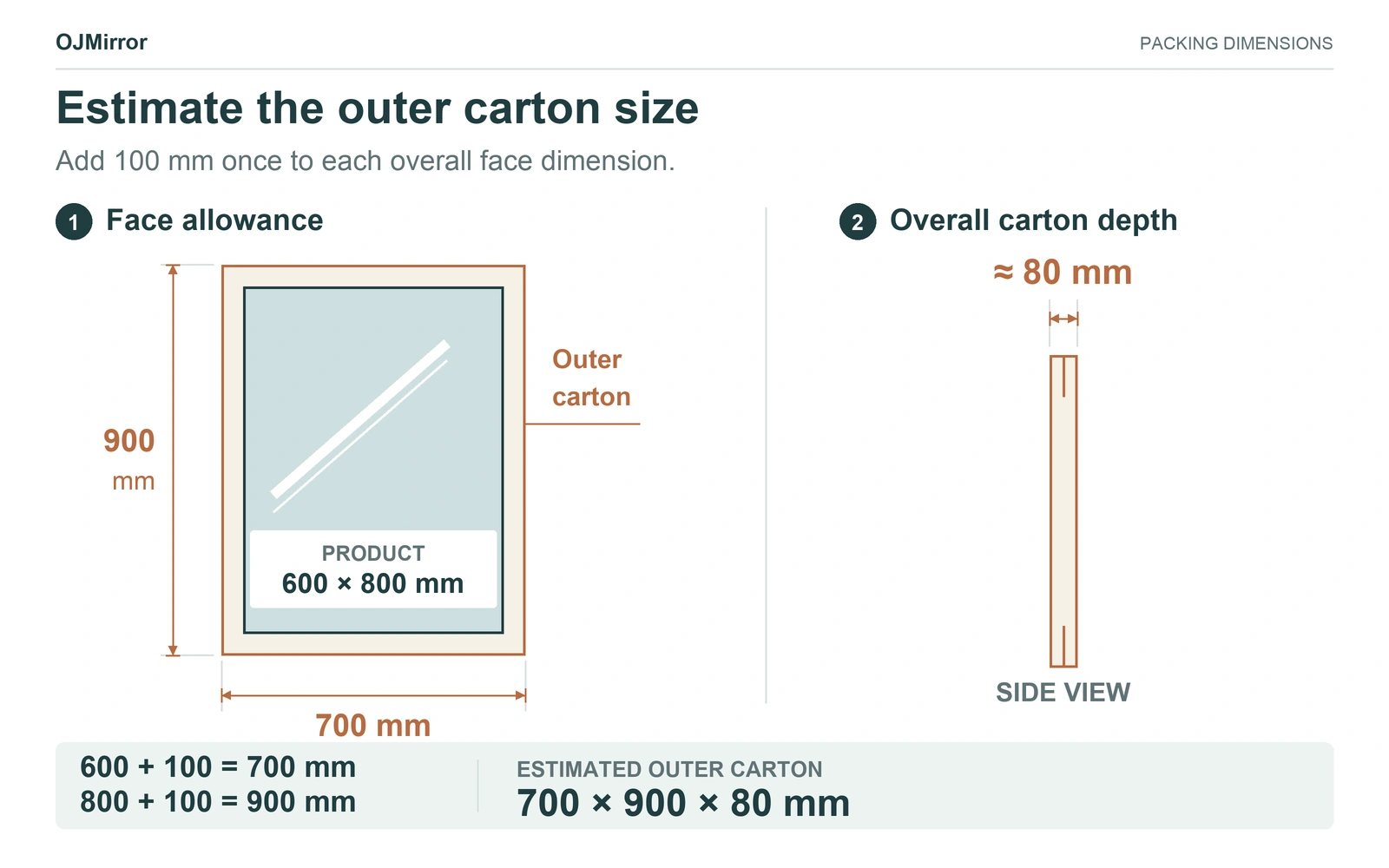
The 80 mm figure is the overall carton depth, not the cardboard thickness. The 100 mm allowance is added once to each overall face dimension, not to each edge. Illustration not to scale; final packing dimensions require confirmation.
Give the delivery location and requested shipping basis. Ask the quotation to name the applicable trade term and place, and identify included and excluded costs. If unloading, storage or delivery access affects the destination, mention it early.
Set Sample, Inspection and Approval Requirements
Decide what each sample must establish: finish appearance, complete product operation, mounting arrangement or packaging. Request sample charges, freight, revision conditions and any proposed credit against a bulk order.
Agree the inspection criteria and records needed for dimensions, appearance, functions and packing. Identify who approves drawings, finishes and samples. The wider OEM and ODM development process provides context for these review stages.
Attach Drawings and References That Answer the Open Questions
Match Each Attachment to an Item ID
Useful attachments have a clear job:
| Attachment | What it should clarify |
|---|---|
| Product drawing | Front view: outside dimensions, orientation and feature positions. Rear view: mounting references, cable exit and relevant components. Side view: depth and projection. Notes: materials, finish, requirements and revision |
| Site photo or elevation | Wall context, nearby fixtures and installation constraints |
| Finish reference | Color, sheen, material and any physical sample identifier |
| Quantity schedule | Item IDs, quantities and delivery batches |
Provide the views available at the quotation stage and identify any drawing development needed. Photos help explain the brief, but they do not approve manufacturing dimensions. Confirm accepted file formats before sending editable drawings or large files.
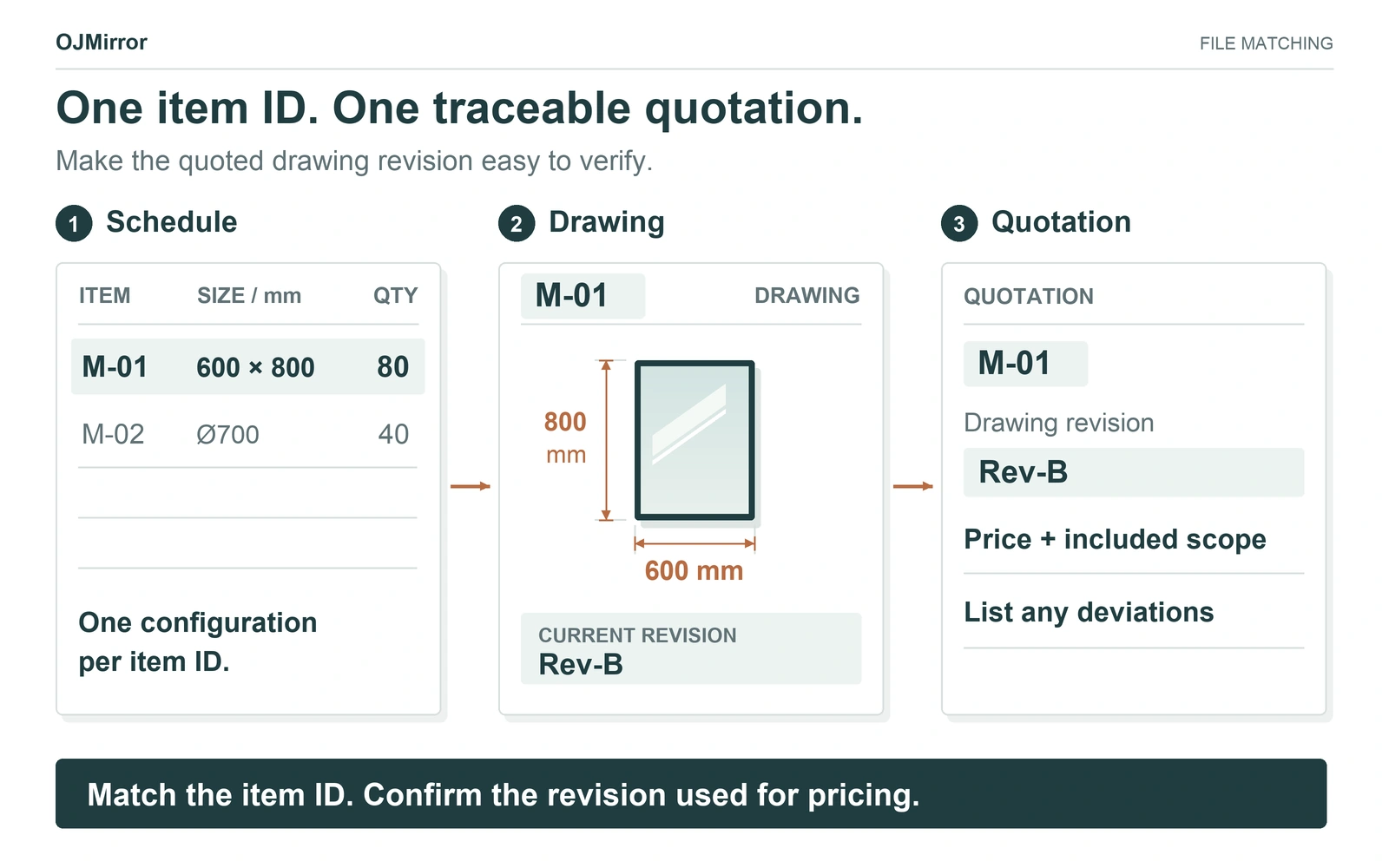
Illustrative references show how to connect the files. Confirm the quoted revision whenever the specification changes.
Use One Current Revision
Give the RFQ a reference, date and revision, plus a requested quotation response date. This deadline is separate from the shipment and arrival dates. Name files consistently—for example, M-01_Drawing_Rev-B_For-Quotation.pdf—and include a short change note. Ask the supplier to identify the revision used for its quote.
Keep quotation drawings distinct from drawings approved for production. When a specification changes, check whether the price, sample, packaging or schedule needs revision too.
Ask Every Supplier to Quote on the Same Basis
Compare the Supplied Configuration and Exclusions
To compare custom mirror quotations, send the same requirement package to each supplier. Ask them to quote the requested version and show alternatives separately. Otherwise, a lower price may reflect a different finish, fewer accessories or a narrower delivery scope.
The hypothetical example below shows why two offers may need clarification before their prices can be compared. It is not a customer case or an OJMirror product specification.
| Buyer requirement | Supplier A reply | Supplier B reply | Follow-up |
|---|---|---|---|
| Front lighting required | Front lighting included | Backlight only | Ask B to quote the requested lighting arrangement |
| Demister priced as an option | Included in base price | Separate optional price | Ask A to separate base and optional prices |
| Room labels required | Included | Not stated | Ask B to confirm scope and any charge |
| Delivery to the named project location | Scope stated | Destination charges unresolved | Clarify exclusions before comparing totals |
View an illustrated comparison
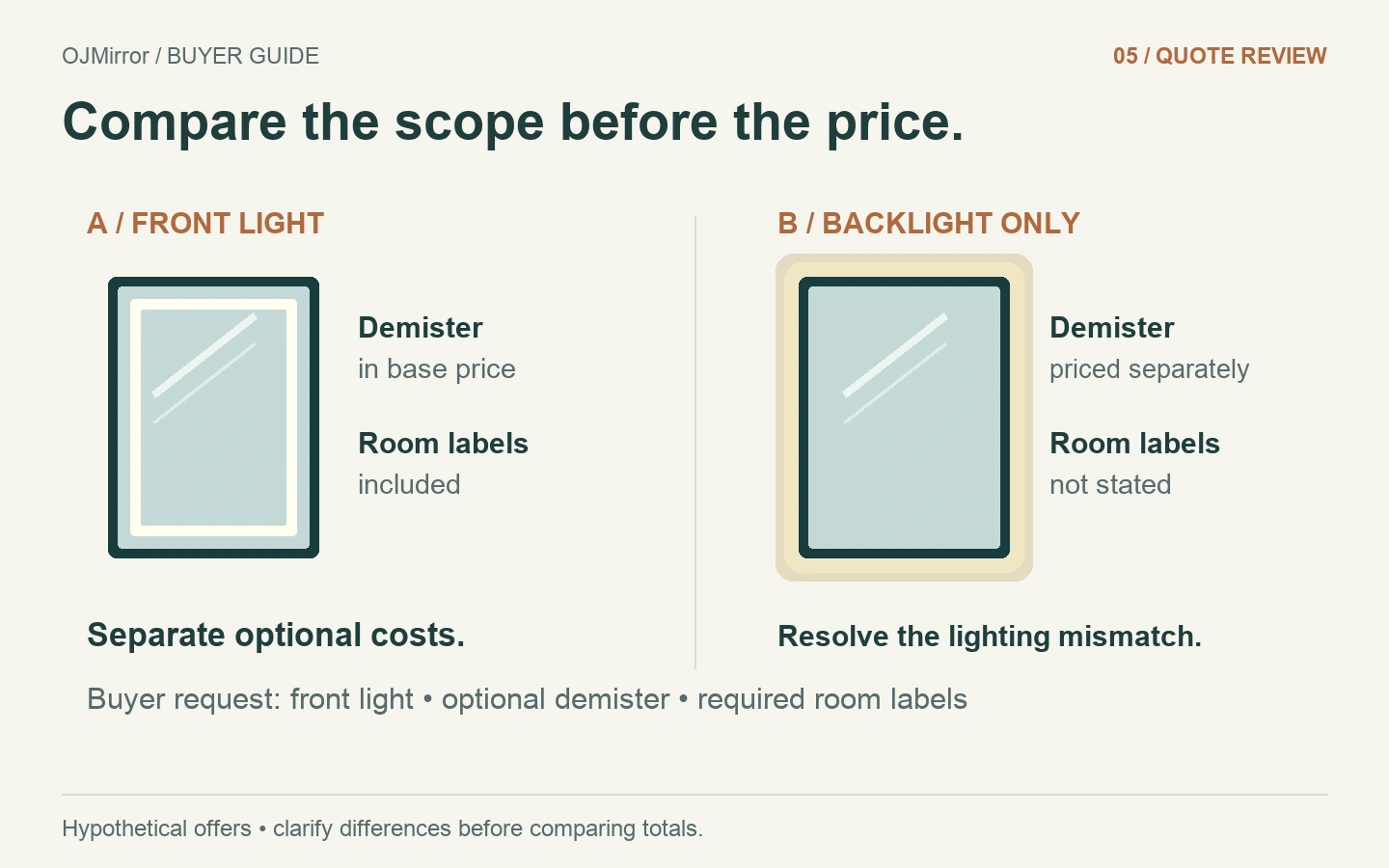
Illustrative comparison only. Align the quoted configuration and exclusions before comparing prices.
These offers do not yet cover the same scope. Resolve the differences, then compare the revised prices.
Use the table below to compare the main quotation details:
| Comparison item | Buyer requirement | Supplier A | Supplier B | Open question |
|---|---|---|---|---|
| Product and drawing revision | [Item IDs / revision] | [Offer] | [Offer] | [Difference] |
| Quantity and MOQ basis | [Quantity by item] | [Per model / finish / mixed order] | [Basis] | [Does the mix qualify?] |
| Unit price and currency | [Requested currency / unit] | [Price] | [Price] | [Same configuration?] |
| Packaging and accessories | [Required scope] | [Included / excluded] | [Scope] | [Missing items] |
| Samples and development | [Required work] | [Charges / conditions] | [Charges / conditions] | [Additional costs] |
| Delivery basis | [Named place / requested term] | [Scope] | [Scope] | [Freight, tax or unloading?] |
| Payment and validity | [Requested terms] | [Milestones / expiry] | [Milestones / expiry] | [Conditions] |
| Documents and after-sales terms | [Required scope] | [Written offer] | [Written offer] | [Coverage / exclusions] |
Keep your requirement status separate from the supplier’s confirmation. “Confirmed requirement” means you have decided what you want; it does not mean the supplier has agreed to provide it. Record deviations and assign an owner to each unresolved point.
Confirm What Starts the Lead-Time Clock
Ask for separate sample, production and transport estimates. Then establish the event that starts each period. Production timing might depend on a combination of drawing approval, sample approval, payment or material confirmation; the actual quotation should state the conditions.
Write the expected shipment date and target arrival date separately. If several batches are needed, confirm the schedule for each one. A production-duration estimate alone does not establish when the goods will reach the project.
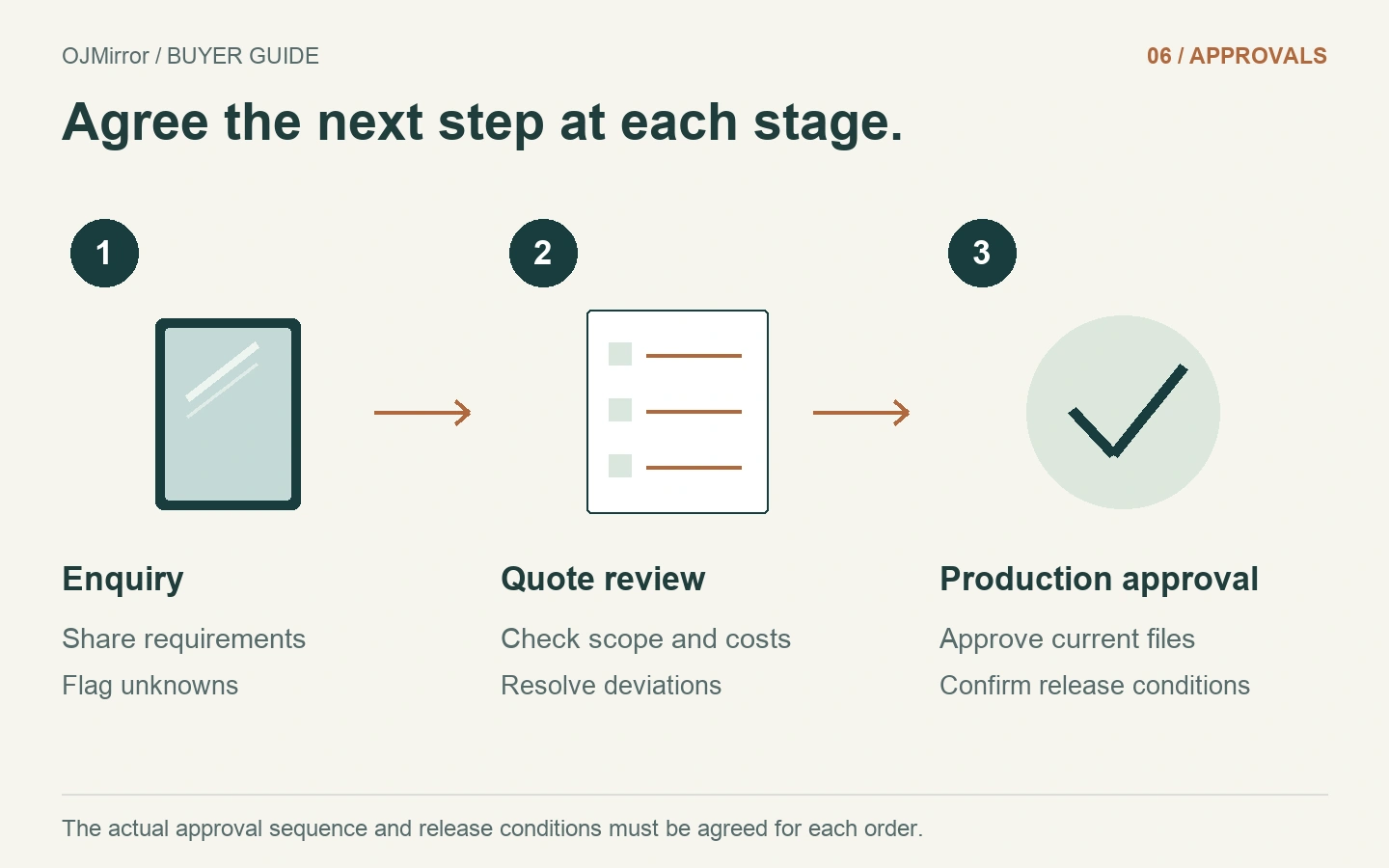
Use the stages to organize decisions. Their sequence and approval requirements should be agreed for the actual order.
For ocean shipments, include sea freight packaging requirements in the RFQ: proposed shipping units, packed dimensions and weights, FCL/LCL plan, receiving equipment and required inspection records.
Check for These Gaps Before You Send
Before sending, check three things:
- Units and quantities: dimensions identify what is measured; quantities are split by configuration; samples and spares are separate.
- Dates and delivery: the quotation deadline, shipment date and required arrival date are distinct; the delivery location and scope are stated.
- Current files and open decisions: attachments use the same item IDs and revisions; unknowns are marked; superseded files are removed from the active package and changes are explained.
Frequently Asked Questions
What is the MOQ for a custom mirror order?
The minimum order quantity (MOQ) needs to be confirmed for the proposed configuration and order mix. Size, finish, components and development work may affect the offer. Ask whether the minimum applies per model, size, finish or total order, and have the supplier confirm it against your item schedule.
How long does a custom mirror quotation take?
Quotation timing depends on how complete the brief is and which technical or costing checks remain. An initial estimate and a detailed offer based on confirmed specifications may have different response dates. Include your deadline and ask the supplier to confirm when it can reply and what information is still needed.
What should a custom LED mirror RFQ include?
Along with dimensions, quantity and destination, describe the lighting arrangement, controls, demister requirements, site power, connection and cable exit. Separate required features from options. If a lighting parameter is undecided, request a recommendation and ask the supplier to state the proposed specification in its LED mirror quotation.
Should shipping be included in a mirror quotation?
Specify the delivery basis you want and ask the supplier to identify included and excluded costs. Product-only and delivered quotations cover different scopes. Request the named place, proposed trade term, packing estimate and any unresolved destination charges so freight and delivery costs can be compared consistently.
What kind of quote can I get without an approved drawing?
You may be able to obtain a budget estimate or a quotation based on stated assumptions. Send reference images, target dimensions and the quantity schedule, then ask whether the supplier can develop a quotation drawing and whether that work has a fee. The offer should identify provisional details and what could change the price. Confirm the required drawings and specification before finalizing an order.
Is an RFQ the same as a purchase order or production approval?
They serve different purposes in the procurement workflow. An RFQ asks for an offer; a purchase order records what the buyer is ordering. Production release should follow the approvals and conditions agreed for that order. Keep the authorized specification, drawing revision and approval record together.
Prepare Your RFQ for OJMirror
Send the six essentials and your available drawings or reference images to OJMirror. Mark undecided details clearly, separate optional features and include your requested reply date. Use the short enquiry above to start, or attach the full RFQ when your project requirements are more developed.
