
Updated October 13, 2026
Download the 12-Point Mirror Packaging Inspection Checklist (PDF)
Quick answer: approve the complete product-and-package system before repeating it across a batch. Reinforced cartons, palletized cartons, wooden crates and selected A-frame arrangements solve different handling problems. Check inner protection, external support, moisture controls, shipping marks and load restraint together. A strong outer crate cannot compensate for an unsupported mirror inside it.
On this page
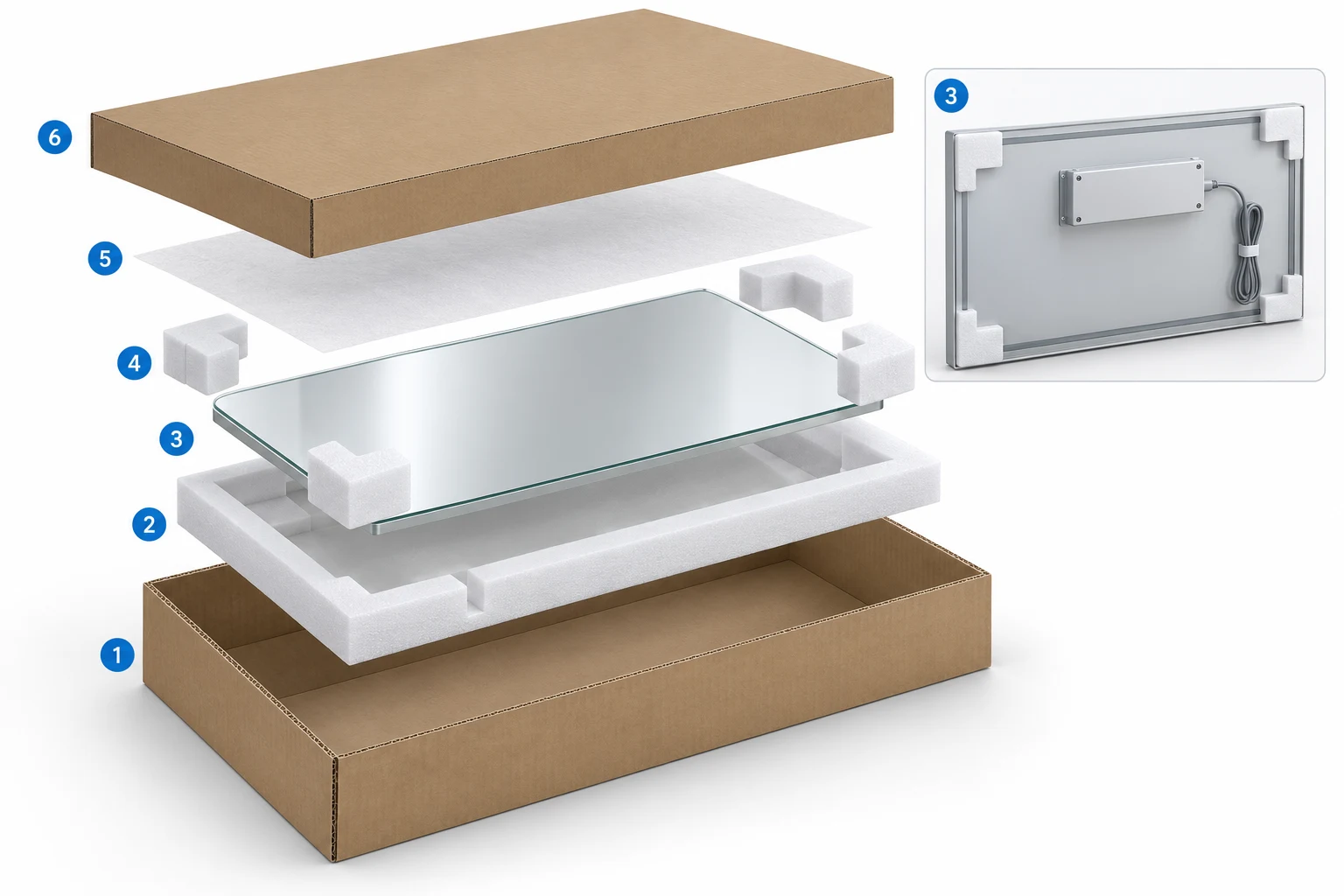
View the packaging design at full size
The five checks that matter most
For an importer, the release decision rests on five records. Obtain them early enough to resolve exceptions before the container closes.
| Control point | Evidence to request | Release question |
|---|---|---|
| Approved reference | Model/drawing revision and packed sample or packing drawing | Does this batch use the approved product and pack? |
| Inner protection | Open-pack photos and a physical inspection sample | Are surfaces, edges and rear parts supported without damaging contact? |
| Shipping unit | Carton/crate/pallet specification, gross weight and marks | Can the complete unit be handled by the planned equipment? |
| Container load | Container inspection, loading plan and staged photos | Are units supported and restrained through transport and safe unloading? |
| Handoff record | Count, seal, exceptions, corrective actions and sign-off | Can the receiver identify what was shipped and checked? |
Product inspection, package validation and container securing each need their own acceptance basis. The IMO/ILO/UNECE CTU Code addresses cargo transport units across sea and land transport; it does not prescribe a universal mirror carton.
Cartons, wooden crates or A-frames: choose for the handling route
Start with the finished product's dimensions, mass, projections and vulnerable surfaces. Then check how many times the shipping unit will be lifted, transferred, stored and opened. The receiving warehouse must be able to handle the selected unit safely.
| Packaging method | Where to evaluate it | Practical trade-off | What needs approval |
|---|---|---|---|
| Reinforced carton | Individually identified finished mirrors | Convenient SKU identification and unpacking; performance depends on the complete construction | Cushioning, closures, compression exposure and permitted orientation |
| Cartons on a pallet | Multiple cartons handled as a grouped unit | Reduces individual handling where pallet equipment is used; adds footprint and restraint requirements | Pallet support, overhang, stability, lifting access and stack pattern |
| Wooden crate | Heavy, large, irregular or handling-sensitive assemblies | Adds an external structure, weight and opening work | Internal supports, frame members, restraint, lifting points and wood compliance |
| A-frame | Selected large sheets or configurations suited to inclined support | Requires compatible lifting and receiving arrangements; not every finished LED mirror can use it | Support contact, balance, separators, restraint and unloading sequence |
| Custom engineered pack | Products with unusual geometry or vulnerable projections | Needs design and validation specific to that assembly | Product load paths, handling method and agreed verification |
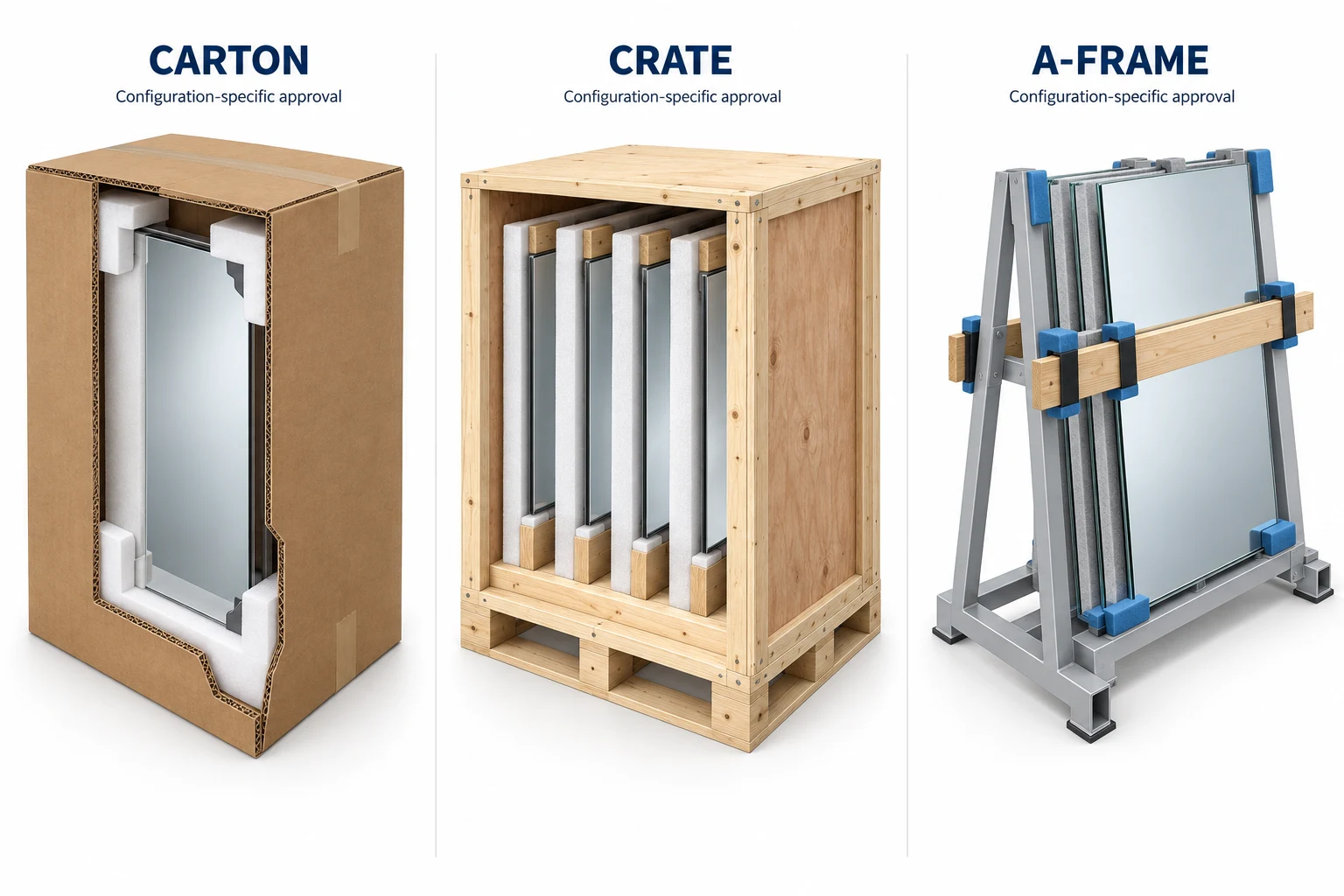
View the packaging comparison at full size
For an oversized mirror, review flexing, support spans, turning clearance and the final unloading method before selecting the crate. Increasing timber thickness alone does not resolve poor internal support. Agree a packed sample or detailed drawing and record its revision through sample approval.
Mirror packaging requirements by product type
| Product type | Packaging priority | Detail to verify before approval |
|---|---|---|
| Frameless bathroom mirror | Exposed edges, corners and face | Compatible separators and distributed support without point loading |
| Framed LED mirror | Frame finish, glass and rear electrical parts | Cushion clearance around the driver, cable exit and brackets |
| Oversized wall mirror | Panel support, movement restraint and lifting | Support spans, packed mass, turning space and receiving equipment |
| Mirrored medicine cabinet | Door, hinges, shelves and hardware | Door restraint and separately secured loose components |
| Custom-shaped mirror | Profile-specific support and contact points | Fitted protection at curves, narrow sections and projections |
Similar front dimensions do not mean interchangeable packaging. Use the finished assembly and the approved packing revision as the reference.
Materials and specifications to confirm
A packaging bill of materials should identify where each component sits and what it protects. A material name such as “EPE foam” or “export carton” is insufficient without the construction and acceptance requirements.
| Component | Specify or confirm | Inspect on the actual pack |
|---|---|---|
| Cushioning | Material, density/grade, thickness, shape and placement | Support locations, fit and clearance from vulnerable parts |
| Corner and edge guards | Material, dimensions and contact area | Continuous protection without concentrated pressure |
| Face separator | Surface compatibility, cleanliness and retention | No abrasive contact, trapped hardware or unacceptable residue |
| Outer carton | Board construction, packed dimensions, closures and verified strength requirements | Damage, closure quality and conformance to the approved sample |
| Crate or pallet | Structural drawing, materials, base and lifting points | Sound members, suitable fasteners, support and equipment access |
| Straps and restraints | Route, contact protection and restraint method | No loading of glass faces, delicate frames or rear projections |
| Moisture controls | Dry-material criteria and any barrier/desiccant plan | Dry condition, correct placement and package compatibility |
| Shipping marks | Item ID, quantity, gross weight, orientation and handling instructions | Agreement with the packing list and receiving plan |
Confirm tolerances and inspection methods with the pack designer; this table deliberately does not assign universal foam thicknesses, carton grades or strap tensions. For exposed edges, include the edge finish of the selected frameless mirror. Do not silently substitute a packing material after sample approval.
A practical mirror packing sequence
The following sequence is a review framework. The factory's approved work instruction should define the handling equipment, staffing and acceptance limits for the particular product.
- Identify and inspect. Match model, drawing revision and finish. Inspect glass, edges, backing and frame before protective layers hide them. Record agreed LED function checks.
- Secure components. Account for brackets, cables, controls and accessories. Restrain loose items in their assigned locations.
- Fit the inner protection. Apply compatible separators and cushions at approved support points. Check clearances around projections.
- Close the shipping unit. Assemble the carton, crate or pallet arrangement to its drawing. Check closures and movement in the approved orientation without improvised shake or drop tests.
- Label and reconcile. Verify item IDs, quantities, packed dimensions and gross weights against the shipment records.
- Inspect and release. Record the sample inspected, exceptions and rechecks. Load only against the accepted container and securing plan.
LED mirrors and medicine cabinets need separate checks
For an LED mirror, examine the driver enclosure, cable exit, touch/control module, mounting bracket and accessory location. Cushioning must not transfer carton pressure into a projecting enclosure. Place loose fasteners where they cannot escape and scratch glass. Protect the finish around cable ties and temporary restraints.
For a mirrored medicine cabinet, review the door restraint, hinge loading, shelves and internal fittings as a system. A door must not swing during handling; loose shelves and hardware need their own approved restraint. Do not apply a wall-mirror packing design to a cabinet simply because their front dimensions match. See the medicine cabinet range when identifying the product configuration for review.
Common mirror shipping damage and the evidence to check
Damage patterns help direct an investigation, but they do not establish the cause by themselves. Compare the product, inner layers, shipping unit and loading records before assigning responsibility.
| Observed problem | Possible contributor | Control to review | Useful evidence |
|---|---|---|---|
| Broken glass | Edge impact, unsupported span or pressure point | Cushioning and support locations | Open-pack views and fracture location |
| Chipped corners | Concentrated impact or incomplete protection | Corner-guard fit and contact | Corner details before closure and on receipt |
| Scratched face | Loose hardware, contamination or movement | Separator and accessory restraint | Surface, separator and accessory photos |
| Damaged driver or cable | Rear movement or contact with packing | Clearance and component protection | Rear view before packing and unpacking sequence |
| Deformed frame | Excess pressure or unsuitable support | Load paths and restraint contact | Packing drawing and frame/contact marks |
| Moisture damage | Wet materials, leakage or condensation | Dry packing and route-specific moisture plan | Container, packing and receiving records |
| Shifted shipping units | Insufficient blocking, restraint or support | Complete loading/securing arrangement | Staged load photos and final door-end view |
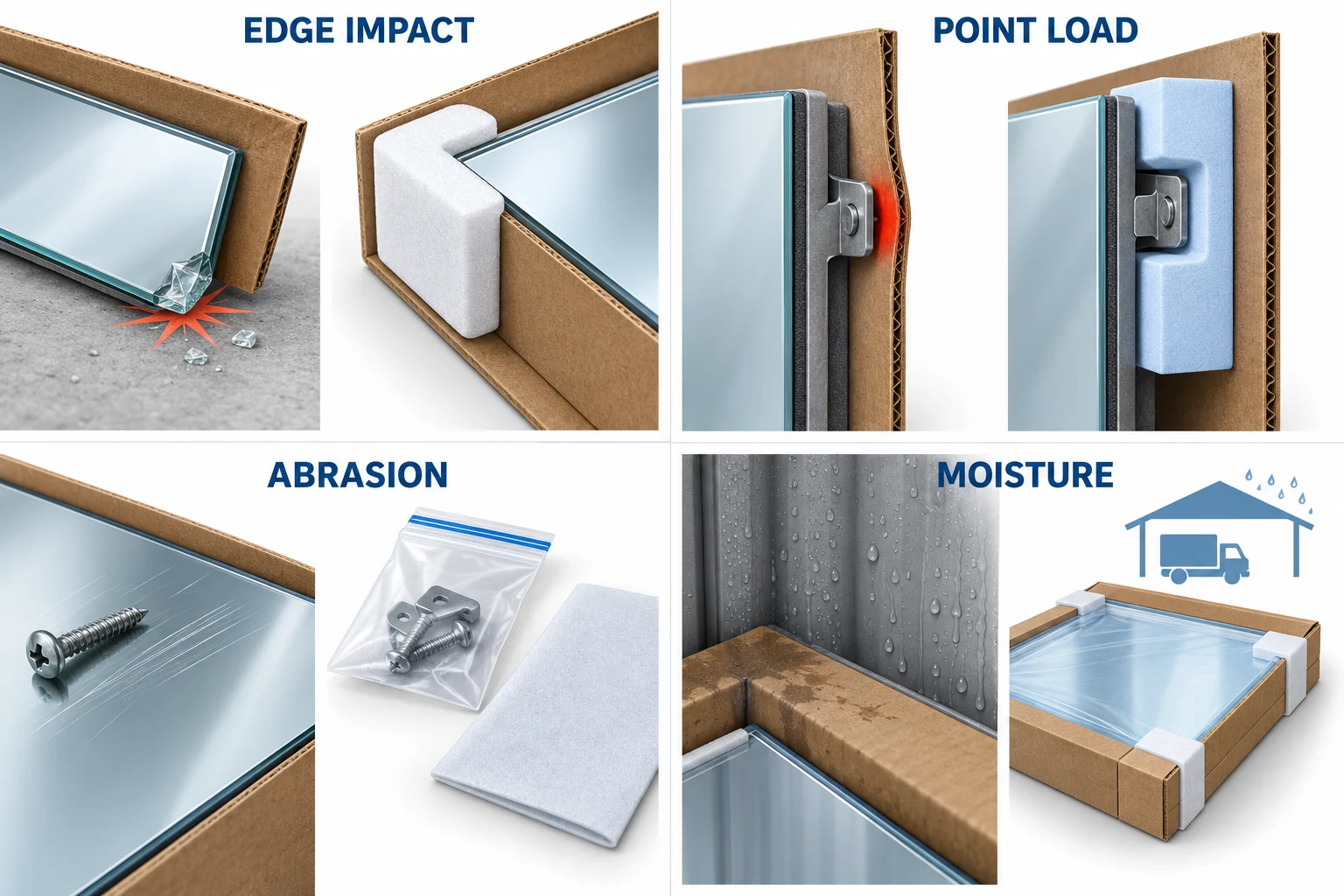
View the damage-prevention details at full size
FCL versus LCL: what changes in the packaging review?
A full container load (FCL) and a less-than-container load (LCL) can share the same ocean leg while having different handling paths. Ask the forwarder to describe the actual route. FCL does not eliminate terminal handling or movement inside the container; LCL may involve consolidation, warehouse transfers and contact with other cargo.
| Question | FCL review | LCL review |
|---|---|---|
| Who controls packing? | Confirm the party loading and securing the booked container | Confirm consolidation facility rules and who secures the grouped cargo |
| How is cargo lifted? | Check factory and receiving equipment against each unit | Include intermediate warehouse handling and pallet/crate acceptance |
| What may be stacked nearby? | Review the planned load and permitted stacking | Confirm restrictions with the forwarder; labels alone cannot enforce them |
| What must be traceable? | Unit IDs, load position, container and seal | Unit IDs plus consolidation and handoff references |
Specify any no-stack or special-handling requirement before booking and confirm it is accepted. Neither service label determines a safe stack height, carton grade or insurance outcome.
Container loading, blocking and lashing
Inspect the empty container before loading: dry and clean interior, sound floor/walls/roof, working doors and seals, no harmful protrusions, and suitable securing points. Record defects and arrange corrective action or replacement as appropriate. Use the CTU Code as the general packing reference.
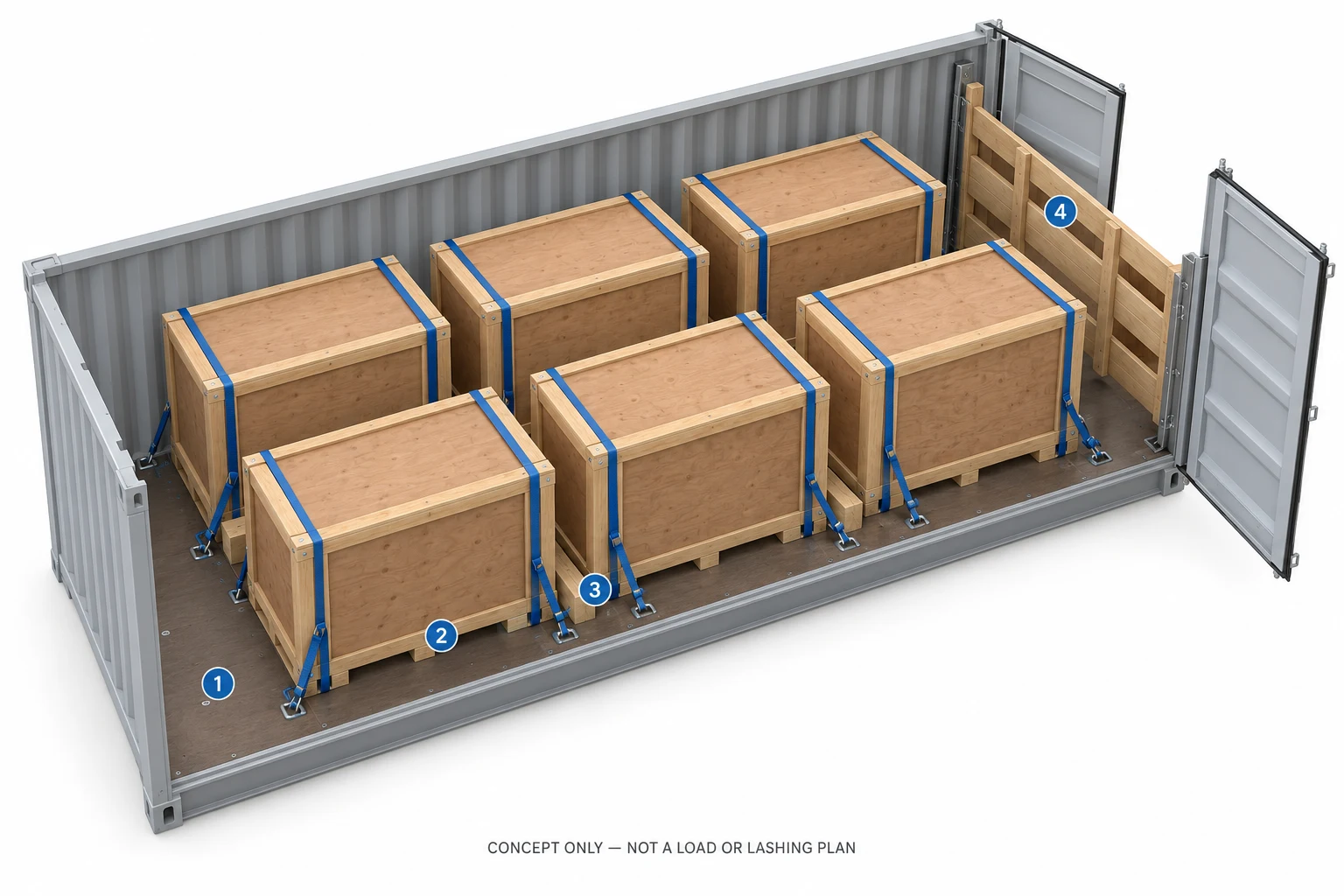
View the container loading diagram at full size
Request a plan that identifies each packed unit's dimensions, mass, orientation and location; floor/support contact; lifting access; restraint materials and contact points; and the unloading order. A competent reviewer must check cargo and container limits and the suitability of the blocking and lashing arrangement. Cargo weight alone does not prevent sliding or tipping.
Photograph progressive loading stages while supports and anchors are still visible. Keep restraints clear of fragile surfaces and confirm that blocking does not deform the package. At the door end, check the opening sequence and restraint so cargo cannot fall toward the person opening the doors. A final photograph cannot reveal every hidden contact point.
Moisture protection during ocean freight
Start with dry goods and packing materials. A desiccant cannot correct a leaking container or make wet timber and cartons acceptable. The CTU Code's condensation guidance discusses moisture from cargo, timber, porous materials and loading conditions.
- Wet-weather loading: protect the transfer path and inspect any exposed units before loading.
- Container leakage: review the container condition and remedy defects before packing.
- Condensation exposure: assess route, duration, temperature changes and moisture-bearing materials when selecting a barrier or desiccant arrangement.
- Sensitive finishes/components: confirm material compatibility and whether protection can trap moisture against the product.
Record the chosen materials, placement and condition. Avoid a generic “bags per container” rule without a design basis.
ISPM 15: check the wood construction, not the crate name
IPPC ISPM 15 covers regulated raw-wood packaging and dunnage. Packaging made wholly from qualifying processed wood, such as plywood, is exempt under the standard. A plywood-panel crate with raw-wood skids or battens requires those components to be assessed.
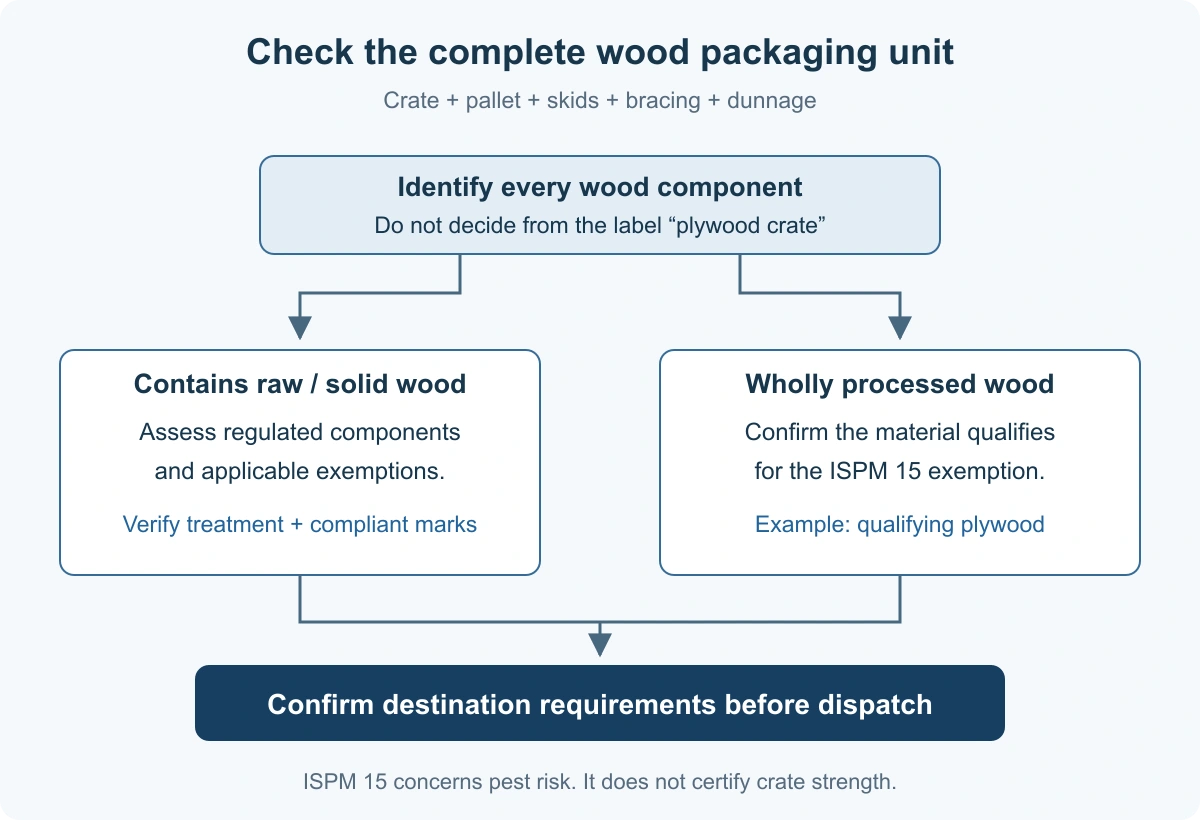
View the wood-material review diagram at full size
Where regulated wood is used, verify applicable treatment and compliant marking through the responsible supplier and destination authority requirements. A photograph of an ISPM 15 mark is useful evidence; “export grade” in a quotation is not a substitute. ISPM 15 addresses pest risk, not crate strength or moisture-proofing.
Packaging tests: match the report to the shipment
Ask what distribution hazards the validation addresses and why the chosen method fits the route. ASTM D4169 provides a framework for performance testing shipping containers and systems. A standard number in a quotation does not identify a tested model, test sequence or passing result.
| Report field | Buyer's verification question |
|---|---|
| Product identity | Does the report cover this model, size, mass and vulnerable configuration? |
| Packing revision | Are cushioning, carton/crate, closures and orientation the same? |
| Method and conditions | Which edition, sequence, hazard levels and conditioning were used? |
| Samples and results | How many units were evaluated, what happened and what criteria were applied? |
| Issuer and traceability | Who performed the work, when, and can the report be tied to the tested pack? |
| Change control | Have design or material changes triggered the agreed review/retest decision? |
Agree testing and acceptance with the buyer, pack designer and testing provider. A drop-only result does not resolve every compression, vibration, moisture or container-securing concern. See OJMirror's quality-control overview for the broader product inspection context; request order-specific evidence separately.
Shipping marks: connect each unit to the packing list
Use an agreed shipping-mark layout that lets the receiver match each handling unit to its contents. For a multi-carton pallet or crate, distinguish the outer handling-unit ID from the individual carton IDs. A room or floor code can supplement the item ID for a hotel project.
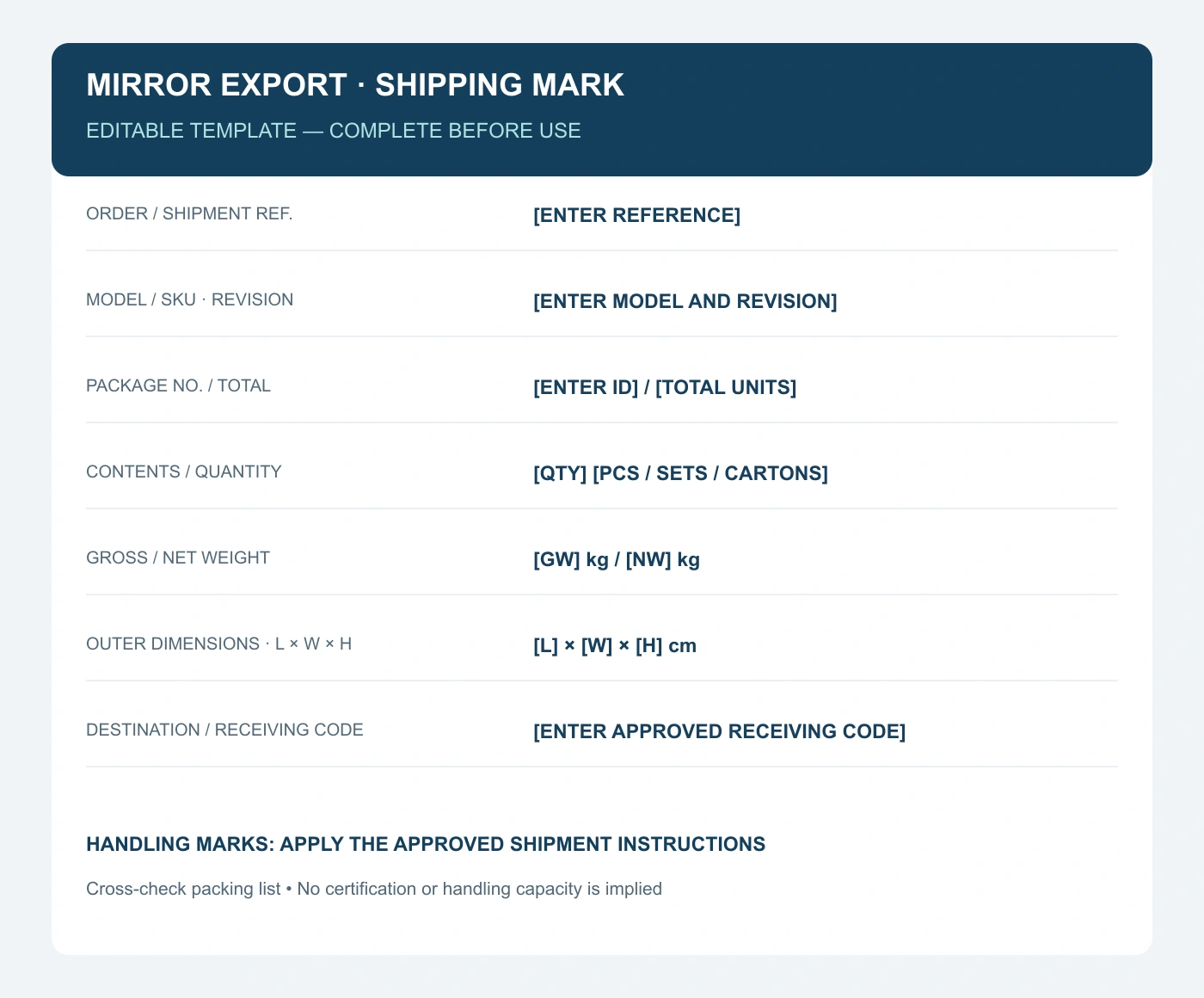
| Field | Check before printing |
|---|---|
| Order / shipment reference | Use the agreed reference without exposing unnecessary customer information |
| Model / SKU and revision | Match the packed product and packing list |
| Package number / total | Use a unique ID for each handling unit |
| Quantity and unit | State the contents of this unit; distinguish pieces, sets and cartons |
| Gross / net weight and dimensions | Record the measured or otherwise verified values with units; include the complete outer pack |
| Destination / receiving code | Match the receiver's instructions and delivery phase |
| Handling instructions | Use only the approved orientation, lifting and stacking instructions accepted for this shipment |
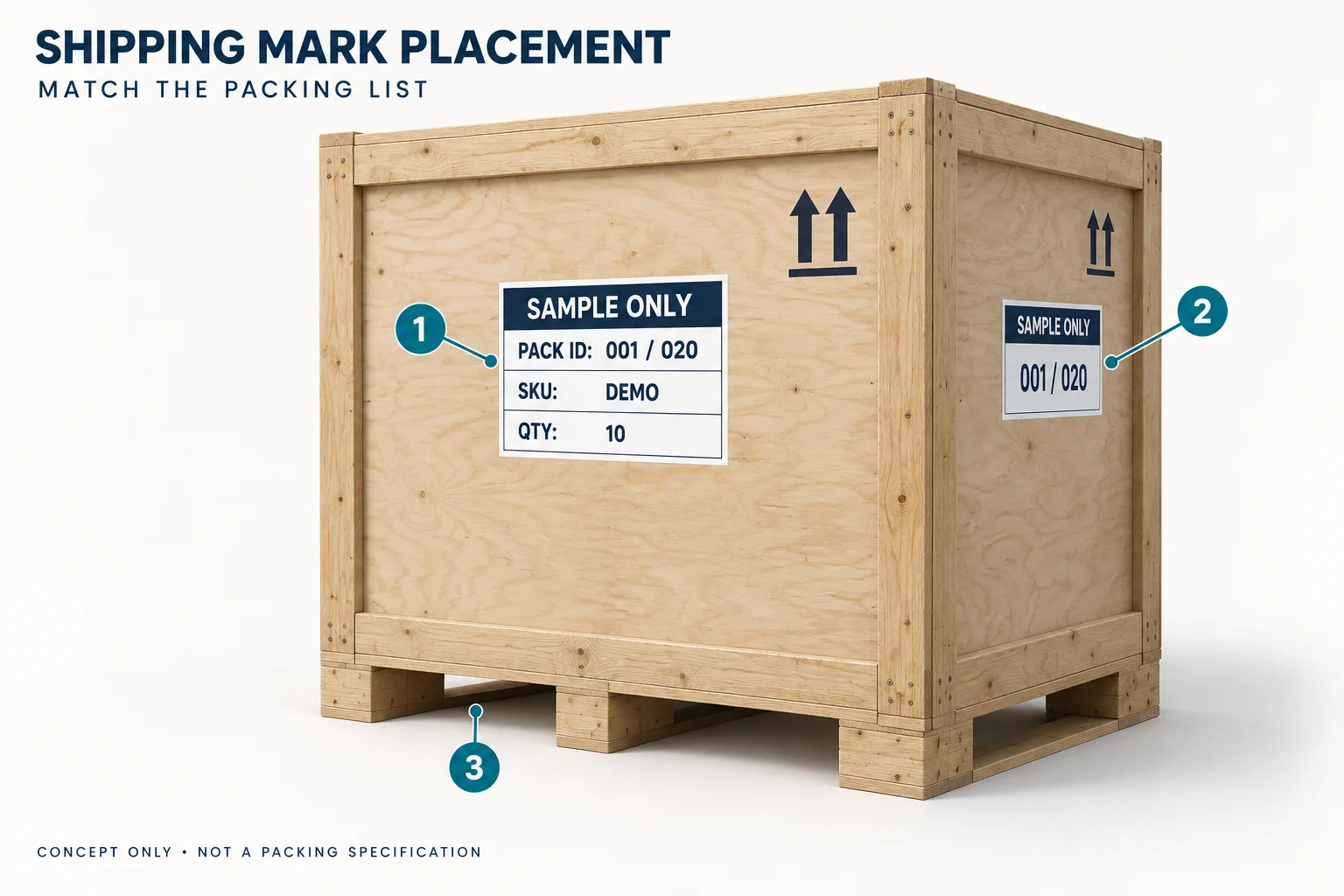
Keep identification visible after wrapping and clear of straps, closures and lifting entries. Remove or obscure conflicting old labels. Verify required handling marks separately from the item label; an arrow or “do not stack” label does not provide physical restraint or ensure the carrier accepts that restriction. Photograph the final readable marks and reconcile the count before release.
The 12-point pre-shipment mirror packaging checklist
Mark each line Pass, Hold or N/A. Record a reason for N/A. Close Hold items through corrective action and recheck before release. Download the printable worksheet for order, inspector and evidence-reference fields.
| Check | Evidence to request | Result / note |
|---|---|---|
| Approved product and pack revision identified | Drawing, packed sample or packing drawing | ☐ Pass ☐ Hold ☐ N/A |
| Mirror face, edges, backing and frame inspected before closure | Inspection record and dated photos | ☐ Pass ☐ Hold ☐ N/A |
| Ordered LED functions and accessories checked | Model-specific check record and accessory count | ☐ Pass ☐ Hold ☐ N/A |
| Face, edges, corners and rear parts protected in the finished pack | Open-pack sample/photos | ☐ Pass ☐ Hold ☐ N/A |
| Mirror restrained in the approved shipping orientation | Closed-pack review | ☐ Pass ☐ Hold ☐ N/A |
| Carton/crate/pallet construction and lifting access match the plan | Pack specification and sample | ☐ Pass ☐ Hold ☐ N/A |
| Labels, item IDs, quantities and gross weights match the packing list | Carton marks and packing list | ☐ Pass ☐ Hold ☐ N/A |
| Applicable wood packaging marks and destination rules checked | Mark photos and material description | ☐ Pass ☐ Hold ☐ N/A |
| Container clean, dry, sound and suitable | Empty-container photos and inspection record | ☐ Pass ☐ Hold ☐ N/A |
| Load supported, distributed and secured without damaging packs | Loading plan and staged photos | ☐ Pass ☐ Hold ☐ N/A |
| Door-end restraint and safe opening confirmed | Final interior photo | ☐ Pass ☐ Hold ☐ N/A |
| Count, container/seal numbers and exceptions recorded | Packing list, seal photo and release record | ☐ Pass ☐ Hold ☐ N/A |
Request shipment evidence through receiving
A useful packaging example connects photos to an identifiable product and pack revision. Ask for a comparable configuration and distinguish a sample demonstration from evidence of the batch being released.
| Evidence set | What it should let you verify |
|---|---|
| Product and rear-component photos | Identity, finish, projections and accessory arrangement |
| Open pack and closed unit | Support locations, separators, closures, marks and gross weight |
| Container and staged loading views | Container condition, unit placement and visible securing details |
| Release record | Count, container/seal numbers, exceptions, rechecks and responsible sign-off |
| Receiving record | Arrival condition, unpacking sequence and any verified damage outcome |
For a proposed order, agree which packing and inspection records are required and available.
Confirm packing-list item IDs and quantities against carton/crate marks. For phased hotel projects, identifiers tied to room type or shipment phase can support receiving checks; see the commercial mirror project context. Under IMO VGM requirements, the shipper is responsible for providing verified gross mass in time for vessel stowage. Identify that party on the transport document and agree the submission process.
Give the receiver handling instructions before arrival. Photograph visible damage or moisture before unpacking and retain relevant packaging if a claim may be needed. Follow the applicable contract and carrier notice terms; there is no universal claims deadline in this checklist.
How much does sea freight mirror packaging cost?
Compare quotations using the same product schedule, route and evidence requirements. Material price alone can conceal extra volume, handling work or validation costs.
| Cost input | Carton | Palletized cartons | Wooden crate |
|---|---|---|---|
| Materials and assembly | Board, inner protection and closure | Cartons plus pallet and unit restraint | Frame/panels, supports, fittings and assembly |
| Freight and space | Actual packed dimensions and gross mass | Includes pallet footprint, height and weight | Includes crate structure and lifting clearance |
| Handling and receiving | Individual-unit equipment and labor | Pallet equipment and de-unitizing | Compatible lifting, opening and removal work |
| Validation and exceptions | Exact product/carton configuration | Cartons and grouped load | Structural and internal protection arrangement |
For a rectangular shipping unit, packed volume in m³ = length in metres × width in metres × height in metres. Multiply by the unit count for the geometric total, then have the forwarder assess usable loading space, weight limits and the applicable billing basis. Dividing container volume by carton volume alone does not produce a reliable piece count.
Compare material, packing labor, transport, handling, unpacking/disposal and required validation on a consistent basis. Include damage or replacement costs only when supported by relevant historical records. No generic dollar premium or breakage saving applies to every crate.
Worked example: compare costs on the same basis
Hypothetical budgeting example only — not an OJMirror quotation, packing specification, tested configuration or actual shipment. Assume 200 mirrors, with 200 individually packed units in Option A or 20 larger handling units containing 10 mirrors each in Option B. The grouping is used only to demonstrate the arithmetic; feasibility and protection performance require separate approval.
| Illustrative input (USD) | A: individual carton scenario | B: crate scenario |
|---|---|---|
| Materials, including inner protection | $1,600 | $2,400 |
| Packing labor | $400 | $600 |
| Additional handling | $200 | $300 |
| Validation allocated to this order | $300 | $300 |
| Total packaging cost | $2,500 | $3,600 |
| Packaging cost per mirror (200 pieces) | $12.50 | $18.00 |
| Assumed outer dimensions per unit (m) | 1.00 × 0.70 × 0.12 | 1.10 × 0.80 × 1.30 |
| Number of outer shipping units | 200 | 20 |
| Geometric packed volume | 16.80 m³ | 22.88 m³ |
Total packaging cost = materials + packing labor + additional handling + allocated validation. For A: $1,600 + $400 + $200 + $300 = $2,500; $2,500 ÷ 200 = $12.50 per mirror. For B: $3,600 ÷ 200 = $18.00 per mirror.
Packed volume = outer length × outer width × outer height × shipping-unit count. A: 1.00 × 0.70 × 0.12 × 200 = 16.80 m³. B: 1.10 × 0.80 × 1.30 × 20 = 22.88 m³. Use the shipping-unit count, not the mirror count, when several mirrors share a crate.
In this example B adds $1,100, or $5.50 per mirror, and 6.08 m³ of geometric volume. Freight, duties, insurance, unloading/disposal and damage costs are excluded. These numbers do not prove that either option is suitable or more economical overall. Obtain forwarder quotes for the actual gross weights, route and charging basis; confirm loadability, stacking restrictions and handling costs before comparing delivered cost. A volume calculation alone cannot establish a 20GP or 40HQ loading quantity.
Frequently asked questions
What is the best packaging for mirrors shipped by sea?
The best choice is the approved pack that suits the actual mirror, route and receiving method. Review support, protection, handling and validation together. A carton, pallet or crate label alone cannot establish performance.
How many mirrors can go in one wooden crate?
There is no fixed count. Dimensions, gross weight, separation, support, lifting equipment and validated crate capacity determine the arrangement. Ask for a drawing and packed weight for the proposed number of units.
Does a plywood crate need an ISPM 15 mark?
A crate made wholly of qualifying processed wood is exempt under ISPM 15. Raw-wood skids, battens or dunnage used with it need their own assessment. Check the complete construction and destination requirements.
Should mirrors always travel upright?
Use the orientation approved for that product-and-package system. If a handler proposes changing orientation or stacking, review the support and load plan before accepting the change. The illustrations here do not prescribe orientation.
Is LCL always unsuitable for LED mirrors?
No blanket conclusion follows from the booking type. Confirm the consolidation route, intermediate handling and accepted unit restrictions, then validate a pack suited to those conditions with the relevant parties.
What changes when packing an oversized LED mirror?
Review panel support, projections, lifting and turning space, gross weight and unloading access. Confirm that the proposed supports and restraints do not load the glass or electrical enclosure. An enlarged version of a smaller carton may need a new assessment.
Is a drop-test report enough to release the container?
No. Match the report to the shipped product and packing revision, review the agreed hazard coverage, and inspect the batch, container and securing arrangement. Keep the package test and shipment-release evidence together.
What should buyers do when mirrors arrive damaged?
Record the condition before disturbing the pack, photograph identifying marks and each unpacking layer, and preserve relevant packaging. Notify the responsible parties under the applicable carrier, insurance and sales-contract terms. Do not infer cause from the broken mirror alone.
Request a mirror export packaging review
Preparing a bulk shipment of LED mirrors or mirrored medicine cabinets? Send the product drawings or model list, dimensions, quantities, destination, receiving equipment, FCL/LCL plan and any buyer packing guide. Identify the packaging and inspection documents you need confirmed for the order.
Contact OJMirror about your packaging requirements. If the product specification is still being prepared, use the custom mirror RFQ checklist to organize the quotation details. Packing materials, test scope and available records should be agreed for the selected configuration.
You can start with the details you know. In the inquiry box, include product type, dimensions, quantity, destination and FCL / LCL / not sure. If drawings are available, use the contact form to attach them.
Sources and scope
Published by OJMirror. This buyer review guide draws on the linked IMO/ILO/UNECE CTU Code, IPPC ISPM 15 and ASTM D4169 references. The cost example is hypothetical. Confirm the order-specific packing drawing, acceptance criteria and responsible sign-off before release.
