
Content revision: October 12, 2026
Quick Answer
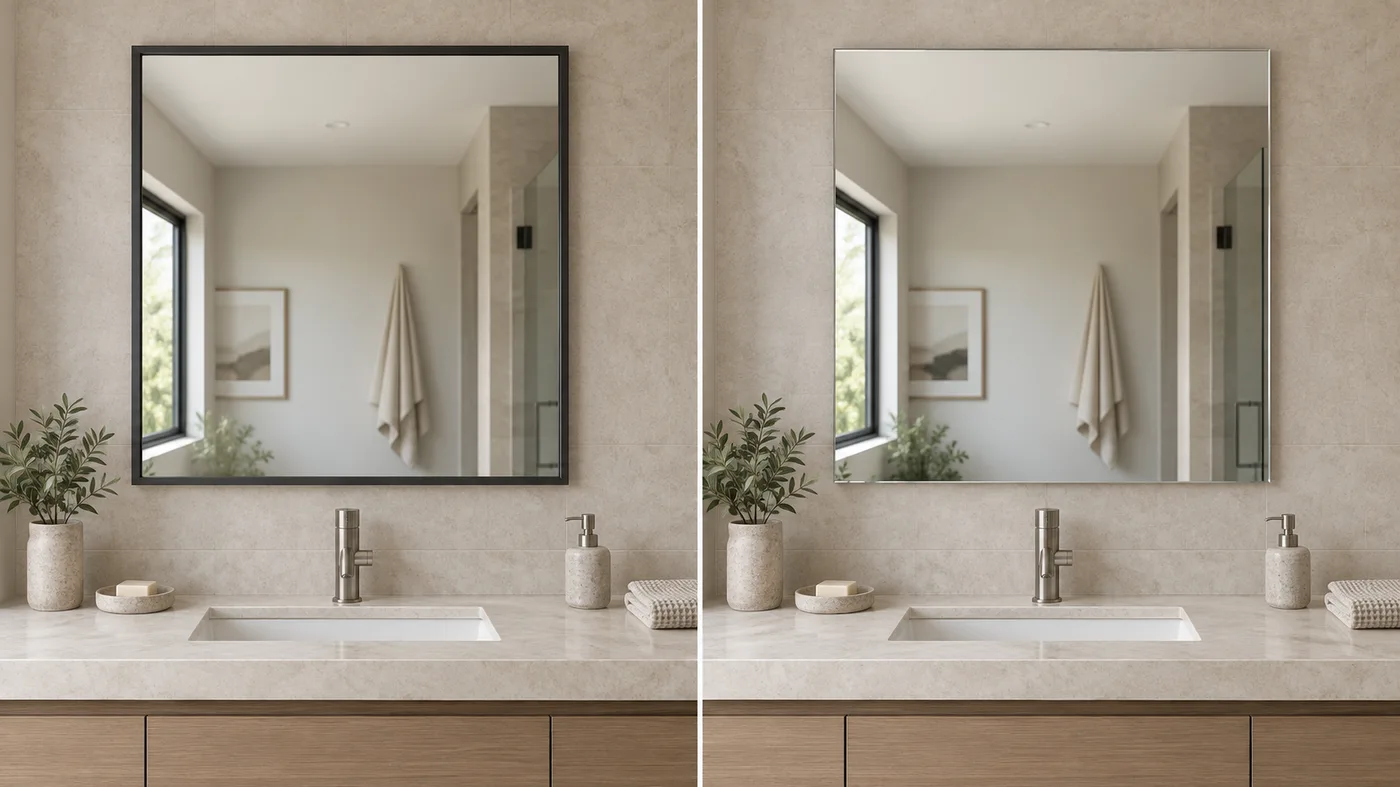
Choose framed when the perimeter is part of the design: a finish that connects the mirror to faucets, lighting, or cabinetry. Choose frameless when you want an uncluttered glass outline and more visible reflection within the same outside dimensions.
Neither is automatically more durable, moisture-resistant, inexpensive, or easier to install. Those outcomes depend on the frame material, glass and backing, edgework, mounting system, lighting, and conditions of use.
In this guide
Which Is Better for a Small Bathroom?
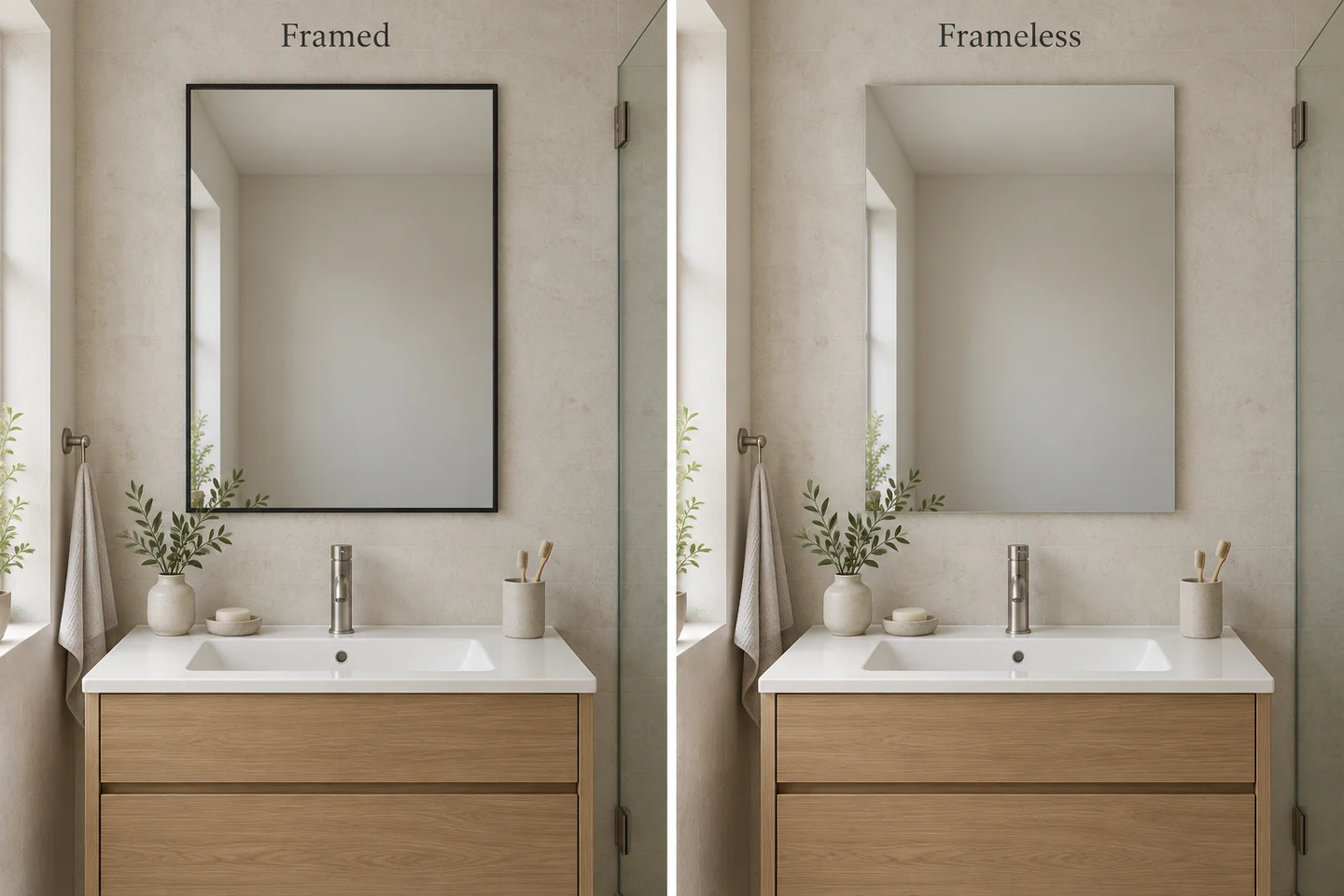
For a compact bathroom, first decide whether you want the mirror to disappear into the wall or give the vanity a defined outline. A frameless edge keeps the perimeter quiet; a narrow frame adds contrast without requiring a large decorative border. Keep the outside dimensions and lighting the same when comparing the two.
Start with frameless if your priority is the largest visible opening within a fixed outside size. Choose a slim frame if its outline connects the vanity to the room's finishes. Neither fixes poor lighting or a mirror that is too small for the layout. Check the opening between sconces, reflected clutter and faucet clearance before settling on the style.
Framed vs. Frameless: Quick Comparison
A coordinated finishStart with framed; check the actual profile and finish sample.
Simpler cleaningCompare joints and ledges, not just the framed or frameless label.
Integrated lightingEither can work; choose the light direction separately.
| Decision point | Framed bathroom mirror | Frameless bathroom mirror |
|---|---|---|
| Best for | Making the perimeter a deliberate finish or design element | Keeping the outline quiet and maximizing uncovered glass at a fixed outside size |
| Appearance | A defined perimeter adds color, texture, and depth | Exposed glass makes the outline less prominent |
| Design flexibility | Profile and finish can suit traditional or contemporary rooms | Shape and edge detail can suit minimal or decorative rooms |
| Visible glass | A front border reduces the opening within a fixed outside size | Usually more exposed glass at the same outside size |
| Edge protection | The frame may shield the perimeter; glass still needs protection | Exposed edges need careful handling and packing |
| Humidity | Assess substrate, finish, joints, backing, and water collection | Assess backing, edge condition, mounting, and water collection |
| Cleaning | Clean glass, frame surfaces, and frame-to-glass joints | Fewer frame joints, but the perimeter still needs care |
| Durability | Depends on the complete assembly, not the frame alone | Depends on the complete assembly, not the lack of a frame |
| Installation | Hardware, wall support, weight, and access govern the work | Hardware, wall support, weight, and access govern the work |
| Cost | Frame material, profile, finish, and joints add cost variables | Edgework, shape, backing, and rear structure add cost variables |
| LED options | Front-lit, backlit, or combined designs may be available | Front-lit, backlit, or combined designs may be available |
| Customization | Frame profile, finish, size, shape, and glass opening | Size, shape, edge finish, corners, and concealed structure |
| Replacement | Check fixing access and whether the finish remains available | Check fixing access, glass dimensions, and edge specification |
What Changes When You Add a Frame?
Ready to compare design directions? Explore custom framed mirrors and frameless mirrors, then check the individual construction and configuration before selecting a product.
Framed bathroom mirror: advantages and trade-offs
A frame creates a deliberate boundary around the reflection. A narrow black profile can define a contemporary vanity; a warmer metallic finish can connect the mirror to lighting or cabinet hardware. A frame can also cover the glass perimeter, although it is not a guarantee against breakage or moisture damage.
The trade-offs are a smaller glass opening at a fixed outside size, more finish decisions, and more surfaces or joints to clean. Wide or textured frames can become visually dominant in a compact bathroom. A slim frame may provide the desired contrast without that effect.
Frameless bathroom mirror: advantages and trade-offs
A frameless mirror leaves the glass outline exposed. It works well when continuous reflection or a quiet perimeter matters. Shapes, corner radii, and edge finishes become the main design details rather than a frame color.
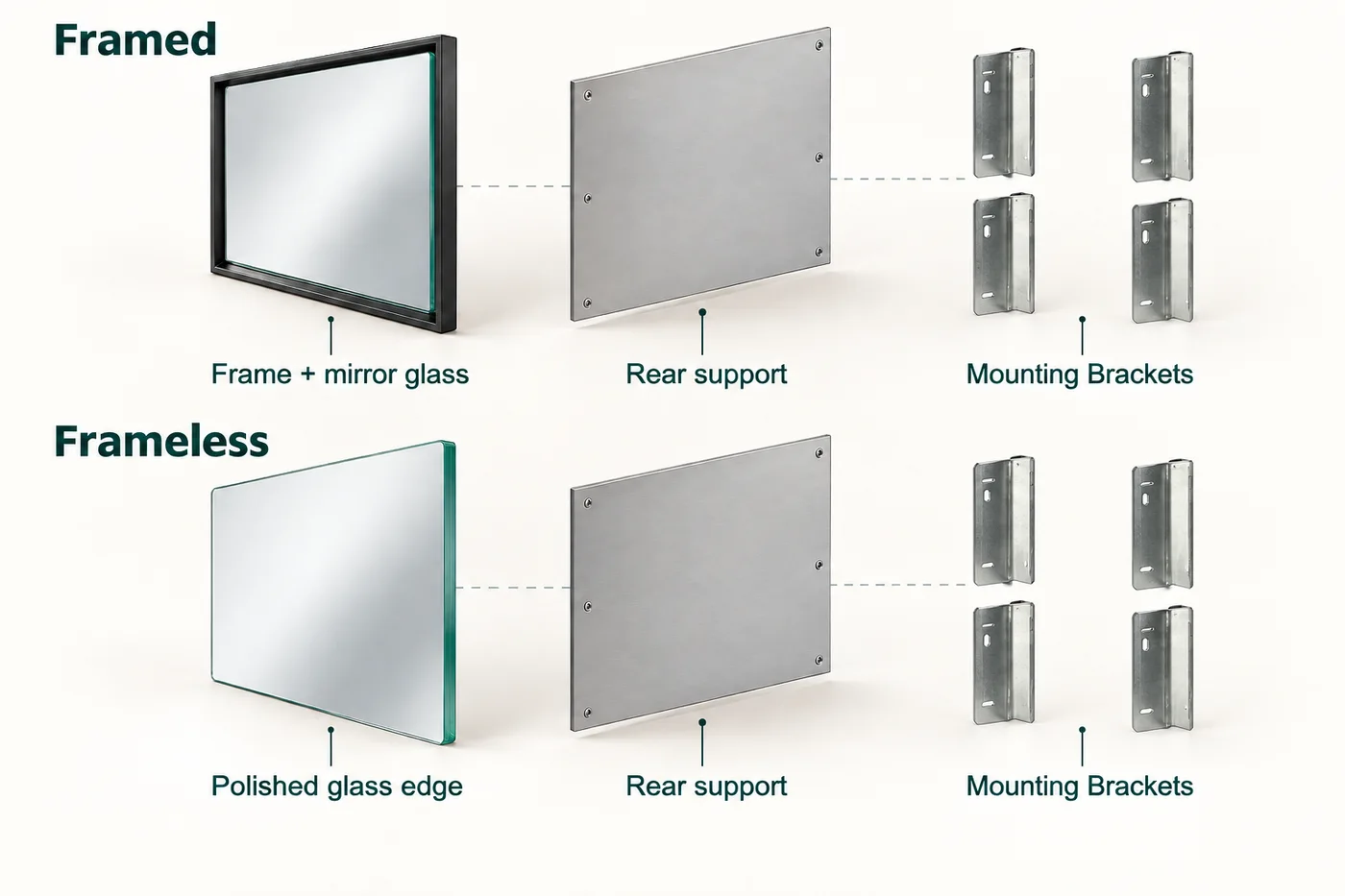
Exposed edges need protection during handling, installation, and cleaning. Beveled or shaped glass can add processing cost, and mounting clips may remain visible on some designs. Frameless refers to the visible perimeter—not the absence of rear structure. A rear chassis, mounting brackets, controls, or LED components can still determine the product's depth and service access.
Match the finish and edge—not just the color name
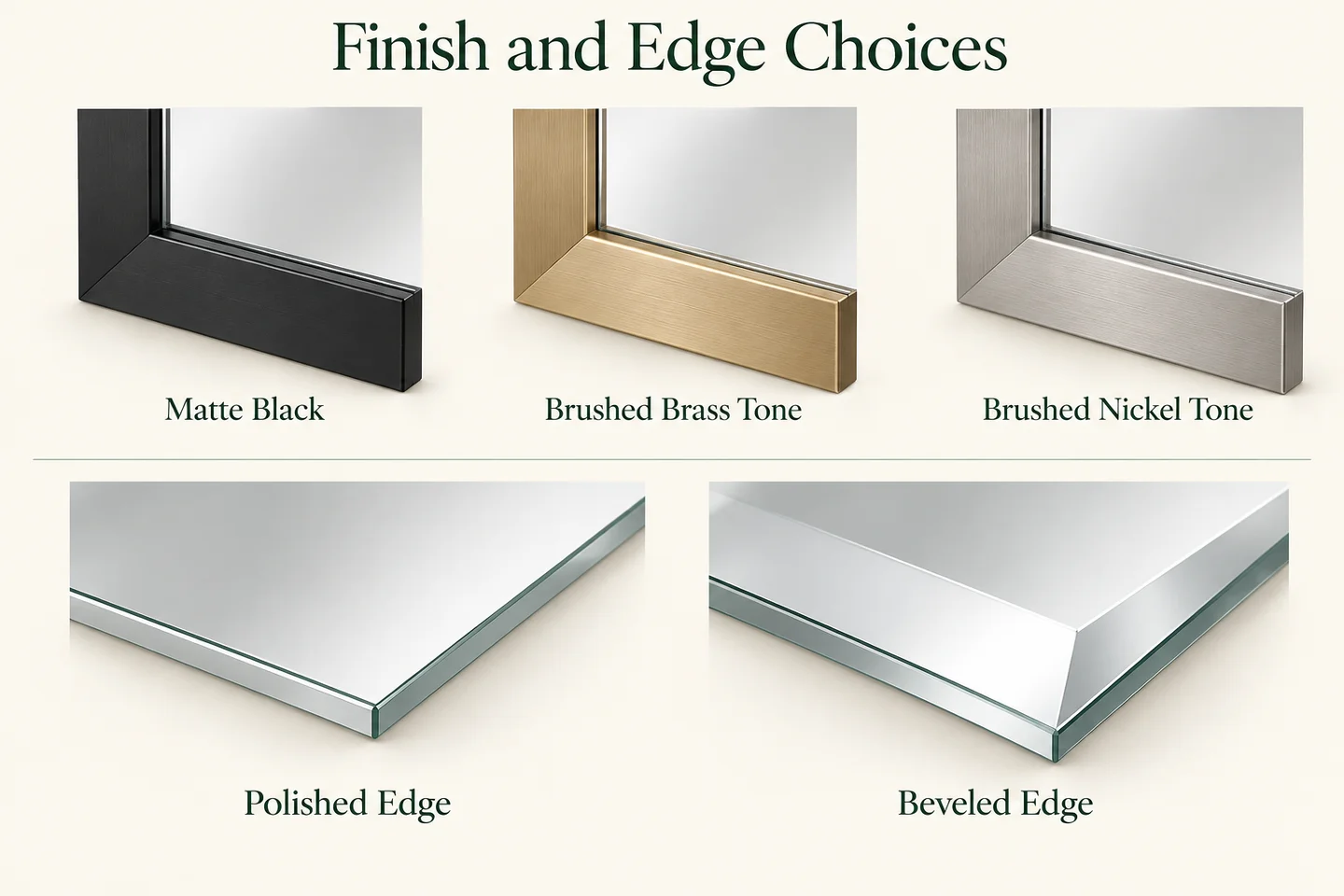
“Brushed brass” can describe an appearance rather than the frame's base metal. Ask for substrate, finish process, sheen, brushing direction, and corner construction separately. A screen image is not an approved finish sample.
A polished edge finishes the glass perimeter without adding a broad sloping border to the front face. A bevel introduces that sloping border and changes how the edge catches light. Specify bevel width and corner treatment on the drawing; the word “frameless” does not settle either choice.
See the beveled mirror guide for a closer look at the sloping border and its effect on reflection.
Which Mirror Is Better for Humid Bathrooms?
Neither construction wins on its name alone. Treat moisture resistance as a combination of frame material, finish, mirror backing, installation, and care. A visible frame alone is not a moisture specification.
Frame materials and moisture resistance
| Material direction | What to review for bathroom use |
|---|---|
| Aluminum | Finish specification, cut edges, joints, and compatible fasteners. Aluminum does not form iron rust, but can corrode. |
| Stainless steel | Specified grade, surface finish, fabrication details, and cleaning restrictions. The name does not mean stain-proof in every environment. |
| Wood | Species or construction, protective finish, end grain, joints, and limits on splashing or standing moisture. |
| MDF | Board specification, sealed edges and holes, finish continuity, and wet-use limitations. An attractive face finish alone is not enough. |
| Composite or polymer | Actual composition, coating, joint design, stiffness, and cleaner compatibility. “Composite” is not one uniform material. |
These are material-review questions, not a claim that every material is offered on every OJMirror model. For a metal-frame starting point, review the aluminum framed mirror collection.
Exposed edges, backing, and desilvering
Frameless edges are more exposed to handling contact, but edge impact and desilvering are different problems. A chip is physical glass damage. Desilvering concerns deterioration of the reflective coating behind the glass.
A frame may cover the edge without sealing or protecting every coating surface. A lower channel that retains water or cleaner can create a different maintenance problem. Protect the backing, prevent liquid from collecting at the perimeter, and follow the product's approved care and installation instructions. Do not create an arbitrary wall gap on a flush-to-wall design to solve a ventilation concern.
For causes, identification, and repair decisions, use the separate mirror desilvering guide. Covering a dark edge does not restore the missing reflection.
Which Is Easier to Clean—and Which Lasts Longer?
A simple frameless mirror usually has fewer visible joints to clean. A smooth, narrow frame can also be practical. Ornate profiles, textured surfaces, and deep frame-to-glass corners add places that require attention; the difference is in the detail, not just the label.
Use the specified cleaner and cloth, avoid soaking the perimeter, and remove residual liquid rather than letting it collect at the lower edge. Do not assume one cleaner is suitable for both the mirror backing and a decorative metal finish.
For durability, compare edge condition, backing protection, frame joints, fixings, and the maintenance method. A frame cannot compensate for inadequate wall support. Frameless glass is not automatically fragile, but an exposed corner needs suitable handling protection. There is no reliable universal lifespan comparison without matched products and conditions.
How Much Do Framed vs. Frameless Bathroom Mirrors Cost?
A basic frameless mirror may avoid the cost of a decorative frame. That does not make every frameless mirror cheaper. A large beveled shape with lighting and a rear chassis can cost more than a straightforward framed, non-lighted unit.
Compare like-for-like specifications before comparing prices. A retail installed price, a product-only price, and a project export quotation cover different scopes.
| Quotation item | Framed option: identify separately | Frameless option: identify separately |
|---|---|---|
| Glass and backing | Raw glass dimensions behind the frame, thickness and backing | Finished glass dimensions, thickness and backing |
| Perimeter processing | Profile material, cutting, corner assembly, finish and any covered-edge treatment | Exposed-edge polishing or bevel, corner treatment and shape processing |
| Rear assembly | Supports, mounting brackets and service access | Any rear supports or housing, mounting brackets and service access |
| LED and controls | Same agreed lighting, controls and electrical scope | Same agreed lighting, controls and electrical scope |
| Packing | Protection for the frame finish, corners and glass | Protection for exposed edges, corners and glass |
| Delivery and site work | Same destination, terms, quantity and installation exclusions | Same destination, terms, quantity and installation exclusions |
Hold the finished outside dimensions constant, then ask which line items changed. The raw glass size may differ from the visible opening. For aluminum versus stainless steel frames, ask suppliers to identify the grade or alloy, profile construction, finish and joining method; the material name alone does not predict the price. For polished versus beveled glass, specify the edge profile and bevel width before comparing processing charges.
For a useful A/B project quote, send one requirement sheet and ask the supplier to identify only the construction-dependent differences. Keep an allowance for spare units, storage, and replacement access where the project needs them. A lower purchase price is not necessarily a lower installed or lifecycle cost.
No universal price range is given here: without a defined specification and scope, a number would create a misleading comparison.
Three budget situations—not one price range
| Your situation | Build the budget around | Compare before accepting the lower price |
|---|---|---|
| Replacing one non-lighted bathroom mirror | Mirror, removal, wall repair, delivery and installation | Does the new outline cover the old fixing marks? Does either quote exclude removal or wall finishing? |
| Choosing a custom LED mirror | Complete mirror assembly, controls, mounting and electrical work | Same light direction and features; confirm what is supplied and what must be installed on site |
| Ordering repeated rooms or a collection | Approved configuration, samples if required, packing, freight, site labor and agreed spares | Same quantity, delivery terms and exclusions; separate one-time costs from per-unit costs |
For a project comparison, use comparable total ÷ usable installed units, not just unit price. Include each cost once: product, one-time preparation, packing if excluded, freight, applicable import charges, installation and agreed spares. Keep uncertain costs as allowances rather than treating them as zero. An export product quotation is not a US retail installed price.
Download the A/B quote comparison worksheet to record both offers using the same scope. It contains no assumed prices or promised savings.
Are Framed or Frameless Mirrors Easier to Install?
The mounting system is a better guide than the front appearance. Either construction may use concealed hardware. Depending on the specified product, frameless mirrors may also use clips, channels, compatible adhesive, or a combined system. Frameless does not mean “glue it to the wall.”
| Before installation | Confirm on the product and site information |
|---|---|
| Mounting interface | Bracket or hanger arrangement, fixing locations, permitted orientation, and installation sequence |
| Wall support | Substrate, structural support, suitable anchors, and complete assembly weight—not glass alone |
| Fit and projection | Finished size, frame/rear depth, and any required installation or removal clearance |
| LED coordination | Power entry, cable route, driver position, switching, and access without damaging adjacent finishes |
| Material compatibility | Approved backing, adhesive if used, and any safety film or support requirements |
| Future removal | How the unit releases, where it must move, and whether fixings or bonding are accessible |
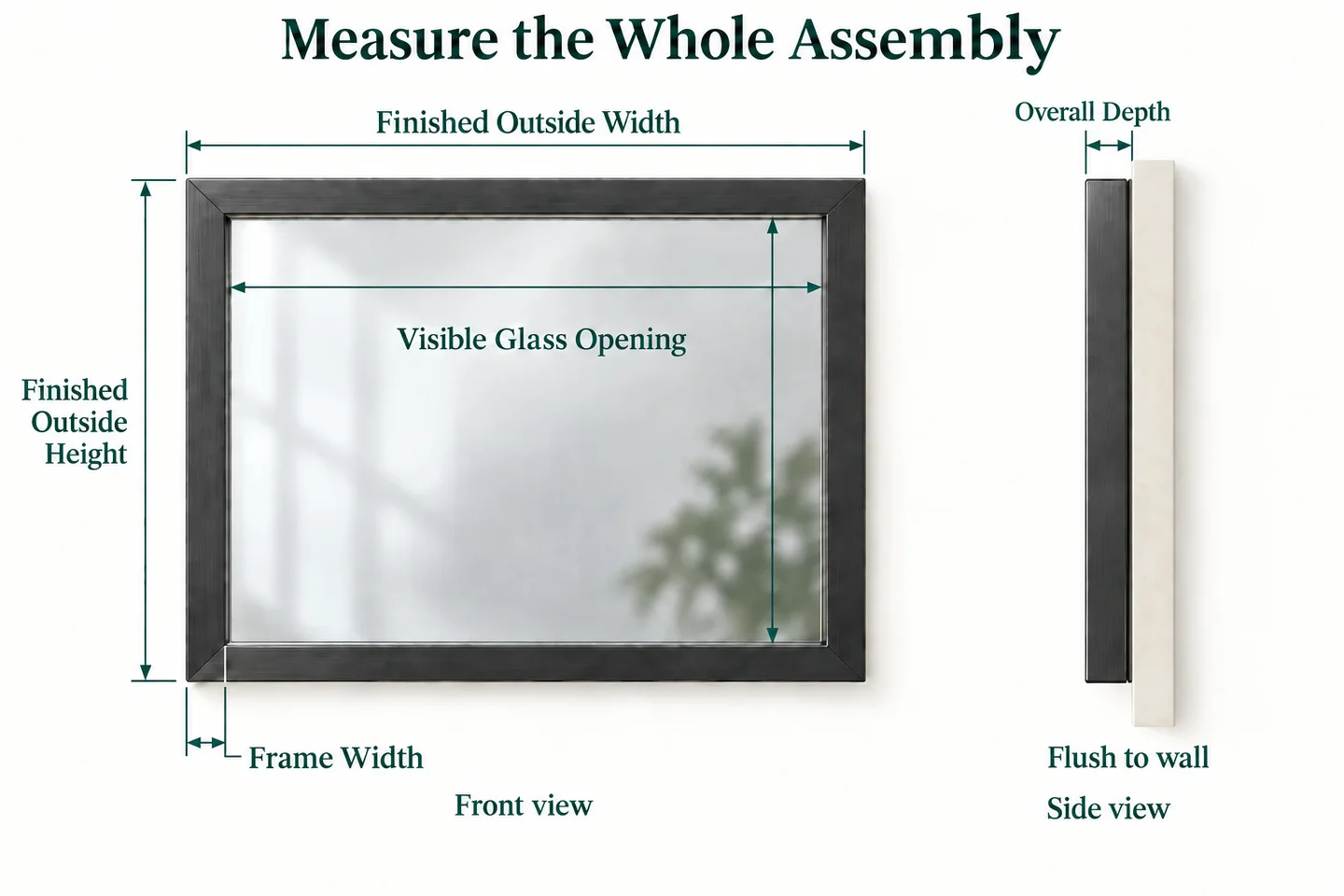
The mounting brackets in the assembly illustration are not a universal installation kit. Follow the actual model drawing. In the flush-to-wall example below, the back of the frame meets the wall; the diagram does not imply exposed spacers behind it.
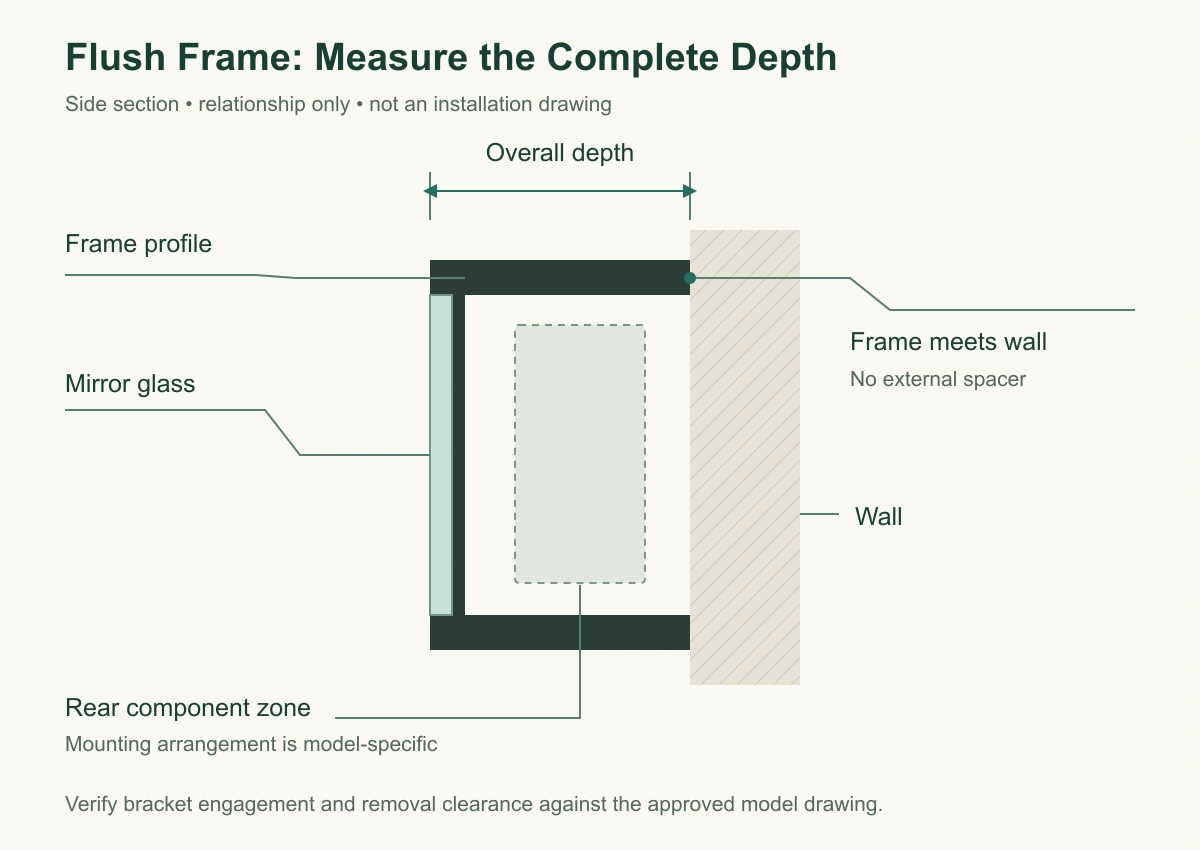
In this section, the rear perimeter of the frame is the wall-contact plane. Rear components occupy the space inside that perimeter; their presence does not automatically create a gap behind the frame. Confirm the actual bracket engagement and release clearance on the selected model's drawing. No fixing pattern or load rating is specified here.
Have a qualified installer assess wall support and removal of heavy or bonded glass. Electrical work must follow the product instructions and applicable local requirements. This comparison is a specification checklist, not a drilling or wiring procedure.
How Does the Frame Affect Mirror Size?
Record finished outside size, visible glass opening, and overall depth separately. Glass size is not always finished size. The frame face visible from the front also need not equal the amount overlapping the raw glass behind it.
A 26-inch mirror over a 30-inch vanity
For a simple flat-border example, assume both mirrors finish at 26 × 36 inches. The framed version has a 1-inch face border on all four sides; the frameless version has no obscured perimeter or illuminated band.
| Measurement | Framed example | Frameless example |
|---|---|---|
| Finished outside size | 26 × 36 in | 26 × 36 in |
| Border per side | 1 in | 0 in |
| Visible glass opening | 24 × 34 in | 26 × 36 in |
| Visible opening area | 816 sq in | 936 sq in |
| Vanity revealed on each side | (30 − 26) ÷ 2 = 2 in | (30 − 26) ÷ 2 = 2 in |
The frameless example exposes 120 square inches more glass—about 14.7% more than the framed opening. This is a calculation example, not a standard size or an OJMirror product specification. A bevel, frosted LED band, different frame profile, or overlap can change the usable flat reflection.
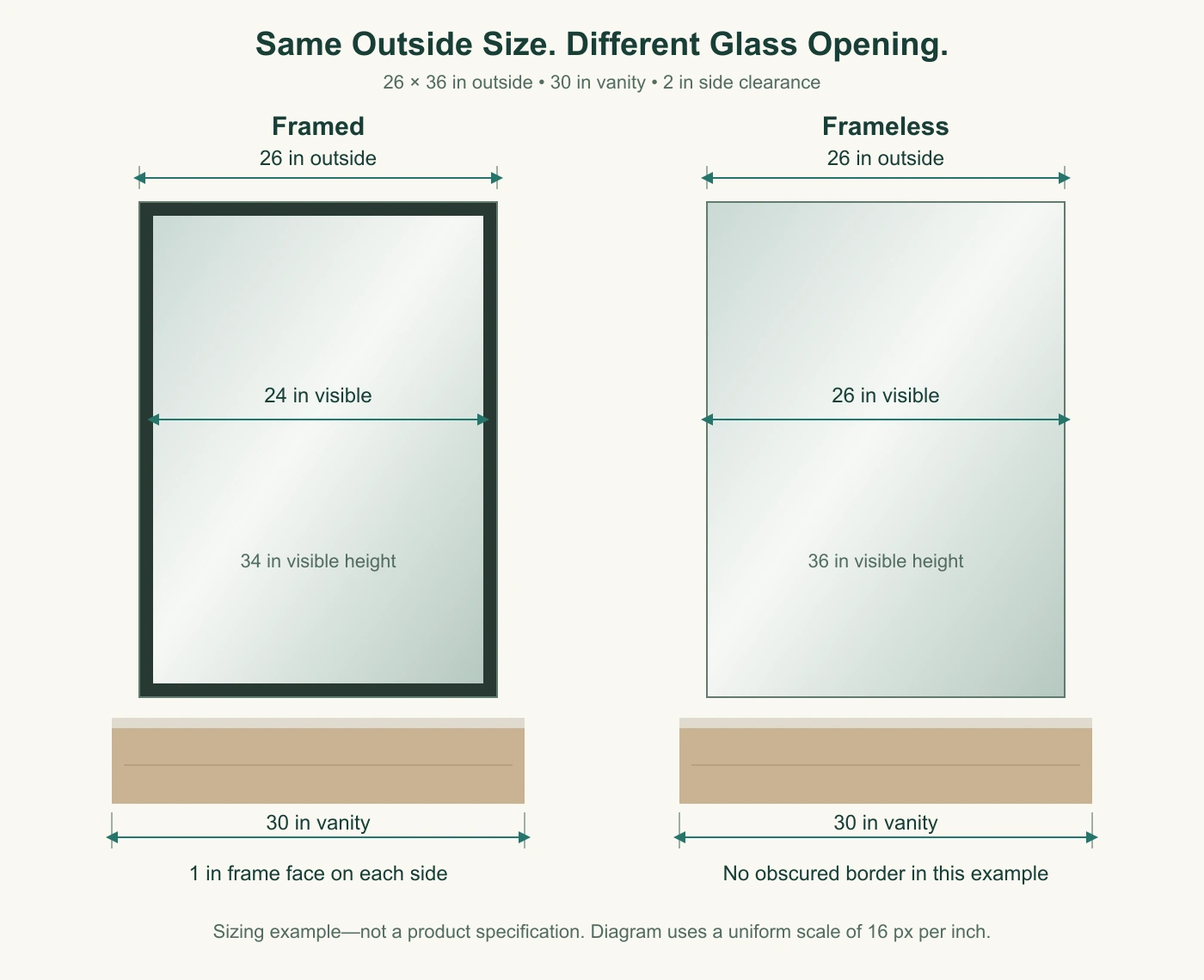
The outside size controls the fit between sconces or walls; the opening controls what remains visible inside it. For detailed clearance planning, continue to the 30-inch vanity mirror size guide or 48-inch vanity mirror size guide.
Use the bathroom mirror size calculator to explore a starting size, then check the actual glass opening, faucet and lighting clearances on your layout.
One large mirror or two?
A broad frameless mirror can create continuous reflection across a double vanity. Two framed mirrors can define separate basins and repeat a finish. Neither is a default rule: check basin centers, sconces, faucet height, wall flatness, handling, and replacement access. One large framed mirror is also an option when its perimeter is an intentional design feature.
Framed vs. Frameless LED Bathroom Mirrors
Framed/frameless describes the visible perimeter. Front-lit/backlit describes where the light emerges. They are separate choices. Availability depends on the model and configuration rather than on the name alone.
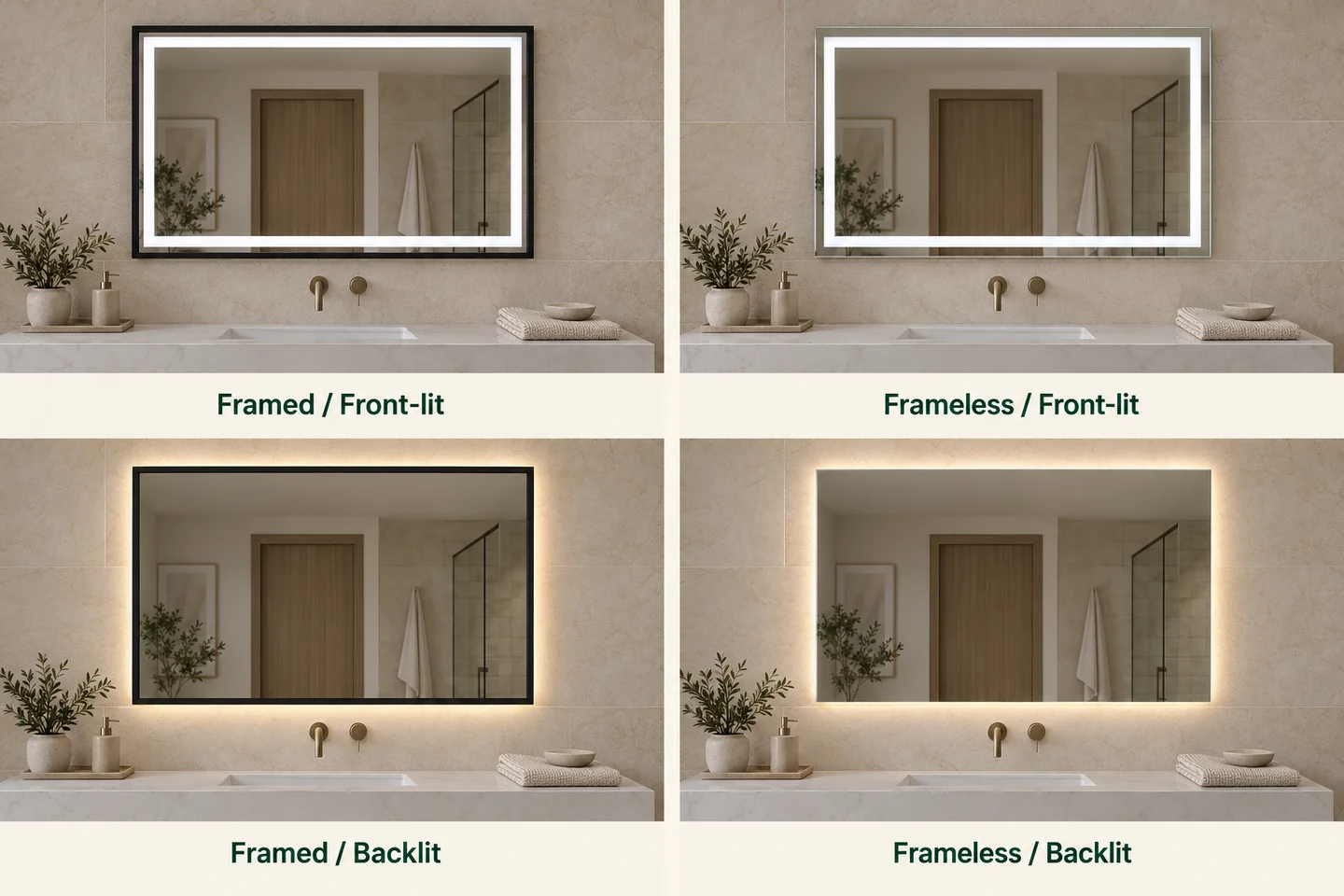
A front-lit design emits light through the front illuminated area; a backlit design casts light behind the mirror. A wall halo is not proof of adequate grooming light. Compare the lighting layout, diffusion, specified output, mounting position, and the room's other lights rather than judging brightness from a photograph.
For either style, confirm the driver and controls, color-temperature requirement, dimming behavior, defogging requirement, power entry, service access, and destination-market electrical documentation. Defogging and dimming are separate configuration items, not benefits automatically included with a frame type.
Which Mirror Fits Your Bathroom or Project?
| Situation | Useful starting direction | Check before choosing |
|---|---|---|
| Small bathroom | Frameless for a quiet outline; a slim frame for deliberate contrast | Outside dimensions, glass opening, surrounding light, and clearance |
| Modern bathroom | Either: exposed glass or a restrained frame profile | Proportion and reflection rather than style labels alone |
| Traditional or finish-led room | Framed when the border ties materials together | Physical finish sample, profile, joints, and cleaning |
| Hotel bathrooms | Either, with a repeatable room specification | Finish consistency, housekeeping, mounting, spare units, and replacement route |
| Apartments or multi-unit developments | Either, using standardized size and installation families | Matched quotations, wall coordination, repeatability, and packing |
| Commercial washrooms | Start with cleaning and service conditions | Exposed corners, fixing security, approved care, and required access |
| Retail or private-label collection | Frames differentiate finishes; frameless designs differentiate shapes and edges | SKU range, approved sample, labeling, packaging, and reorder specification |
A luxurious result does not require a frame, and a minimalist result does not require frameless glass. Material detail, proportion, installation, and the surrounding room determine the effect.
What Should Project Buyers Approve Before Ordering?
Ask for evidence that belongs to the quoted configuration—not a photograph of an unrelated mirror. The most useful manufacturing comparison is between two approved assemblies with the same project brief.
| Approval item | Evidence to request | Decision it supports |
|---|---|---|
| Outside size, opening and depth | Dimensioned drawing linked to the model and revision | Fit on the wall and the amount of visible reflection |
| Frame or exposed edge | Physical finish/edge sample and relevant corner detail | Appearance, joint quality and cleaning access |
| Rear structure and mounting | Rear view, specified hardware, assembly weight and installation instructions | Wall coordination, engagement and future removal |
| Lighting, if specified | Approved configuration and applicable model documentation | Light direction, controls, electrical scope and service access |
| Inspection | Agreed acceptance criteria and records identifying the inspected configuration | What was checked, against which requirement—not a generic quality promise |
| Packing and replacements | Packing specification, identification scheme and agreed spare/reorder requirements | Handling protection and repeat-room replacement |
This is a request checklist, not a claim that the pictured assemblies have passed a particular test. Keep unmeasured weight, unconfirmed thickness and missing test results open until documented. Download the matched-product evidence sheet to record the two model IDs, revisions, measured values and evidence references.
For context on the processes to discuss, see glass and mirror processing and metal and aluminum fabrication. Those capability pages do not replace the selected product's approval documents. For repeated rooms, agree the controlling drawing and sample, change approval process and room labels before ordering.
Which One Should You Choose?
Start with framed when the perimeter is part of the design. Start with frameless when the glass should define the shape and maximize the reflective area. Then compare the mounting, moisture exposure, cleaning, lighting, and quote scope on equal terms.
Request a Custom Mirror Project Review
Planning a hotel, apartment, custom interior, or wholesale collection? Send what you already know; unresolved choices can be identified during the review.
- Mirror dimensions or a wall/vanity drawing
- Quantity and project type
- Framed or frameless preference, with finish or edge reference
- LED and defogging requirements, if any
- Mounting condition and destination market
Ask OJMirror to review feasible construction directions and identify the information needed for a matched quotation. Confirm the final configuration, electrical requirements, packing, and delivery scope before approval.
Frequently Asked Questions
Are frameless bathroom mirrors outdated?
No frame style has an automatic expiry date. Choose by proportion, edge detail, lighting and the surrounding materials. Frameless glass can give a room a quiet outline; a frame can add a deliberate finish or contrast. Neither choice needs to imitate a trend to work.
Can you add a frame to an existing frameless bathroom mirror?
Sometimes, but first check the existing clips, edge condition, wall clearance and attachment method. The added frame must be compatible with the existing assembly and must not obstruct controls, illuminated areas or removal access. Do not use a decorative border to conceal loose glass or unresolved edge deterioration.
Should the mirror frame match the faucet?
It can coordinate without being identical. Compare undertone, texture and sheen with the faucet, lights and cabinet hardware; the same finish name can look different across samples. If using contrast, repeat that finish elsewhere deliberately rather than relying on a screen image to establish a match.
Do frameless mirrors make a small bathroom look bigger?
They can make the wall look less interrupted and expose more glass within the same outside dimensions. They do not create physical space. Mirror proportion, reflected clutter, lighting, and the vanity layout matter too; a narrow framed mirror can still work well in a small room.
Do framed bathroom mirrors last longer?
Not automatically. A frame may shield edges, but long-term performance also depends on backing, joints, fixings, finish, care, and moisture exposure. Compare complete product specifications and maintenance conditions rather than assigning a lifespan to either style.
Are frameless bathroom mirrors cheaper?
A simple non-lighted rectangle may be economical, while a large beveled or illuminated assembly may not be. Match outside size, glass and backing, lighting, mounting, packing, quantity, and delivery scope before comparing framed and frameless quotes.
Do framed bathroom mirrors rust in humid bathrooms?
Steel components can rust if protection is inadequate or damaged. Aluminum does not develop iron rust, but it can corrode; stainless steel also needs a suitable grade and care method. Review the complete frame and fastening system, not just the visible finish color.
Can I replace a framed mirror with a frameless mirror?
Often, but check the wall area the old frame concealed, the new fixing layout, assembly dimensions, and any electrical connection. A different outline can reveal unfinished wall or old holes. Have bonded or heavy glass assessed before removal.
Can either style include LED lighting and defogging?
Yes, depending on the selected model. Frame style does not define light direction, controls, defogging coverage, or electrical suitability. Specify those items separately and review the approved configuration rather than assuming every option is included.
Which type is better for hotels and commercial bathrooms?
Choose the construction that meets the room design, cleaning routine, installation conditions, and replacement plan. Consistent dimensions, approved finishes or edges, reliable mounting information, and a repeatable order specification matter more than a universal framed-versus-frameless preference.
Comparison Method and Scope
This guide separates visible frame style from rear construction, lighting and installation. The dimensional comparison holds outside size constant and calculates the uncovered opening from the stated border width; the cost comparison holds scope constant rather than presenting unmatched retail and export prices as equivalent.
The sizing example and section drawing explain relationships, not a supplied model's dimensions or an approved installation detail. Product-specific decisions should use the selected model's approved drawing, finish sample and installation instructions. This page does not report comparative laboratory testing or a measured product lifespan.
