
Table of Contents
OJMirror product note: Our mirrors have white safety film applied to the back as standard. The film material, thickness, coverage around components and any test classification must be confirmed for the selected mirror construction. This statement does not establish an ANSI, CPSC or EN rating.
What is mirror safety backing?
Safety backing sits behind the mirror and is intended to support fragment retention after breakage. A mirror may still crack when struck, handled incorrectly or stressed by its mounting. The relevant question is what happens to the broken glass and whether the specified construction meets the project’s requirements.
“Backing” can describe several different things in a quotation. Define the term before comparing suppliers:
| Rear component | Main purpose | What to confirm |
|---|---|---|
| Permanent safety film | Help retain fragments after breakage | Film identity, coverage and applicable assembly test evidence |
| Reflective coating and protective paint | Produce and protect the mirror surface | Coating system and compatibility with materials touching it |
| Structural board, frame or backplate | Support hardware or form part of the mounting assembly | Load path, attachment method and installation instructions |
| Temporary protective film | Protect a surface during processing or transport | Whether it must be removed; do not substitute it for safety backing |
A rear safety film is not necessarily a waterproofing layer, a mounting adhesive or a structural support. These functions need separate confirmation. A label such as “shatterproof” is too broad unless the supplier defines exactly what it means and provides evidence for that claim.
How does mirror safety backing film work?
A conventional mirror combines glass with reflective and protective coatings on its rear. The safety film is a separate layer behind those coatings. Its intended role is to help retain fragments after breakage; it does not turn protective paint into a structural support or prevent the glass from cracking.
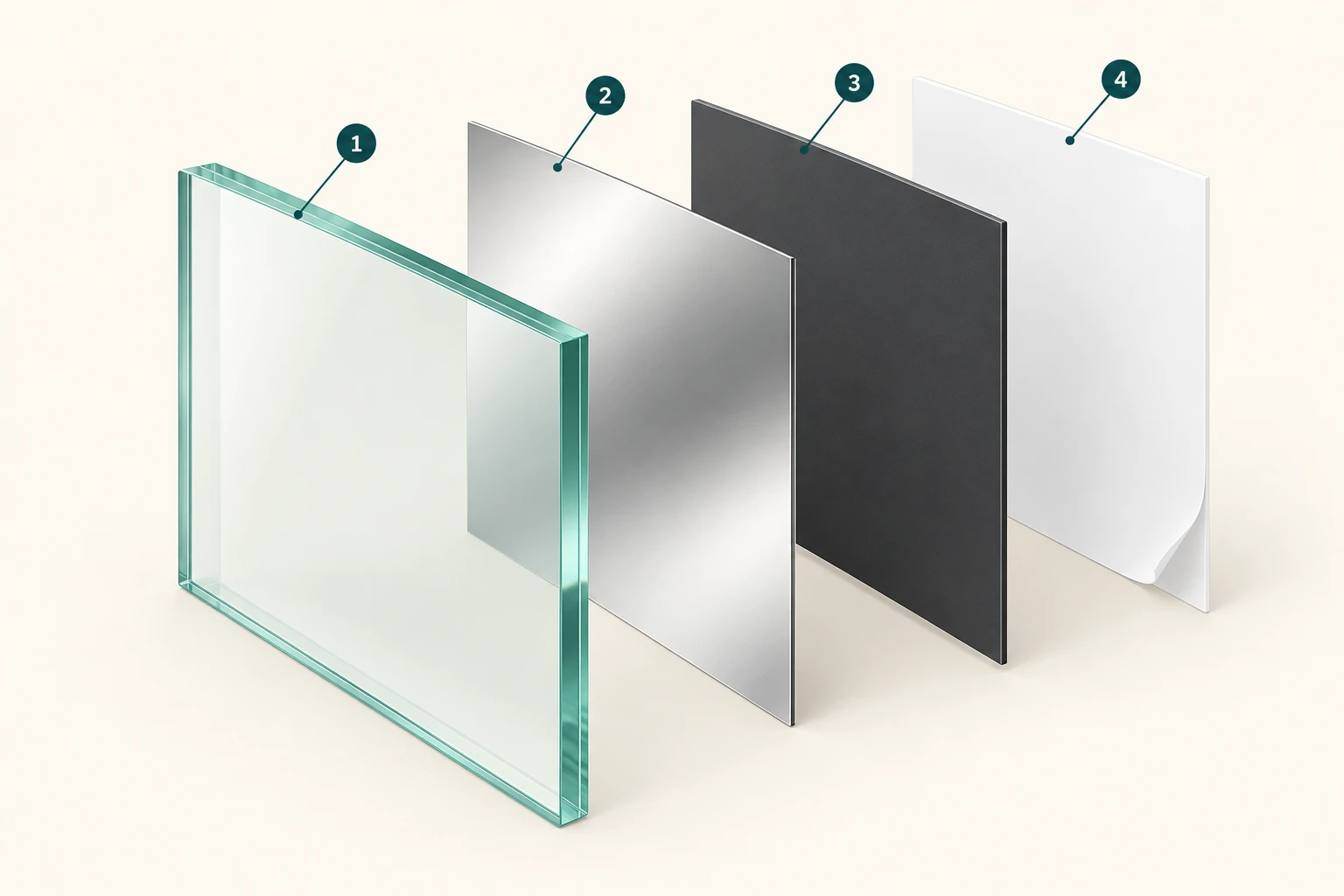
The effectiveness of a backing system depends on the supplied construction and adhesion, including the condition of the mirror coatings beneath the film. Keep the approved layer system intact during installation. If a bracket, demister pad or adhesive needs a particular contact surface, resolve that interface on the rear drawing before production.
Safety-backed, tempered and laminated mirrors: what changes?
These terms describe different constructions. They should not be used interchangeably in a purchase order, and some specified assemblies may combine more than one approach.
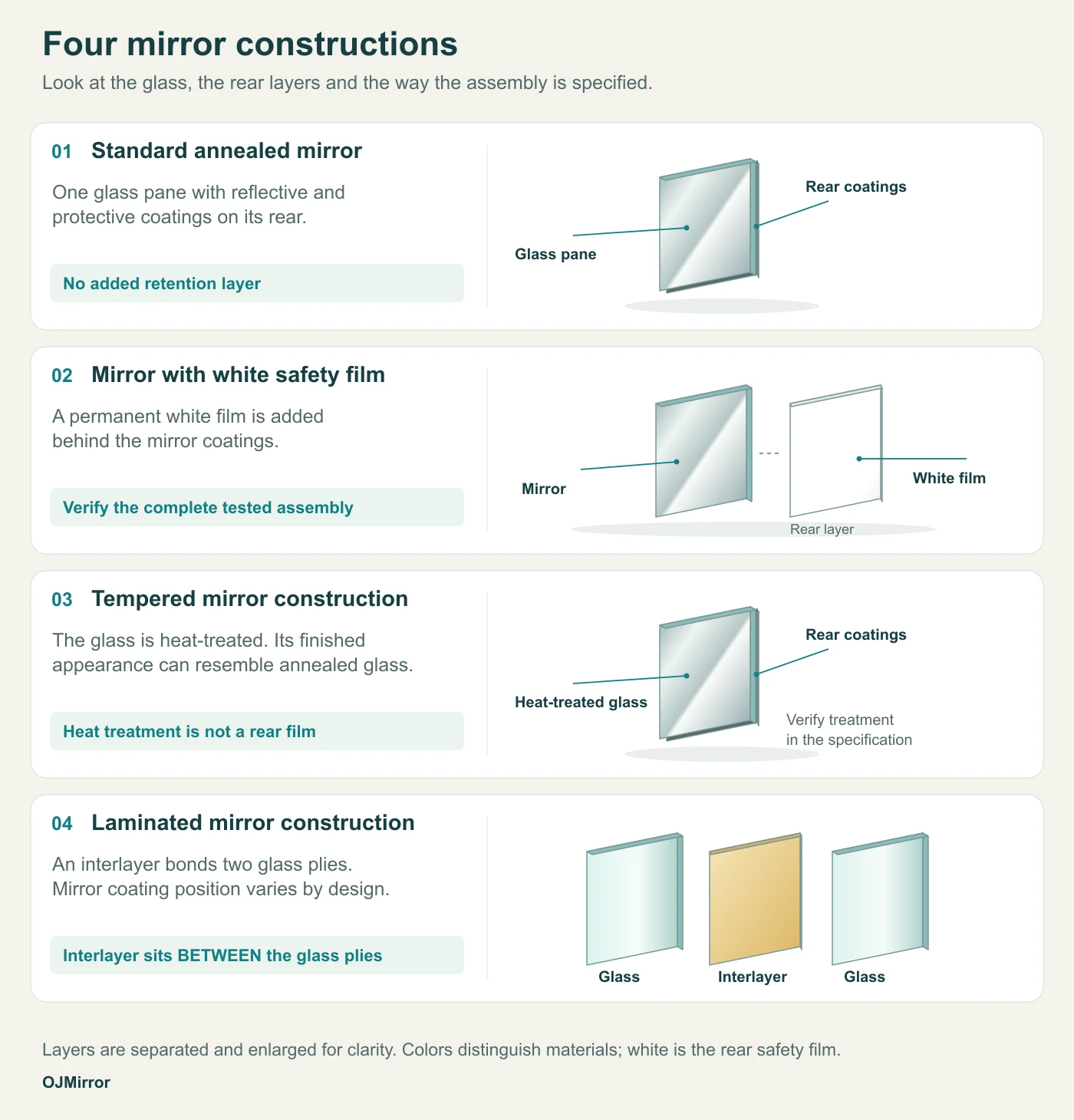
| Construction | Defining feature | Purchasing implication |
|---|---|---|
| Standard annealed mirror without added safety backing | Conventional glass and mirror coatings | Do not assume fragment retention or a safety-glazing rating |
| Mirror with rear safety film | A permanent film is added behind the mirror | Match the film, glass and assembly to the supporting evidence |
| Tempered mirror construction | Glass is heat-treated | Confirm that the specified glass and mirror-processing route are available and appropriate |
| Laminated mirror construction | Glass plies are bonded through an interlayer | Review the complete stack, edges, mounting and tested configuration |
Tempered glass has a different breakage pattern from annealed glass: it tends to break into small fragments. That behavior does not by itself keep the fragments attached to the wall. A backing film and a laminated interlayer address retention through different constructions. Selection should follow the project specification and installation conditions rather than a universal “best” label. See Pilkington’s description of toughened safety glass.
Do not infer that OJMirror offers every construction in this comparison. Request confirmation of the proposed model before using a particular stack in drawings or tender documents.
Types of mirror safety backing materials
White is the confirmed color of OJMirror’s rear film. Color alone does not identify the polymer, adhesive formulation, thickness or impact classification. A white film from one supplier is not necessarily equivalent to another.
| Material description in a quotation | What it tells you | What still needs verification |
|---|---|---|
| PET / polyester backing | Identifies a polymer family | Exact film product, adhesive system, intended use and supporting report |
| PE / polyethylene backing | Identifies a different polymer family | Permanent safety-backing designation and the complete product specification |
| Reinforced or composite backing | Describes a multi-component construction | Actual layers, reinforcement and approved mounting interface |
| White safety film | Describes appearance and intended function | Polymer, product code, thickness and evidence for the finished mirror |
| Temporary protection film | Describes removable process/transport protection | It must not be substituted for a permanent safety-backing system |
A named manufacturer example helps explain the distinction: AGC identifies its SAFE+ backing as PET in its Mirox installation guide. That identifies AGC’s specified system; it does not identify OJMirror’s white film. Ask for the material reference in the proposed bill of materials before completing a submittal.
Safety ratings: ANSI Z97.1, CPSC categories and EN 12600
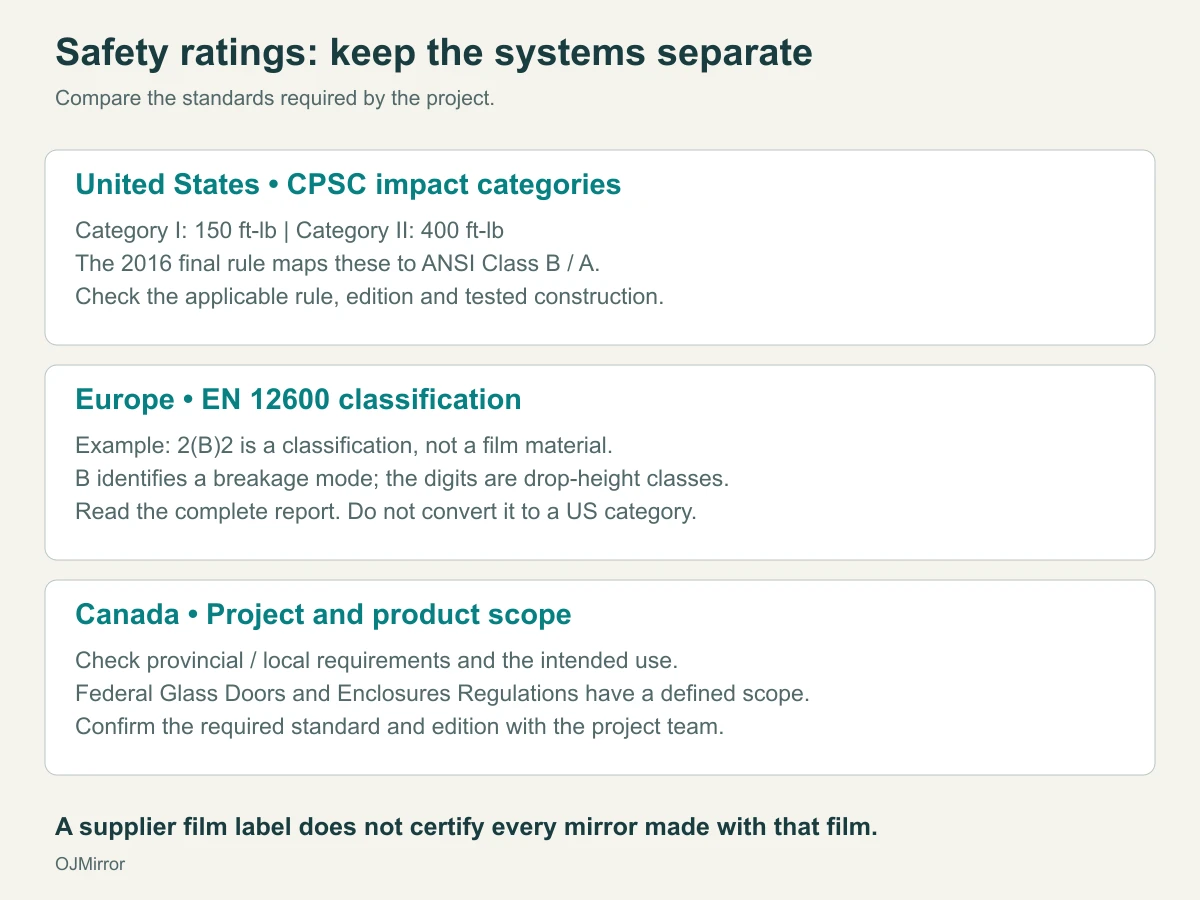
A rating is meaningful only when the standard, edition, classification and tested construction are identifiable. A film brochure is useful evidence about that film product; it does not automatically establish the rating of every finished mirror using it.
| Reference | What it addresses | Buyer’s check |
|---|---|---|
| ANSI Z97.1 | Safety-glazing performance and test methods | Standard edition, class and covered construction |
| 16 CFR Part 1201 | US requirements for specified architectural glazing products | Product scope, exceptions and incorporated test edition |
| EN 12600 | Pendulum impact testing and breakage classification | Complete classification and matching test report |
| Project specification | Requirements for the particular building and use | Location, acceptance authority and required documents |
CAT I vs CAT II: what buyers need to verify
The CPSC’s 2016 final rule describes Category I at 150 foot-pounds and Category II at 400 foot-pounds. It maps these to ANSI Class B and Class A respectively and incorporates ANSI Z97.1–2015 test procedures. Its stated product scope includes doors and bathtub/shower enclosures; it should not be read as a blanket rule covering every bathroom wall mirror. For a current project, verify the applicable regulation, local code and required edition. See the official 2016 final rule.
The ANSI catalogue now lists ANSI Z97.1–2026. A newly published standard does not automatically replace the edition incorporated into a regulation or written into a contract. ANSI’s public abstract also distinguishes a test standard from advice about where a particular type of safety glazing must be installed.
For procurement, ask: “Which standard and edition were used, what classification was achieved, and does the report cover this glass/film construction?” Avoid a bare requirement such as “CAT II film” without the supporting assembly details.
Europe: read the full EN 12600 classification
An EN 12600 notation such as 2(B)2 contains drop-height-based classes and a breakage-mode letter. It is not a material name or a direct conversion to a US category. Review the complete report and the specified application instead of reducing the designation to a single number.
For example, Pilkington Optimirror Protect is publicly described by its manufacturer with a 2(B)2 classification. That is evidence for the named manufacturer’s product, not evidence for OJMirror mirrors or for a different film. The Pilkington technical guide provides additional classification context.
Canada: identify the applicable product and jurisdiction
Canada’s Glass Doors and Enclosures Regulations have a defined scope and reference a specified edition of CAN/CGSB safety-glazing requirements. Do not extend a rule for doors and enclosures to all wall mirrors without checking the installation. Ask the project specifier to confirm the applicable provincial/local requirements, product scope and required edition.
For all destinations, the acceptance decision needs the relevant project documentation. This guide does not assign a compliance rating to an OJMirror product.
Match the backing to the application
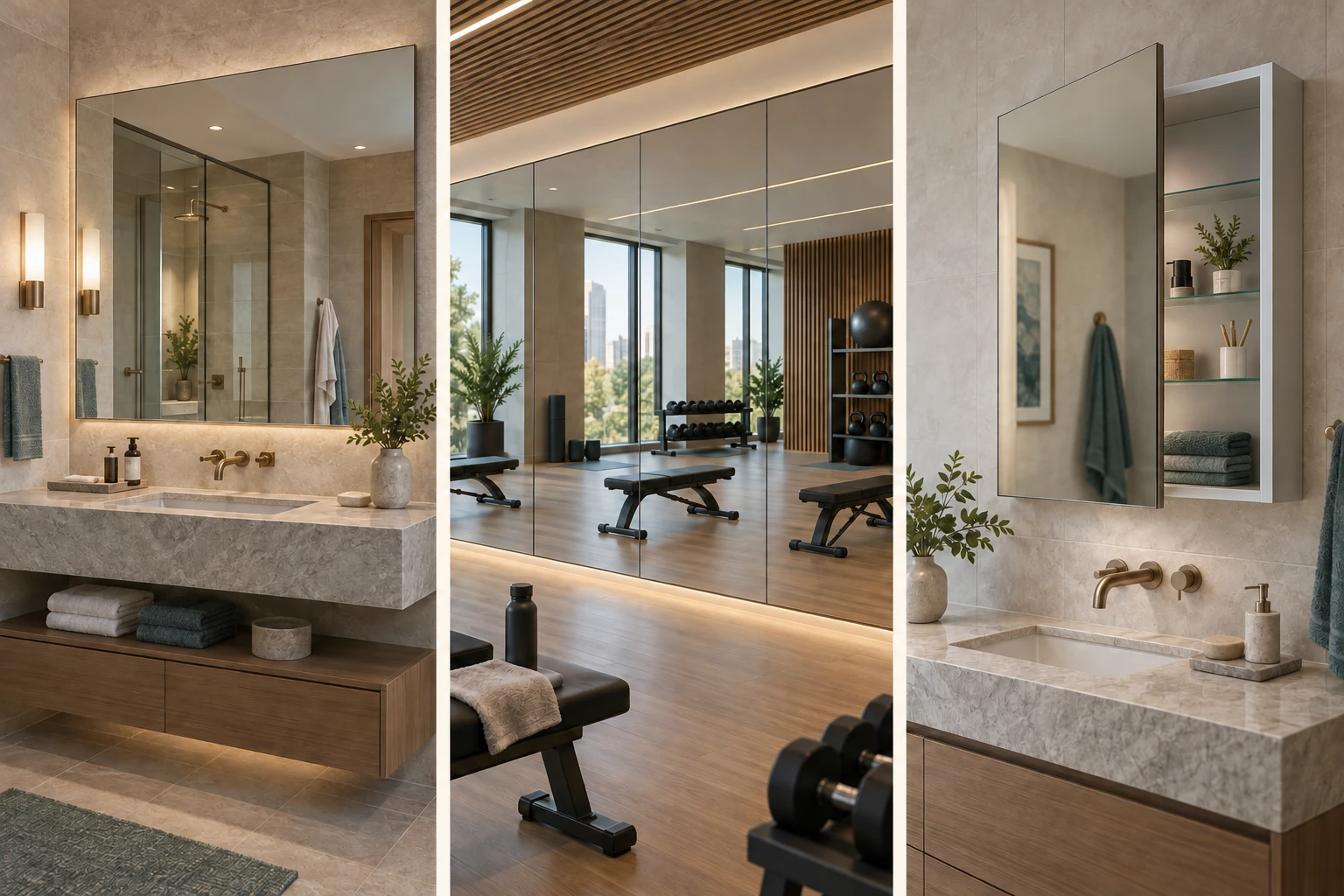
The same keyword can lead to very different purchase requirements. A fixed vanity mirror, a gym wall and a moving cabinet door have different mounting and use conditions.
| Application | Review before specifying | Evidence to request |
|---|---|---|
| Hotel bathroom or vanity | Mirror dimensions, wet-area exposure, edges and wall attachment | Rear view, mounting instructions and project-required test evidence |
| Gym or fitness studio | Panel layout, accessible edges, impact exposure, joints and restraint | Installation layout and evidence for the selected construction |
| Retail fitting room or full-length mirror | Low-level contact, public access and fixing details | Full assembly drawing, hardware details and inspection criteria |
| School | Occupant activity, accessible locations and potential contact | Written project safety requirements and traceable documentation |
| Healthcare facility | Intended users, maintenance and access requirements | Specified construction and the facility’s acceptance requirements |
| Commercial restroom | Frequent cleaning, public contact and accidental damage | Mounting details, edge condition and agreed inspection criteria |
| Wardrobe or other moving door | Door movement, edge restraint and applicable door requirements | Door assembly specification and relevant test documentation |
| LED mirror | Film relationship to lighting areas, brackets, pads and electrical components | Model-specific rear drawing and separate electrical documentation |
| Mirrored cabinet door | Door substrate, hinges, glass attachment and movement | Door construction and hardware assembly details |
For OJMirror enquiries, start with the relevant bathroom mirrors, frameless mirrors or gym mirrors category, then specify the installation and evidence needed. A category page alone is not a project approval.
What to put in a mirror safety-backing specification
A useful specification turns “with safety film” into a construction that can be checked at sample approval and reproduced in production. Keep confirmed product facts separate from requirements that still need agreement.
| Specification item | OJMirror position / confirmation needed |
|---|---|
| Rear safety film present | Standard feature; white film, confirmed by OJMirror |
| Film manufacturer, product code and polymer | Confirm for the selected construction; do not assume PET or PE |
| Film thickness and tolerance | Confirm from the actual material specification |
| Glass type and thickness | Confirm against the selected model and approved drawing |
| Rear coverage and exclusions | Define in a rear drawing, including edges and component zones |
| Reflective coating / protective paint | Confirm compatibility with film and mounting materials |
| Test standard, edition and classification | Request documents matching the proposed assembly; no rating assigned here |
| Mounting adhesive and mechanical support | Agree the named products, load path and installation method |
| Material and production traceability | Agree the records supplied with sample and batch inspection |
| Change control | Require approval before substituting glass, film or mounting materials |
Published film products differ. For instance, Novacel describes dedicated permanent mirror-backing films and a manufacturing application process; this is a reason to identify the actual material rather than infer it from appearance. See Novacel’s mirror-backing overview. Its products and claims must not be attributed to OJMirror without confirmation.
A practical drawing note is:
Rear safety film required. Supplier to identify the proposed glass/film construction, show rear coverage and exclusions, and submit the project-required test documentation for review. Mounting materials and any substitutions require written approval before production.
Add the required standard and classification only after the project team establishes them. Avoid copying a competitor’s certificate designation into an OJMirror drawing.
Can safety-backed mirrors be installed with mirror mastic?
Only when the exact backing, adhesive and installation system are compatible. A product marketed as mirror mastic may have different substrate requirements from another mirror adhesive. Check the actual product data sheet and the backing supplier’s instructions before specifying direct bonding.
| Mounting method | Interface that needs review |
|---|---|
| Mirror mastic or other adhesive | Mirror coating, film adhesion, adhesive-to-film bond and wall substrate |
| Mechanical clips | Glass support, edge protection, restraint and wall anchors |
| Mounting rails | Rail-to-frame/backplate connection and anchorage to the wall structure |
| Adhesive with mechanical support | Both the bonding system and the mechanical load path |
| LED mirror brackets | Bracket attachment, chassis, backing coverage and component clearances |
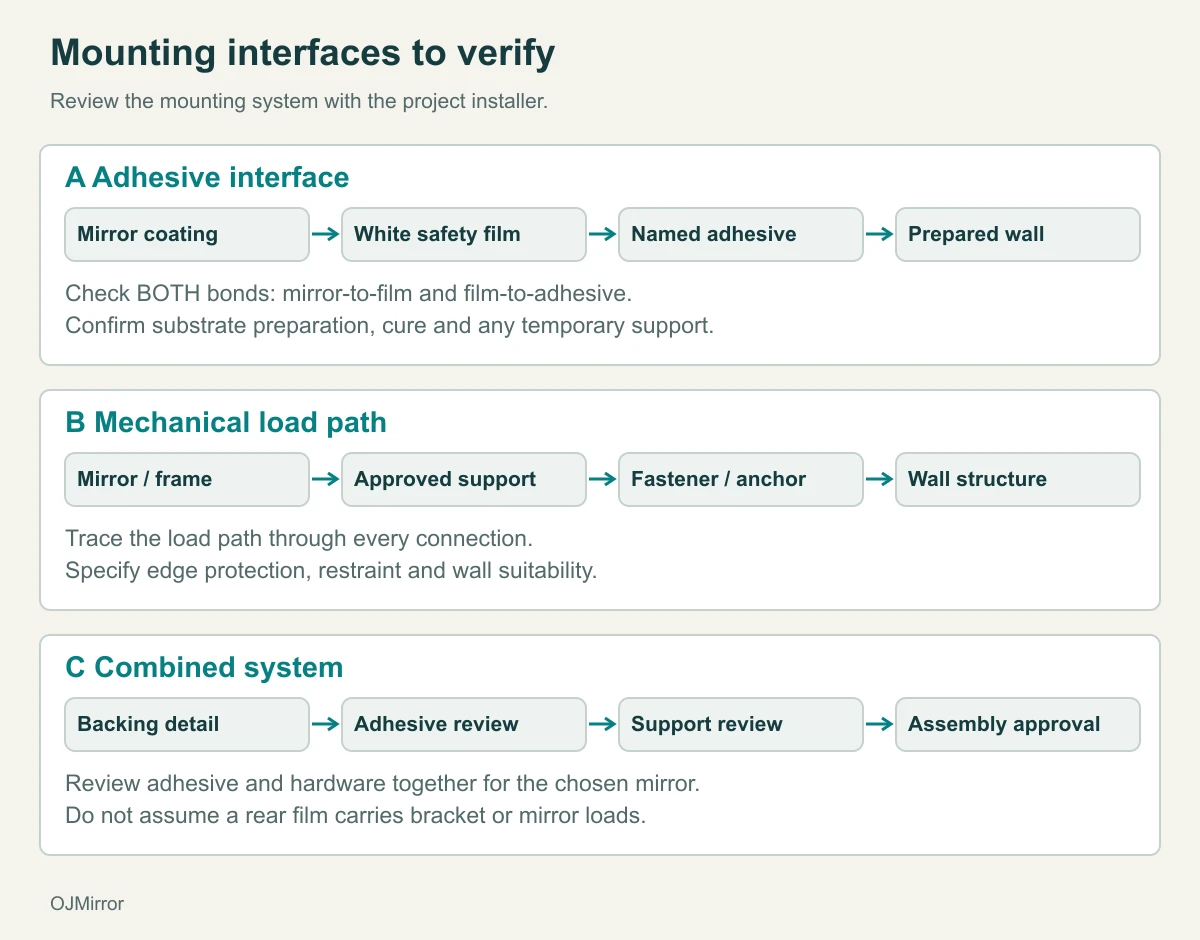
Mounting compatibility is a separate decision. If adhesive contacts film rather than the mirror’s rear paint, both the adhesive/film bond and the film/mirror bond become relevant. “Suitable for mirrors” does not necessarily establish suitability for every backing film.
For example, the Sikaflex-124 product data sheet discusses compatibility with most Category II safety films and calls for tests with actual substrates and conditions. It is a product-specific statement, not approval for an unidentified OJMirror film. Use the current instructions for the exact adhesive and film combination.
Where LED components, demister pads or brackets share the rear surface, confirm the arrangement on the selected model’s drawing. Do not cut away backing or move hardware on site without an approved method. Rear film is not a substitute for correctly designed mechanical support.
Factory application and quality inspection
Factory application allows the backing to be incorporated into the defined mirror construction before brackets and other rear components obstruct access. The process still needs material identification, appropriate surface preparation and inspection. Presence of film alone does not demonstrate good adhesion or adequate coverage.
For an existing mirror, determine whether the rear can be accessed safely, which coatings and adhesives are already present, and whether the proposed retrofit system is suitable. An installer should review removal, handling, reinstallation and the evidence required for the modified assembly. Do not assume that applying a generic film to an installed mirror produces the same result as a tested factory construction.
OJMirror’s quality testing page describes checking film identity, coverage, positioning, bubbles and lifting against the specification. Use that inspection scope to request records for the mirror you are ordering. The glass and mirror processing page provides related fabrication context; neither page replaces a product-specific test report.
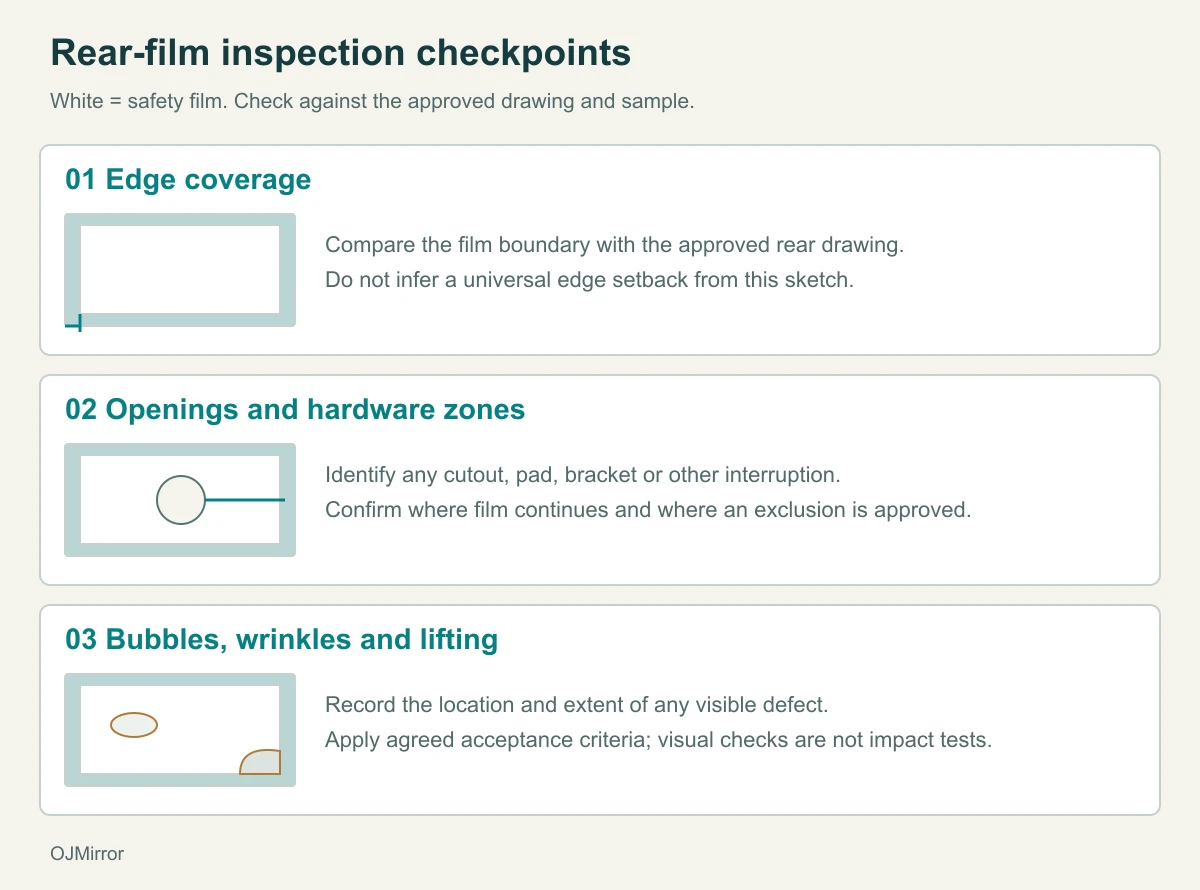
For a production review, agree the material reference and rear coverage drawing first. Then request records of surface preparation, film application and inspection appropriate to that material. Review edge boundaries, approved openings and the areas around rear components before the mirror is packed. Any disputed appearance should be compared with an agreed sample and acceptance criteria, not a generic online photograph.
Evidence to attach to the selected model
| Evidence | What should be identifiable |
|---|---|
| Full rear photograph | Mirror model, drawing revision and overall film coverage |
| Edge and opening close-ups | Relevant locations and approved coverage boundaries |
| Application or inspection record | Actual product/batch, date and inspection result |
| Film material record | Supplier/product reference and specified properties |
| Applicable test document | Tested assembly, standard edition, classification and limitations |
These are requested submittal items. This article does not publish a verified factory photo series or an OJMirror impact-test report. The current confirmed product facts are the presence of rear safety film and its white color.
Sample approval and batch inspection
Approve a representative construction before ordering a repeat batch. A front photograph cannot establish what is on the rear, and a rear photograph cannot establish an impact classification.
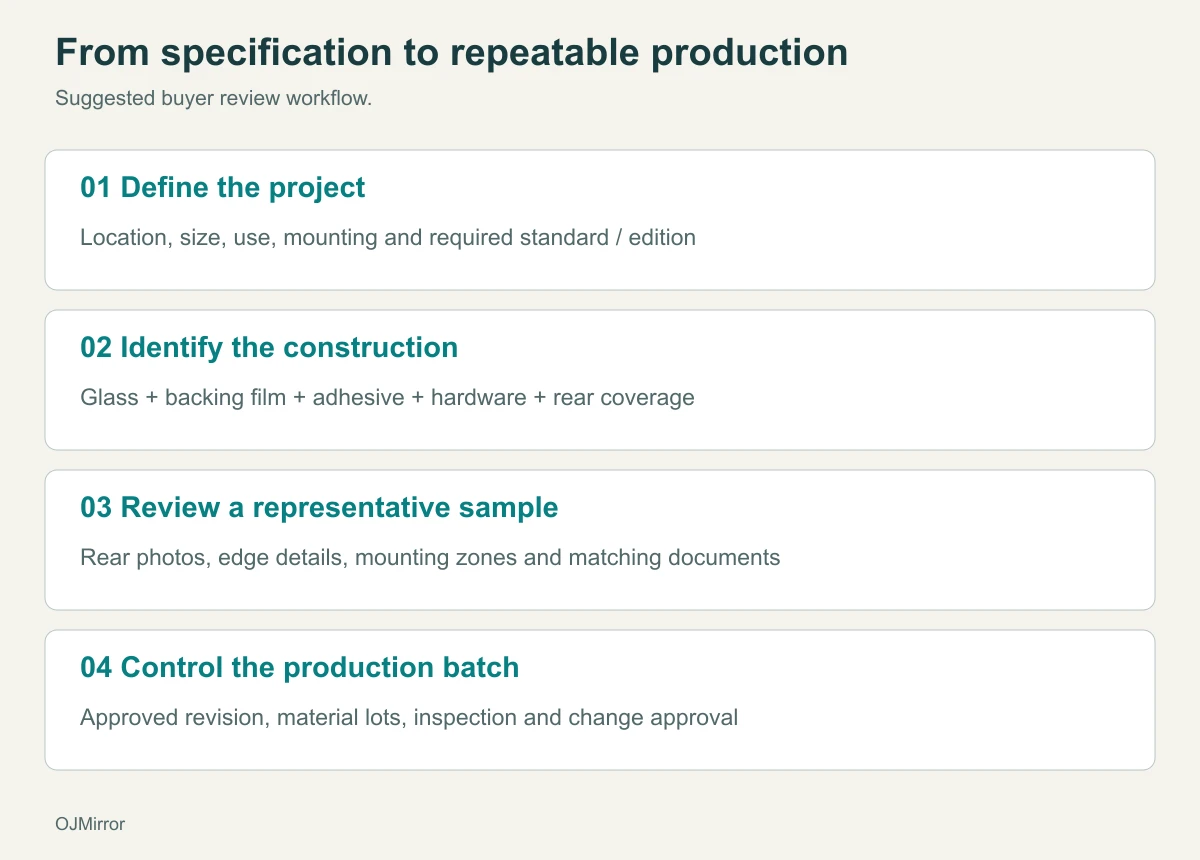
Request a sample package containing:
- The approved drawing revision: overall dimensions, glass thickness, rear components and mounting details.
- Clear rear photographs: a full rear view plus edge, bracket, pad and other relevant close-ups.
- Material identification: the actual film designation and the agreed glass construction.
- Applicable test documents: the report or certification requested by the project, including the tested construction and any limitations.
- Inspection criteria: agreed checks for lifting, bubbles, damage, coverage and identification, with acceptance limits written into the inspection plan.
- Change-control records: how material or construction substitutions will be reviewed before shipment.
During batch inspection, compare the mirror to the approved sample and drawing. Record the relevant lot information and any deviations. Packaging and handling should also be reviewed: backing does not prevent all transit damage, and a damaged mirror needs assessment rather than an assumption that the film makes it usable.
If an impact test is required, use the specified laboratory or approved testing arrangement. An informal breakage video is not a substitute for a report under the required standard. The construction in the report must be traceable to what is supplied.
What documents should buyers request?
Organize the submittal by document purpose so a drawing, photograph and test report are not treated as interchangeable evidence.
| Document | Question it should resolve |
|---|---|
| Project requirement / mirror schedule | What must be supplied, where will it be used, and who accepts it? |
| Proposed construction drawing and material schedule | What glass, film, rear components and mounting interface are proposed? |
| Sample photographs and inspection record | Does the sample match the agreed appearance and construction? |
| Applicable performance documents | Does the evidence cover the requested standard and supplied construction? |
| Installation instructions | How will this assembly be supported on the actual wall? |
| Batch identification and approved deviations | Is the delivered product consistent with the approved version? |
Commercial Mirror Safety Backing RFQ Checklist
Download the editable RFQ checklist, fill in the available details, and paste it into the project enquiry or send it with your drawing reference. Leave an unknown requirement as “to be confirmed”; do not select a test class simply because another project used it.
- Company, contact name and business email
- Destination country, project application and mirror schedule reference
- Width × height, units, quantity and glass construction if specified
- Required standard, edition and classification, or the project specification file
- Proposed mounting method, wall substrate and relevant rear components
- Drawing link/revision, sample evidence and documents needed for review
Request a custom safety-backed mirror review
Send OJMirror the mirror dimensions, quantity, destination, application and mounting arrangement. Include the project’s safety-glazing specification or test requirement if one has been issued. For LED mirrors and cabinets, include the required functions and door or rear-component arrangement.
A useful enquiry separates three points: what is required by the project, what construction is proposed, and which documents are available for review. This makes missing evidence visible before the sample or purchase order is approved.
Request a commercial mirror review. You can attach one PDF or image in the enquiry form. For CAD or additional files, include a drawing link or use the contact page to agree the transfer method.
Prepared by OJMirror. Updated October 13, 2026. Sources linked above explain general standards and manufacturer-specific examples; they are not OJMirror test reports. Model-specific rear photographs and material/test documents should be requested for the proposed order.
Frequently asked questions
Does safety backing make a mirror unbreakable?
No. It is intended to help retain fragments if glass breaks. It does not prevent every crack, impact failure or handling accident, and it does not replace appropriate mounting.
Do OJMirror mirrors include rear safety film?
Yes. OJMirror has confirmed that its mirrors have white safety film on the back as standard. Film identity, thickness, coverage and test evidence still need confirmation for the selected construction.
Is safety backing the same as tempered glass?
No. Rear film is an added layer; tempering is a glass heat-treatment process. They address different aspects of breakage behavior. Specify the required construction and evidence rather than treating the terms as equivalents.
Is a safety-backed mirror the same as laminated glass?
No. A rear film is behind the mirror, while laminated construction uses an interlayer between glass plies. The complete stack and its applicable test evidence determine whether it fits the project.
What is the difference between Category I and Category II?
The CPSC 2016 final rule describes 150 foot-pounds for Category I and 400 foot-pounds for Category II. These are test categories, not film polymers or thicknesses. Confirm the applicable rule and a report covering the proposed construction.
Does EN 12600 2(B)2 mean the same as Category II?
Do not treat them as interchangeable. They belong to different systems. Review the standard, complete classification, tested construction and project acceptance requirements separately.
Is safety backing required for every gym mirror?
The answer depends on the location, installation and applicable requirements. Obtain the project’s written specification and confirm it with the responsible specifier or local authority. A general article cannot approve an individual gym installation.
Can safety film be added to an existing mirror?
A retrofit may be possible with a suitable system, but rear access, existing materials, installation and supporting evidence require review. Adding an unidentified film does not automatically create a rated assembly.
Can mirror adhesive be applied directly to safety film?
Only where the named adhesive and backing system are compatible and the installation method is approved. Review the actual substrates, preparation, curing and support requirements; do not assume all mirror adhesives work with all films.
What documents should a buyer request?
Request a model-specific drawing, rear photographs, film identification, installation instructions, the project-required test evidence and an agreed inspection/change-control plan. Match every document to the construction being ordered.
