
On this page
Quick Answer: Which LED Mirror Color Temperature Is Best?
- Warm bathroom or evening preference: start with 3000K.
- Everyday grooming or a shared bathroom: start with 4000K.
- A cooler appearance: compare 5000K with 6000K before deciding.
- Different preferences or routines: consider adjustable CCT and confirm its actual settings.
These are starting points for comparison, not universal lighting requirements.
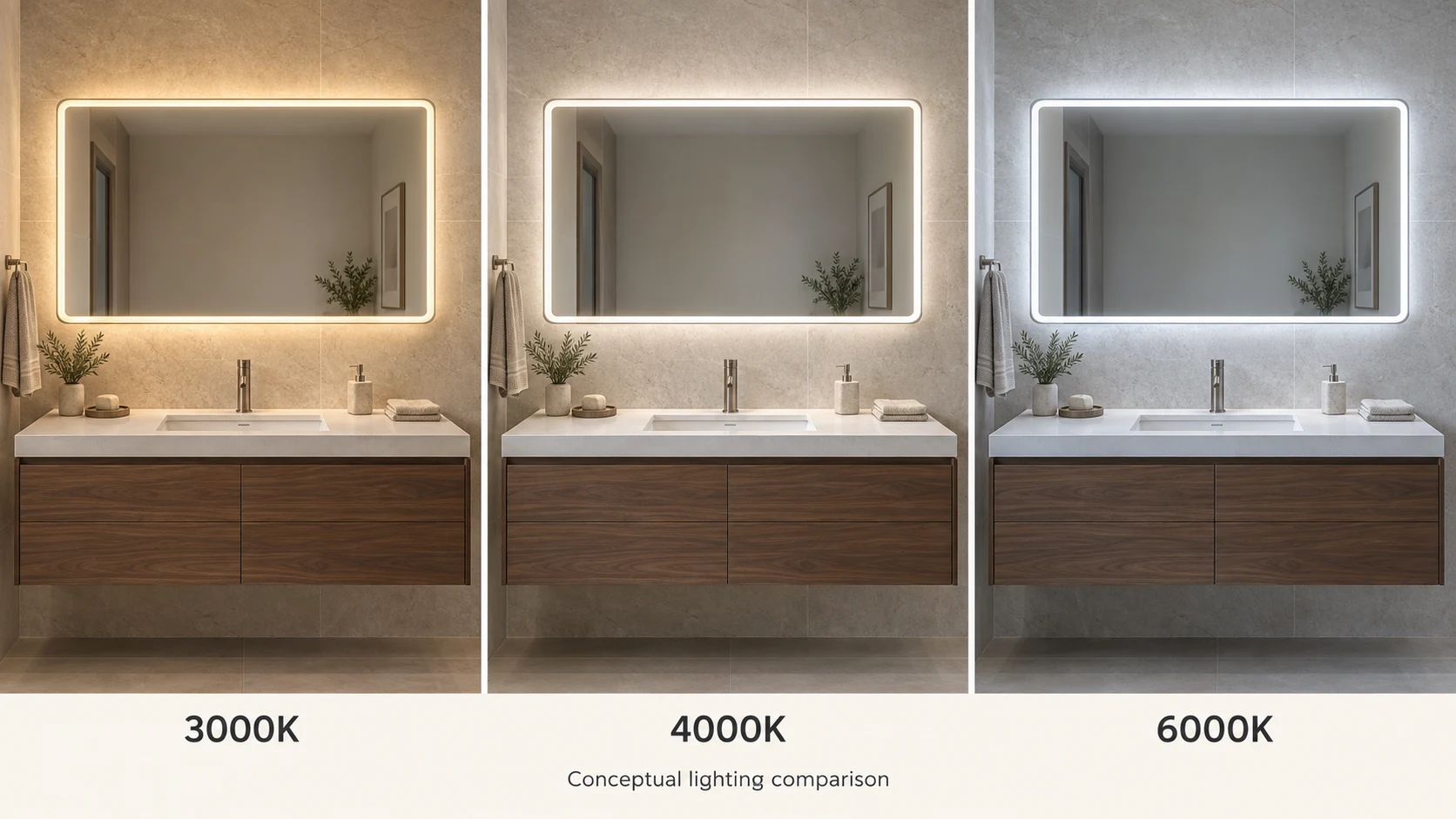 View full-size image ↗
Warm-to-cool appearance illustration. Screen colors are not calibrated CCT samples; no specific product is depicted.
Best LED Mirror Color Temperature by Bathroom Use
Use these starting points to narrow your sample selection. They are design suggestions, not lighting standards or a statement of available OJMirror configurations.
| Bathroom use | First setting to compare | What makes the choice work |
|---|---|---|
| Everyday bathroom | 4000K; compare 3500K if you prefer warmer light | Comfortable light at the face, without deep shadows |
| Makeup vanity | 4000K, with 5000K as another comparison | Documented color rendering and even facial illumination |
| Relaxing bathroom | 2700K–3000K | Useful dimming and enough light for the task |
| Hotel guest bathroom | 3000K–3500K for a warm design brief | Sample-room approval and consistent configurations across rooms |
| Commercial washroom | Around 4000K, subject to the lighting brief | Coordination with ceiling and wall fixtures |
| Shared family bathroom | Adjustable CCT | Simple controls and predictable settings after switching off |
A windowless room does not automatically need a higher Kelvin value. Check light quantity and distribution first; choose the white-light appearance separately.
LED Mirror Color Temperature Comparison Chart: 2700K–6500K
| Color temperature | Appearance | Start here when… | Check before ordering |
|---|---|---|---|
| 2700K–3000K | Warm white | You prefer warm finishes or relaxed evening lighting | Facial illumination and dimming |
| 3500K | Between 3000K and 4000K | You want a less warm alternative without moving fully to 4000K | Whether the exact configuration is offered |
| 4000K | Middle-ground white | You want a first sample for daily grooming | Surrounding fixtures, glare and rendering |
| 5000K | Cooler, often called daylight white | You prefer a cooler appearance or a second makeup-check setting | Actual preset availability and color-rendering evidence |
| 6000K–6500K | Cool white | You deliberately prefer a crisp, cool appearance | Comfort at night and contrast with warm room lighting |
| Adjustable CCT | Selectable white tones | Several users or routines need different settings | Presets, dimming and power-cycle behavior |
Names such as neutral white and daylight vary between suppliers. Compare Kelvin values and samples. This chart describes selection ranges, not a list of settings available on every OJMirror model.
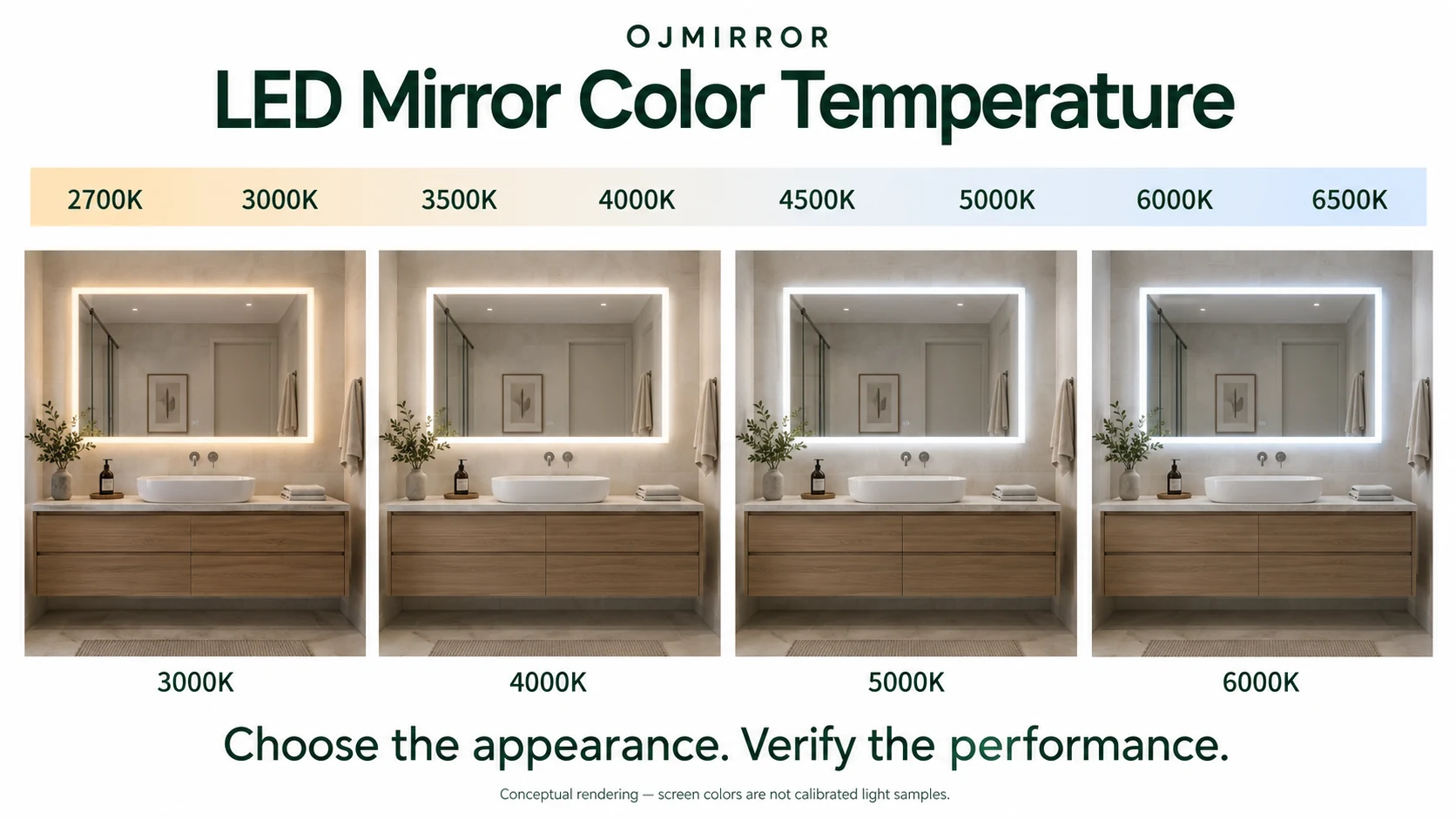 View full-size image ↗
Color-temperature illustration. Screen colors are approximate and do not represent measured product performance.
3000K vs 4000K vs 5000K vs 6000K: What Changes?
Color temperature describes the appearance of white light and is expressed in kelvin, abbreviated K. For LEDs, the specification is usually correlated color temperature, or CCT. Within this comparison, the lower number looks warmer and the higher number looks cooler. CCT is separate from light output and color rendering. The U.S. Department of Energy’s LED color guide also explains why two sources with the same nominal CCT can differ in tint and color appearance.
3000K: When Warm White Is the Right Fit
Choose 3000K for a warm-white bathroom appearance. It can suit everyday grooming as well as a room intended to feel relaxed, provided the mirror delivers useful light to your face.
Compare 3000K beside the actual tile, stone and cabinetry with the room lights on. If the combined appearance feels too warm, try 3500K or 4000K. If the color suits you but your face remains dark, review output and light direction before changing CCT.
3500K: A Warmer Alternative to 4000K
Compare 3500K when 3000K feels too warm but 4000K feels too cool. This intermediate appearance can be worth sampling for a warm hotel or residential lighting scheme. It is a design option to request, not a setting to assume: a three-preset mirror may skip it entirely.
Review 3500K beside the actual room lights. Matching nominal Kelvin labels alone does not guarantee matching tint, especially when different LED assemblies are used.
4000K: A Middle-Ground Choice
Start with 4000K when you want a middle-ground white light or are unsure which direction to choose. It is a practical option to compare for a bathroom used for several daily routines.
Check its appearance with the normal bathroom lighting on. If 4000K feels too cool, compare 3000K or 3500K; for a cooler appearance, try 5000K. Fixtures do not have to share an identical label, but their combined appearance should be intentional.
5000K vs 4000K: When Is Cooler White Useful?
Choose 4000K as the first comparison when you want a middle-ground appearance; compare 5000K when you want a cooler white. Neither number proves better makeup accuracy, brighter output or fewer facial shadows.
With warm ceiling or wall lights, a 5000K mirror may look more noticeably different than a 4000K mirror. In a cooler room, that difference may be welcome. Test both with your usual fixtures on and at a comfortable brightness.
For 3000K vs 5000K, the warm-to-cool difference is more pronounced. If you like the atmosphere of 3000K but want another condition for checking makeup, adjustable white may be useful. Confirm that the proposed mirror actually includes 5000K: a 3000K / 4000K / 6000K preset model does not automatically provide intermediate settings.
6000K: Choosing a Cooler White Appearance
Choose 6000K when you prefer a crisp, cool-white appearance. It can also be useful when you want to compare your appearance under a cooler lighting condition.
Try it at the brightness you would use at home, particularly in the evening. Separate an unwanted cool tone from glare caused by an exposed strip or reflected hotspot. A “daylight” label does not establish accurate skin-tone rendering.
What Color Temperature Is Best for Makeup and Shaving?
Makeup: Compare Color Rendering as Well as CCT
4000K is a practical first sample for makeup; compare 5000K if you prefer a cooler white. Check setting-specific color-rendering information and look for shadows around your eyes and chin at your normal standing distance.
Where practical, check finished makeup in the environment where it will be worn. Changing the mirror’s CCT does not reproduce that environment’s complete lighting conditions.
Shaving and Skincare: Prioritize Visibility
For shaving and skincare, 4000K is a useful starting comparison, but inspect shadows around the chin, nose and eyes before settling on a mirror. A comfortable warm-white setup with effective facial lighting may be more useful than a cooler mirror whose light mainly reaches the wall. Check the reflection at your normal standing distance; dimming can help you find a comfortable level.
How to Match Your LED Mirror With Bathroom Lighting
Observe the mirror light alone, then turn on the fixtures normally used with it. This helps identify whether an unwanted impression comes from the mirror or from the combination. Include nearby wall, countertop and cabinet finishes in the comparison.
For a windowless bathroom, assess facial illumination separately from light color. A cooler setting cannot compensate for insufficient light or poor distribution.
Color Temperature vs Brightness vs CRI
Before changing your selection, connect the complaint to the property that needs attention.
| What you notice | Check first |
|---|---|
| The white light looks too warm or too cool | Compare CCT settings with the mirror alone and with the usual room lights |
| Your face is dark or strongly shadowed | Review light direction, output, viewing distance and supporting fixtures |
| Skin or makeup colors seem wrong | Review rendering information, mixed lighting and the intended viewing environment |
CCT describes white-light appearance. Lumens describe light output. Lux describes illuminance at a location, so any measured value needs a stated position and orientation. Specify the surface and measurement point when comparing lux values.
CRI, often reported as Ra, concerns color rendering relative to a reference. It does not describe light distribution. A high Ra value therefore leaves the question of facial shadows unresolved.
Does a Makeup Mirror Need CRI 90?
A documented Ra of 90 or above is a useful requirement to discuss for color-sensitive grooming. It is not a guarantee of perfect skin-tone rendering. Ask which CCT setting and LED assembly the result covers; where relevant, request R9 or fuller color-rendering information as well. A CRI claim for an LED component does not establish illumination at the face from the complete mirror.
Frontlit vs Backlit vs Dual-lit: Does Direction Matter?
Frontlit mirrors direct light forward through a diffuser; backlit designs primarily create a glow on the wall; dual-lit designs include both zones. At the same nominal 4000K, their effect on the face can still differ because the source position, diffuser, output and room surfaces differ.
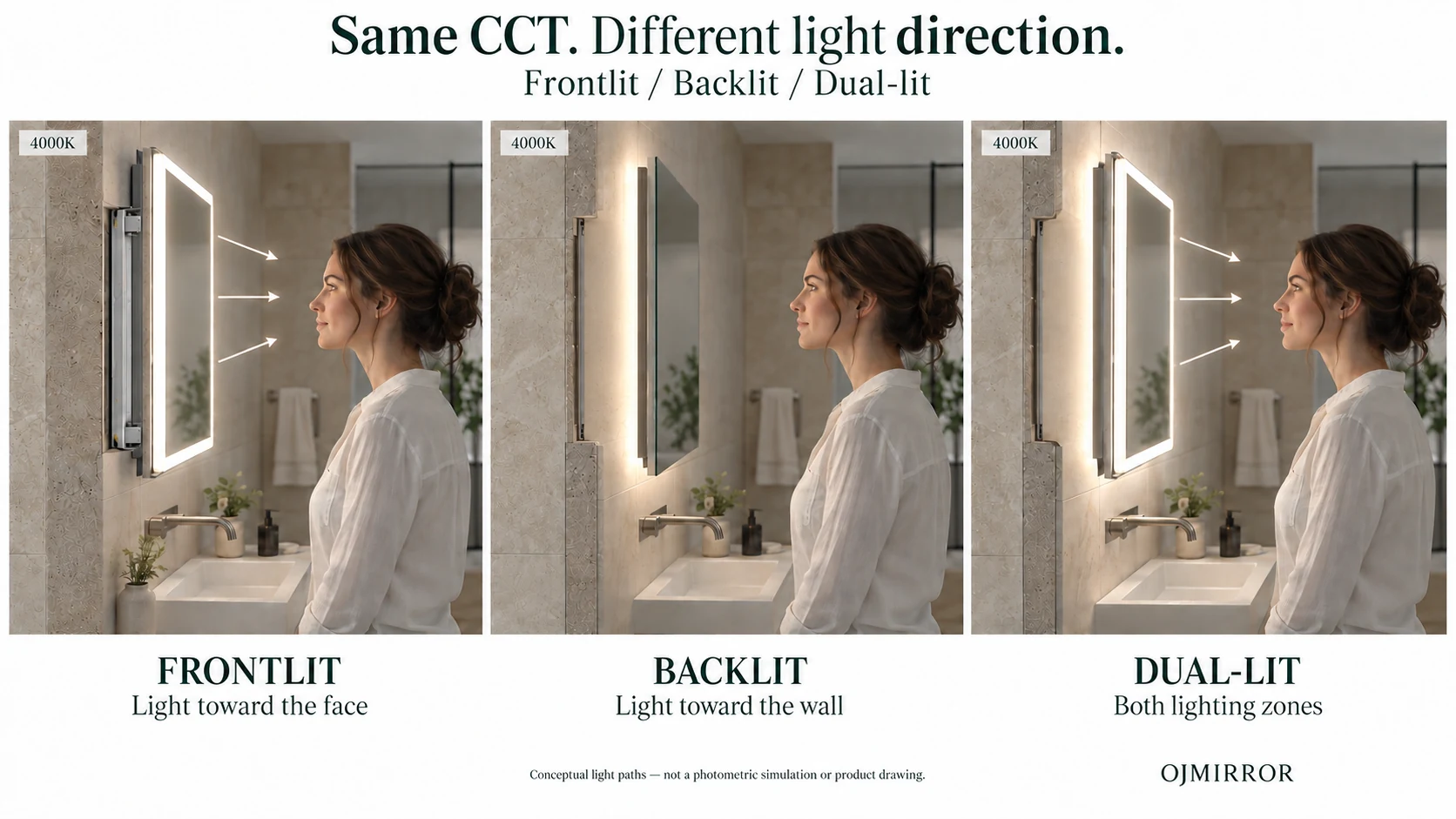 View full-size image ↗
3D lighting illustration. Arrows show light direction, not measured output; this is not a construction drawing or photometric simulation.
When comparing bathroom mirrors, look at how each design directs light toward the user as well as onto the wall. Judge facial illumination from your usual standing position.
Fixed CCT vs Adjustable Color Temperature
For one bathroom, the main question is whether you want to change the light color during normal use. Choose a fixed CCT when you already know the appearance you want and prefer simple operation. Choose user-adjustable CCT when people sharing the mirror have different preferences or you want different settings for different routines.
Check the actual presets or adjustment range before buying. A series advertised in three color temperatures may consist of three separate fixed versions; it does not necessarily mean each mirror switches between them.
A 2700K–6500K range describes endpoints; 3000K / 4000K / 6000K presets describe specific selectable settings. They are different specifications. For continuous adjustment, confirm whether a user can reliably return to a preferred setting and whether output or tint changes noticeably along the range.
The DOE overview of color-tunable lighting distinguishes white tuning, dim-to-warm behavior and full-color tuning. Ask for the control behavior you need, rather than relying on the word “adjustable.”
Confirm dimming separately when comparing dimmable LED mirrors. Color adjustment and brightness adjustment are distinct functions. Some lighting systems change color as they dim, so check both behaviors on the actual configuration.
During a demonstration, try the settings at your normal viewing distance and carry out your usual grooming routine. If you adjust brightness while comparing colors, note the settings: matching dimmer percentages do not establish matching light levels at your face.
Check the Controls Before Ordering
Use a short demonstration to distinguish the functions. These checks describe what to verify, not a control sequence shared by every mirror.
| Check | Action on the proposed sample | Record |
|---|---|---|
| CCT selection | Follow the model’s instructions through its available settings | Named presets or adjustable range; whether 3500K or 5000K is actually selectable |
| Dimming | Adjust brightness at the CCT you intend to use | Whether light color stays fixed or changes with dimming |
| Memory | Switch off at the panel, then separately test a mains power cycle | Returning on/off state, CCT and brightness for each method |
A claim such as “three colors with memory” leaves these details open. Ask for the model’s control instructions and confirm them on the sample.
LED Mirror Color Temperature for Hotels and Commercial Projects
Once you have a preferred appearance, turn it into a clear specification for the mirrors you intend to order. This section covers controls, sample approval and consistency across rooms or repeat orders.
Specify Who Can Change the Setting
Decide whether the CCT should be fixed for each room, selected during installation or adjustable by the user.
| Arrangement | Who selects the setting? | What to confirm |
|---|---|---|
| Fixed CCT | Buyer, when ordering | The exact version supplied |
| Installer-selectable | Installer or maintenance staff | Supported settings and selection method |
| User-selectable presets | Person using the mirror | Actual presets and operation |
| Continuous adjustment | User or specified control system | Range and how settings can be repeated |
Review the Sample in a Representative Room
For example, a hotel planning warm-white wall lights could begin with a 3000K mirror in its sample room. Review the combined appearance and facial illumination, then confirm the guest controls before repeating the configuration across rooms.
Identify the sample by model, size and revision. Use the test-record fields below to link lighting results to that configuration and the settings being approved.
The LED Mirror Selection and Sample Worksheet provides a record for these checks, including control behavior and unresolved questions. Use it with your project requirements; it does not prescribe universal acceptance thresholds.
Turn the Preference Into a Model-specific Specification
Use the following as an inquiry checklist. It does not confirm that every listed configuration is available on every model.
| Specification | What to request for the proposed model |
|---|---|
| Model and size | Model code, drawing revision and mirror dimensions |
| CCT | Fixed value, named presets, or adjustable endpoints and behavior |
| Color rendering | Required Ra, any R9 requirement, and setting-specific evidence |
| Lighting zones | Frontlit, backlit or dual-lit; independent control if required |
| Dimming | Driver and control compatibility; useful adjustment range |
| Memory | Separate panel-off and mains power-cycle results |
| Sample approval | Approved configuration and changes requiring another review |
For a custom LED mirror, ask OJMirror to identify the relevant model in the mirror product catalogue, then request its configuration sheet. A general customization description is not a substitute for a model-specific offer.
Confirm the Configuration and Record Changes
Use these lighting checks alongside the broader mirror sample approval checklist, then give the sample a clear decision:
- Confirm this configuration when agreed requirements and relevant use checks are satisfied. Record the approved version, settings, applicable rooms and any deviations accepted by the buyer's designated reviewer.
- Hold when critical evidence is missing or the sample conditions are unclear. Name the missing information and who will obtain it. Missing evidence does not automatically mean failed performance.
- Revise and recheck when a mismatch is established. Identify whether the change concerns color, output, distribution, rendering or controls, then reassess the affected points.
Record the approved configuration in the purchase documents and confirm production release separately. Retain those records for repeat orders, and compare replacement samples with the project requirements and adjacent units.
Use the custom mirror RFQ checklist to connect the lighting decision with the dimensions, quantities and other details needed for an inquiry.
How to Verify LED Mirror Lighting Performance
A photograph helps compare appearance; a test record supports a specification. Use both when approving a project sample.
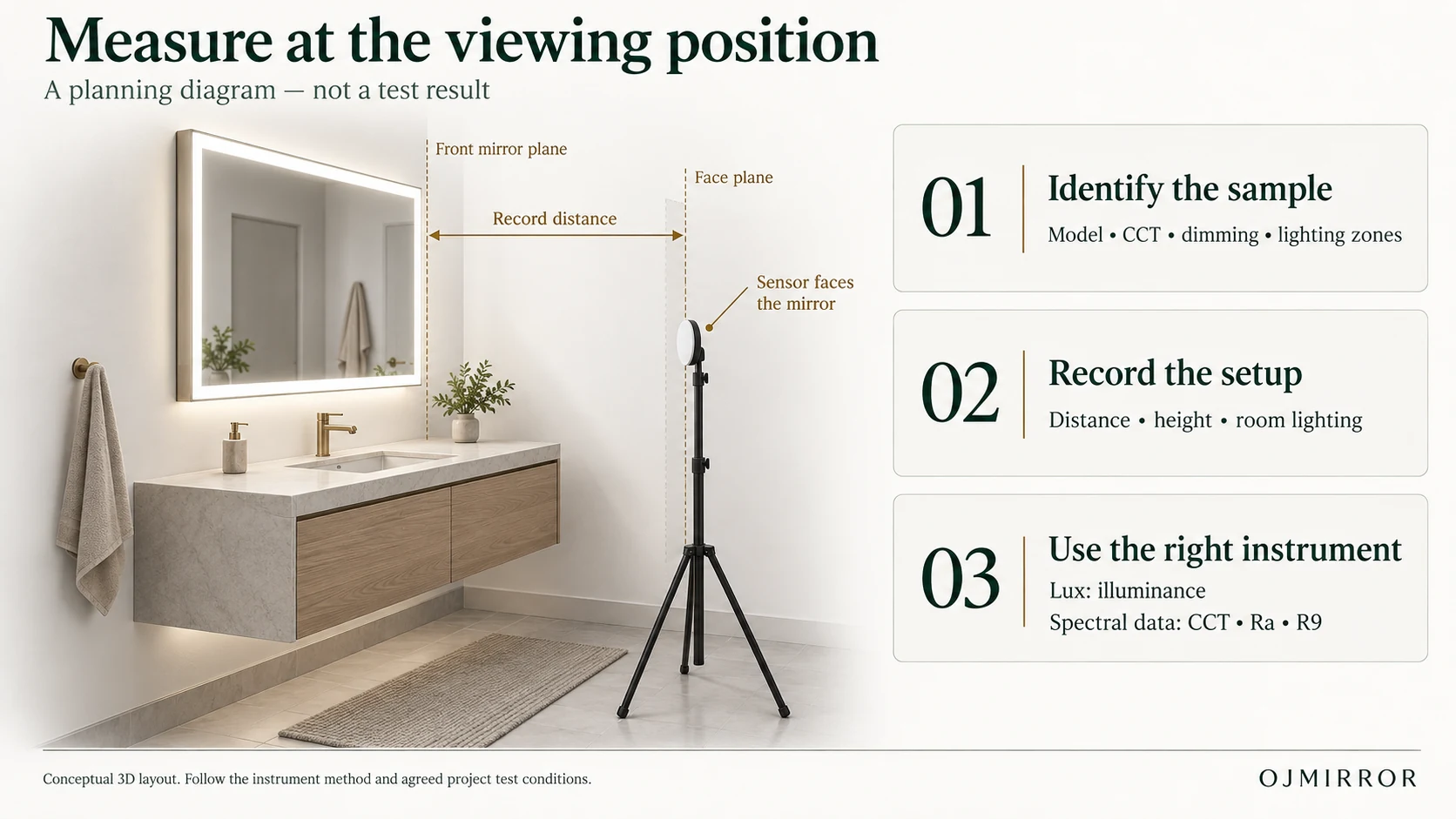 View full-size image ↗
Measurement setup illustration, not a test photograph or result. Set distance, sensor height and orientation according to the project and instrument method.
- Identify the sample. Record model, dimensions, revision, selected CCT, dimming level and active lighting zones.
- Control the comparison. Keep the camera position, exposure and white balance fixed for comparison photos. Record the room lights, finishes and ambient conditions. Automatic white balance can hide differences between settings.
- Request color measurements. Use a suitable spectral instrument or report for measured CCT and color rendering. Record the test method, instrument and the assembly tested; do not infer Ra or R9 from photos or a lux meter.
- Check illuminance where it matters. For a facial-lighting check, document distance, measurement height, sensor orientation and active room lights. Compare the same positions across samples. A single reading at the mirror surface cannot establish facial illumination.
- Record a decision. Agree acceptance criteria before testing, note deviations and retain the approved configuration for repeat orders.
Discuss applicable checks through OJMirror’s mirror quality testing page, and retain the original records with the approved sample.
What a Useful Test Record Includes
Ask for a record linked to the proposed model, size and revision. For an adjustable mirror, list each tested setting separately rather than applying one result to every CCT.
| Record field | Evidence to retain |
|---|---|
| Sample identity | Model, dimensions, revision, lighting zones and whether the same unit was used throughout |
| Operating condition | Target CCT, dimmer setting, input power and stabilization conditions |
| Color measurement | Measured CCT, Ra and R9, instrument, method and whether the result covers a component or the finished mirror |
| Facial illuminance | Lux at named positions; distance, height, sensor orientation and ambient-light condition |
| Traceability | Test date, operator, instrument identification/calibration information and original report or files |
No model-specific readings are published in this guide. Request the applicable report for the configuration under review; a rendering, component datasheet or unlabelled meter photo is not a substitute for that record.
Frequently Asked Questions
Is 3000K or 4000K better for a bathroom mirror?
Start with 3000K for a warmer appearance or 4000K for a middle-ground look used across daily routines. Choose with the normal room lights on, then check facial shadows and comfort. Neither setting is universally better.
Is 4000K good for makeup?
Yes, it is a practical starting point. Its Kelvin value alone does not establish color accuracy: check rendering information and even light at your face. Where practical, also check finished makeup in the lighting where it will be worn.
Is 5000K better than 4000K for a bathroom mirror?
Only if its cooler appearance better suits your preference or lighting brief. It does not automatically provide more light or more accurate colors. Compare the proposed samples under the same room conditions.
Is 6000K too cool for a bathroom?
It may feel too cool beside warm fixtures or during evening use, but some users prefer it. Try the actual mirror at a comfortable brightness; an unpleasant hotspot may be a glare problem rather than a color-temperature problem.
Is 4000K “neutral white” or “cool white”?
Both descriptions are used in the lighting and mirror market. Because naming conventions vary between manufacturers, compare the Kelvin value and the actual product configuration rather than relying on terms such as “neutral white” or “cool white” alone.
Is 5000K the same as 6000K?
No. They are different nominal color temperatures, even when both are marketed using “daylight” language. Confirm the actual setting offered by the mirror and assess it in the intended room.
Can a fixed-color mirror be changed after installation?
Only if its design provides a supported way to do so. Ask the supplier about the exact model before ordering; a fixed version should not be purchased on the assumption that it can later become user-adjustable.
Is 6000K brighter than 4000K?
Not necessarily. Kelvin describes white-light color, while lumens describe output. Compare the complete mirrors at the settings you will use, then check the light reaching your face.
Is RGB the Same as Adjustable CCT?
No. Adjustable CCT changes the appearance of white light; RGB refers to red, green and blue color mixing. Some products combine colored effects with dedicated white-light channels, but an RGB label alone does not establish the quality of white light for grooming. Confirm the white-light mode, controls and rendering evidence for the proposed configuration.
Request a Model-Specific LED Mirror Lighting Specification
Send OJMirror your LED mirror project specifications:
- Mirror size: width, height and any shape or layout requirements. If dimensions are still open, start with the bathroom mirror size calculator.
- Quantity: total units and any different room or mirror types.
- Preferred CCT: 3000K, 3500K, 4000K, 5000K, 6000K or the adjustable settings you want to discuss; availability must be confirmed for the model.
- Dimming and controls: required brightness adjustment, switching and memory behavior.
- Project type: hotel, apartment, commercial space or another application.
Attach a drawing or reference photo if available. These details give OJMirror a clear basis to review available configurations and prepare a quotation against your project brief. Confirm the options and supporting lighting information for the proposed model before finalizing the order.
Published by OJMirror. Updated October 13, 2026. This guide combines cited lighting references with selection and sample-review guidance. Illustrations are conceptual; no named technical review or model-specific test results are claimed.
