
By Kris Chou · Product Manager at OJMirror
This construction can improve corrosion resistance in indoor bathrooms and similar settings. The guide below explains the differences, benefits, limitations and cost considerations, followed by technical checks for project buyers.
Quick facts
- Better for bathrooms? Often a useful option, provided the coating, edgework and installation suit the exposure.
- Waterproof or immune to black edges? No. Moisture and coating damage can still cause deterioration.
- Automatically lead-free? No. Copper-free construction and lead content are separate claims.
- Always more expensive? No fixed premium applies; compare equivalent specifications.
Buying takeaway: Consider a documented copper-free silver mirror when corrosion resistance matters. Check the coating, edgework and installation requirements—not the label alone.
Mirror Basics ↓ · Technical Guide for Project Buyers ↓
Table of Contents
Copper-Free Mirror Basics
Is a copper-free mirror right for you? Start with your application:
| Your situation | Recommendation and next step |
|---|---|
| Normal indoor bathroom | Consider a documented copper-free silver mirror; check exposure and installation. |
| Replacing a mirror with black edges | Assess corrosion risks first; changing the glass alone may not resolve the cause. |
| Low-cost mirror for a dry room | Compare equivalent specifications and prices, not the backing label alone. |
| Hotel project or custom LED mirrors | Verify material consistency and inspection records, including processed areas and assembly requirements. |
| Pool, spa or constantly damp location | Obtain product-specific suitability confirmation; do not assume normal bathroom suitability applies. |
What does “copper-free mirror” actually mean?
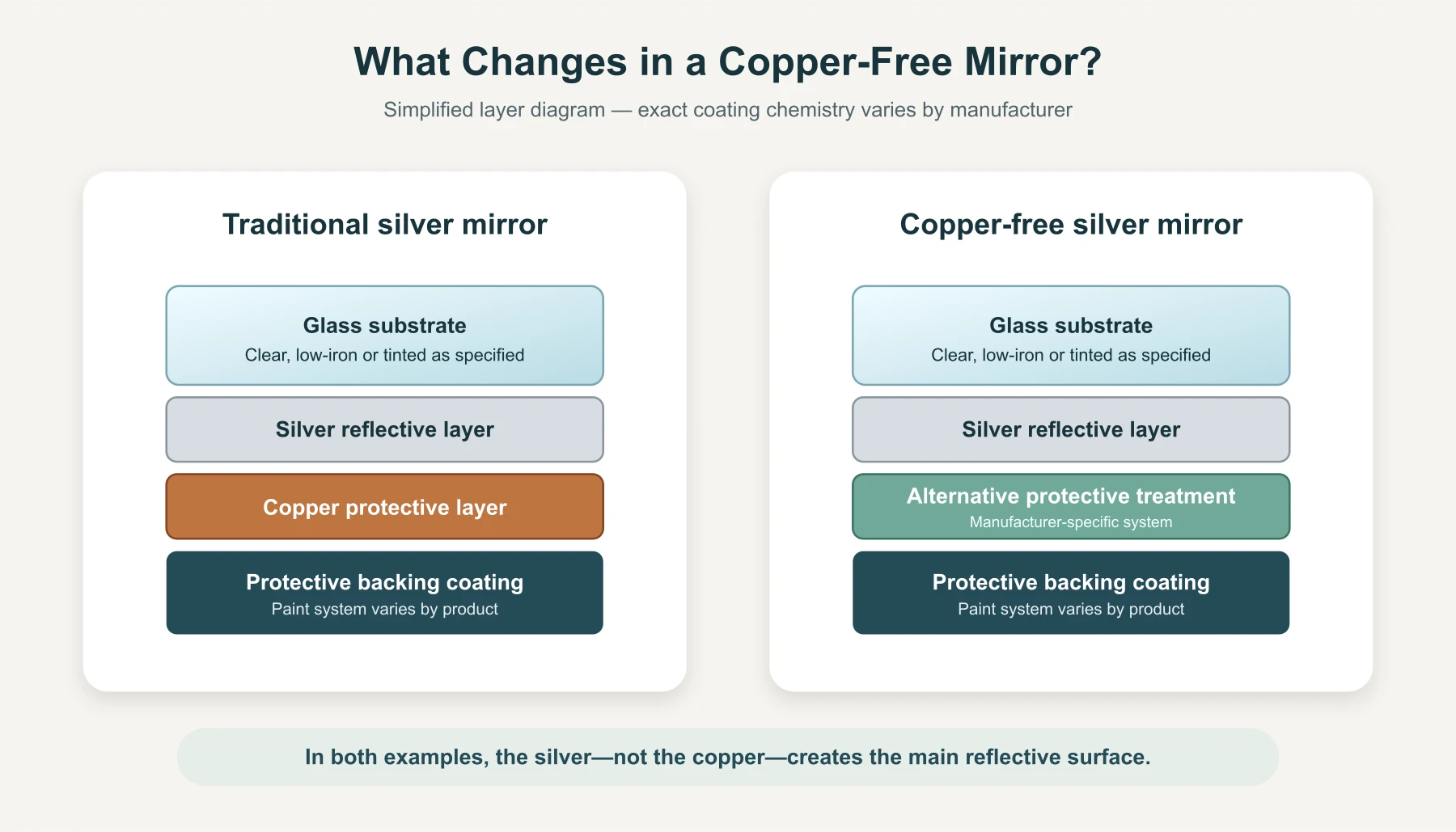
You look through the glass at a reflective coating on the back: this is a second-surface mirror. In both traditional and copper-free silver mirrors, silver creates the reflection. The difference is how that silver is protected.
Three terms describe separate choices:
- Copper-free: the backing omits the traditional copper layer, not the silver.
- Lead-free: a separate material claim, often about the backing paint; verify it independently.
- Copper-framed: a frame material or decorative finish, unrelated to the backing. A copper-colored frame can surround copper-free glass.
Copper-free mirror vs. regular mirror: what is the difference?
The main difference is how the silver is protected: traditional silver mirrors use a copper layer behind it, while copper-free silver mirrors use an alternative protective system. Here, “regular mirror” means a traditional copper-backed silver mirror—not every household mirror.
| Decision factor | Copper-free silver mirror | Traditional copper-backed silver mirror | What to verify |
|---|---|---|---|
| Main reflective layer | Usually silver | Usually silver | Material construction |
| Copper layer | Omitted | Normally present behind the silver | Supplier declaration or data sheet |
| Protection behind silver | Alternative, manufacturer-specific system | Copper plus protective backing | Exact product data |
| Corrosion resistance | Can be improved | Depends on coating, fabrication, and exposure | Test method, duration, criteria, and result |
| Lead content | Separate claim | Separate claim | Material declaration |
| Appearance | Depends on glass and coating quality | Depends on glass and coating quality | Approved sample and visual limits |
| Bathroom suitability | Conditional | Conditional | Environment, fabrication, and installation |
Are copper-free mirrors better than regular mirrors? They can offer better corrosion resistance, making them worth considering for humid indoor spaces. But the coating system, fabrication, installation and exposure determine actual performance. Compare evidence for the specific products rather than assuming every copper-free mirror outperforms every traditional mirror.
Why can copper-free mirrors offer better corrosion resistance?
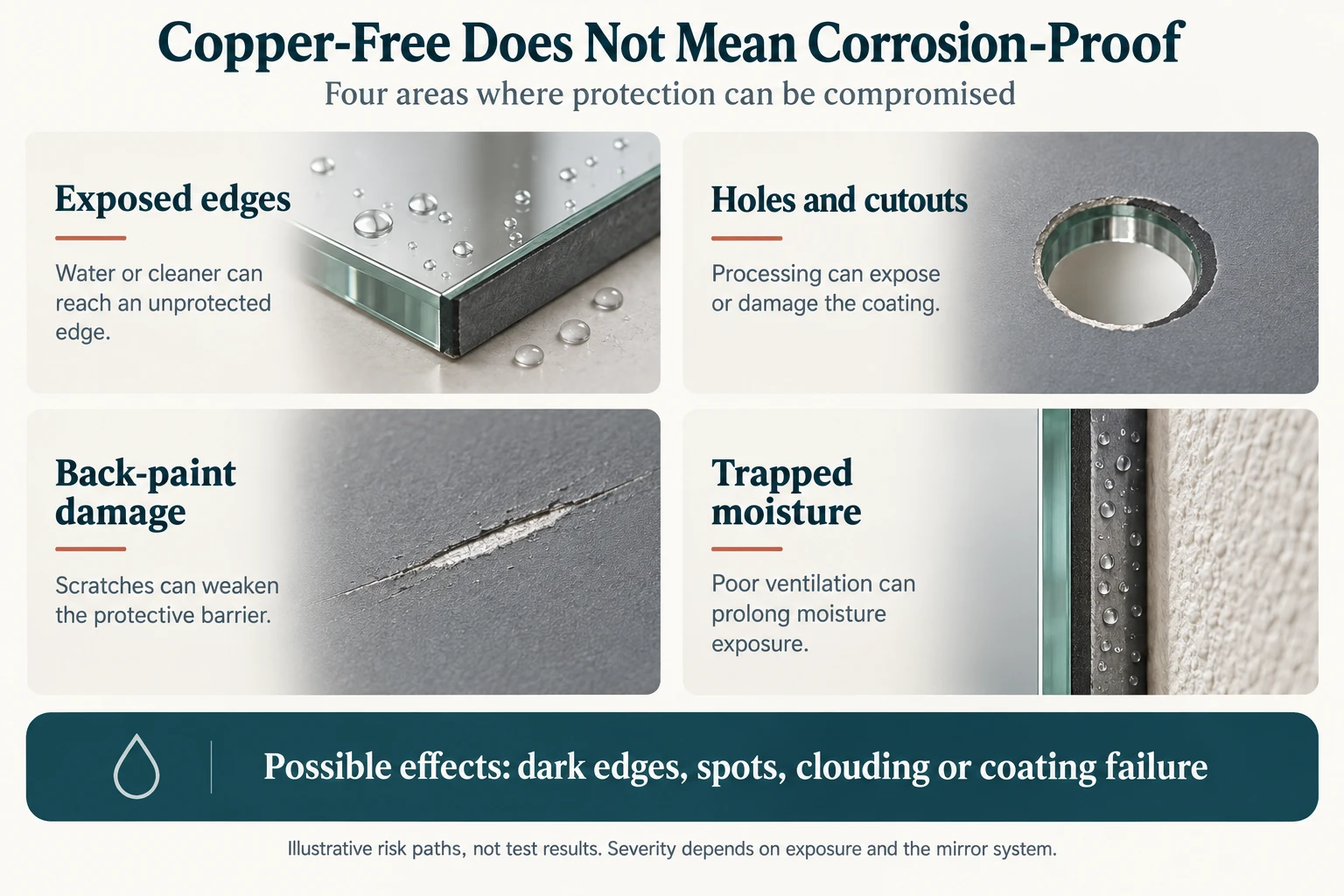
The silver layer is protected, but that protection is not invulnerable. Water, cleaning chemicals, and airborne contaminants can reach the coating through a vulnerable edge, a drilled opening, damaged backing paint, or prolonged contact with a damp wall.
Once degradation starts, the visible symptom may be a dark edge, brown discoloration, clouding, spots, or coating separation. People often call all of these defects “mirror rust,” although the actual failure can involve the silver, the protective system, the paint, and the way the mirror was processed or installed.
Already seeing black edges? Our mirror desilvering guide explains how to distinguish surface marks from possible coating damage and compare repair or replacement options.
A well-designed copper-free system can reduce the corrosion risk associated with the traditional backing construction. Performance still belongs to the whole stack: glass preparation, silver quality, protective treatment, backing paint, edgework, installation, cleaning, and exposure.
What are the practical benefits?
Better resistance for many indoor applications
Improved corrosion resistance is the main practical reason to consider copper-free mirror glass. That can be valuable in bathrooms, hotel guestrooms, residential projects, vanity collections, and medicine cabinets, where mirrors face repeated humidity and cleaning cycles.
For a project buyer, replacement can involve more than the glass cost: labor, room downtime, wall-finish work, and electrical disconnection for an LED product. That makes the material and installation specification especially important in repeated-room programs. See OJMirror's bathroom mirror range for project formats; the range page does not establish the backing specification of every configuration.
Less copper in the mirror backing
Omitting the traditional copper layer reduces copper use in this part of manufacturing. It does not mean an assembled LED mirror contains no copper: wiring and electronic components may still use it. Low-VOC, recycled-content and environmental-certification claims require separate evidence.
Copper-free mirror pros and cons at a glance
| Potential advantage | Limitation to weigh |
|---|---|
| Improved corrosion resistance with a suitable protective system | Not waterproof or corrosion-proof; edges and backing remain vulnerable |
| A useful option for many indoor bathrooms | Performance depends on fabrication, installation and exposure |
| No conventional copper layer behind the silver | Lead content and other environmental claims require separate evidence |
| A documented option for projects where replacement is disruptive | Any price premium needs justification; the label alone does not prove longer service life |
What are the disadvantages of copper-free mirrors?
Copper-free glass still requires careful handling and compatible installation materials. Scratches, poorly processed openings and unsuitable adhesives can compromise its protective system; standing water or aggressive cleaners can cause further damage. Quality also varies between products, so a copper-free label is not a substitute for material data and relevant test results.
Some separate requirements are neither advantages nor disadvantages of copper-free glass: lead content and environmental claims need their own documents; breakage safety and mounting need their own assessment. For LED mirrors, electrical compliance applies to the finished assembly, not the mirror coating.
Copper-free silver mirror vs. aluminum mirror
These names describe different aspects of construction. Copper-free silver mirror identifies silver as the reflective metal and excludes the traditional copper backing layer. Aluminum mirror identifies aluminum as the reflective metal; it does not specify the full protective system.
| What to compare | Copper-free silver mirror | Aluminum mirror |
|---|---|---|
| Reflective metal | Silver | Aluminum |
| Protective construction | Alternative treatment and backing coatings | Confirm the coating and backing with the manufacturer |
| Appearance and reflection | Review the actual glass, coating data and sample | Review the actual glass, coating data and sample |
| Bathroom suitability | Depends on the complete protective system and intended exposure | Depends on the complete protective system and intended exposure |
Neither label alone establishes reflectance, service life or resistance to bathroom cleaning chemicals. Compare finished-material data and samples under the same conditions; do not apply optical-component reflectance figures to bathroom mirrors.
Is a copper-free mirror suitable for a bathroom?
It is often a strong material direction for a normal indoor bathroom, especially where corrosion resistance and replacement cost matter. The decision still depends on the actual exposure.
Review these conditions before specifying the mirror:
- how often the room becomes humid and how quickly it dries;
- whether an edge sits close to a basin, shower, or wet countertop;
- whether the mirror is framed or has exposed polished edges;
- whether holes, cutouts, or de-silvered lighting areas are present;
- what adhesive, tape, sealant, or mechanical mounting system will be used;
- whether moisture can be trapped against the wall or cabinet;
- which cleaning products and methods are expected;
- whether the location is coastal, poolside, or exposed to corrosive chemicals.
Normal bathroom humidity is different from constant high humidity or aggressive chemical exposure. A mirror for a pool, spa, marine, or similar setting needs a separate product review.
Installation also changes the exposure. Industry guidance recommends a ventilated space behind the mirror, avoiding standing water at the lower edge, and choosing adhesives compatible with the backing.
| Exposure condition | Planning direction | Additional review |
|---|---|---|
| Normally ventilated residential bathroom | Copper-free mirror may be suitable | Edge processing, mounting, and cleaning |
| Hotel guest bathroom | Prefer documented and repeatable material | Batch consistency, room schedule, replacement plan |
| Mirror edge frequently wetted at a vanity | Treat as a higher-risk detail | Clearance, water path, edge protection |
| Pool or spa area | Do not assume normal indoor suitability | Specialist material and manufacturer approval |
| Coastal or chemically aggressive location | High corrosion risk | Product-specific testing and written confirmation |
| LED mirror or medicine cabinet | Review the glass and complete product | Electrical, thermal, mounting, and ventilation requirements |
Are copper-free mirrors more expensive—and are they worth it?
There is no universal price premium. Compare like-for-like quotations: a difference in glass thickness, dimensions, edgework or LED components can matter more to the finished price than the backing description. Ask the supplier to separate the mirror-glass specification from other product options.
Example: comparing two mirror quotations
This is an illustrative comparison worksheet, not an OJMirror quotation or a statement of tested performance. Replace the assumptions with your project requirements.
| Specification | Quote A | Quote B |
|---|---|---|
| Mirror construction | Traditional copper-backed silver mirror | Copper-free silver mirror |
| Glass thickness | 5 mm, assumed for comparison | 5 mm, assumed for comparison |
| Dimensions and quantity | Same project drawing and quantity | Same project drawing and quantity |
| Edgework and openings | Same polished edges and drawing-defined openings | Same polished edges and drawing-defined openings |
| Safety backing | Same specified film, if required | Same specified film, if required |
| Corrosion evidence | Request method, duration, criteria and result | Request method, duration, criteria and result |
| Unit price | Enter supplier quote | Enter supplier quote |
| Delivery basis | Same packaging, destination and delivery terms | Same packaging, destination and delivery terms |
If one quote omits backing film or uses different edgework, resolve that difference before comparing prices. For LED mirrors, also match the frame, lighting, controls and electrical specification. A higher price alone is not evidence of better durability.
When is it worth paying more? Consider a documented copper-free option when repeated humidity exposure and difficult replacement make durability important. In a hotel, replacing a mirror may also involve labor, wall repairs, electrical work and room downtime. For an easily replaced mirror in a dry room, the initial price may carry more weight.
For a project comparison, use a shared planning period and compare purchase + installation + maintenance + expected replacement + downtime costs. Replacement assumptions must be explicit. If reliable failure-rate or service-life data are unavailable, compare scenarios rather than presenting a calculated saving as a proven benefit.
Do not pay a premium solely for the word “copper-free.” Look for a suitable coating system, sound processing and evidence relevant to the material being supplied.
Specifying mirrors for a hotel or commercial project? Send your dimensions, quantities, intended environment and preferred glass thickness. OJMirror can review the proposed configuration and confirm which supporting documents are available.
Discuss Your Mirror Specification →
How long does a copper-free mirror last?
There is no single lifespan that applies to every copper-free mirror. Coating quality, edge processing, ventilation, cleaning and exposure all affect its condition over time. Follow the material supplier's installation and care instructions and keep water from remaining against vulnerable edges.
A 120-hour CASS result is not a number of years in a bathroom. Accelerated salt-spray testing evaluates specimens under defined conditions; it should not be converted into a service-life promise. ISO 9227 scope.
What should you check in a copper-free mirror warranty?
Request the written terms for the quoted product. Check whether they cover desilvering, black-edge corrosion or backing-coating defects, and review the coverage period, exclusions and claim documentation. For project orders, also clarify whether a remedy includes only replacement glass or associated freight, removal and reinstallation. Assess the warranty alongside the material specification and test evidence; its duration is not proof of corrosion-free service life.
How to clean and maintain a copper-free mirror
Follow the mirror supplier's care instructions. For routine cleaning:
- Use a clean, soft, lint-free cloth lightly dampened with warm water.
- If a cleaner is necessary, use one approved for the mirror. Apply it to the cloth rather than spraying the glass, edges or openings directly.
- Avoid abrasive pads and cleaners containing ammonia, vinegar, acids or alkalis unless the manufacturer explicitly approves the product.
- Finish by drying the surface, edges and joints; do not leave liquid against the backing.
- If the same edge repeatedly becomes wet, address the water source or ventilation rather than relying on more frequent cleaning.
These precautions follow the National Glass Association's mirror-cleaning guidance. For LED mirrors and cabinets, also follow the finished product's electrical and cleaning instructions.
Common questions about copper-free mirrors
Copper-free mirror vs. silver mirror: are they different?
A mirror can be both. “Silver mirror” identifies the reflective metal; “copper-free” describes the omission of the traditional copper protective layer. A copper-free silver mirror still uses silver to create the reflection.
Is a copper-free mirror completely waterproof?
No. Copper-free describes the backing construction, not a waterproof rating. Edges, holes, backing paint, mounting, wall moisture, ventilation, and cleaning still affect durability.
Can a copper-free mirror develop black edges?
Yes. Copper-free construction does not eliminate black-edge risk. See the corrosion causes and vulnerable areas before choosing a replacement.
Can black edges on a copper-free mirror be repaired?
Surface cleaning cannot restore a deteriorated reflective coating. Ask the supplier to assess persistent marks, then compare concealment, resilvering and replacement. Covering damage does not resolve its cause.
Is copper-free the same as lead-free?
No. They are separate material claims. Ask for evidence for each one required by the project.
Does a copper-free LED mirror contain no copper?
Not necessarily. The phrase normally refers only to the mirror-glass backing. Electrical wiring, circuit boards, connectors, or other parts may contain copper.
How can you tell if a mirror is copper-free?
You cannot reliably identify it from the front alone. Match product marking to the technical data and a material declaration. A corrosion-test result is supporting performance evidence, not proof of the backing chemistry.
For Project Buyers and Procurement Teams
Specifying mirrors for a hotel or commercial project? Start with the material options below, then review construction, test evidence and the six-step purchasing workflow. These checks address the proposed configuration, not an automatic approval of every finished product.
OJMirror material options
| Material detail | OJMirror-confirmed specification |
|---|---|
| Mirror glass | Copper-free silver mirror |
| Backing paint | Lead-free |
| Available thicknesses | 3 mm, 4 mm, 5 mm and 6 mm |
Confirm thickness against the proposed product and drawing. These are material specifications, not a claim that every finished mirror or thickness has passed the same test. See the raw-material CASS record for its separate scope.
What is a copper-free mirror made of?
The exact build-up varies, but a copper-free silver mirror can be understood as four functional parts.
1. Glass substrate
The glass is the face of the mirror and the base for the reflective coating. A specification may call for clear float glass, low-iron glass, or tinted glass in a particular thickness.
These are separate decisions. Low-iron describes the glass composition and its visual color; copper-free describes the backing construction. One term should not be used as a substitute for the other.
2. Silver reflective layer
A thin silver coating forms the reflective surface. Its uniformity, adhesion, and protection affect the finished appearance. The glass itself also influences perceived color, especially around exposed edges and in thicker products.
A general article should not assign one universal reflectance value to all copper-free mirrors. If reflectance is a project requirement, use the value and method stated in the technical data for the exact mirror material being purchased.
3. Alternative protective treatment
Instead of applying the traditional copper layer, the manufacturer uses another treatment to protect the silver. Industry literature refers to technologies involving metals or activator systems such as palladium or titanium, but there is no reason to assume that every copper-free mirror uses the same chemistry.
4. Protective backing coating
One or more backing coatings provide chemical and physical protection. They help isolate the metal layers from moisture, cleaning chemicals, abrasion, and handling damage.
Paint color is not a performance specification. Neither is the statement “double coated” on its own. A buyer comparing two materials should review the applicable technical sheet and test evidence rather than judging the system by the visible color or number of paint layers.
How is a copper-free mirror manufactured?
Production begins with careful glass cleaning and surface preparation. The glass is sensitized, and a silver coating is deposited to form the reflective layer. The manufacturer then applies its copper-free protective treatment, adds the backing coating, and cures the system.
Technical literature describes several protective treatments that can replace the conventional copper layer. The precise treatment depends on the mirror manufacturer; the word copper-free alone does not identify it.
After the mirror sheet is produced, a fabricator may cut it to size, polish or bevel the edges, drill holes, create cutouts, remove coating for illuminated areas, add safety backing, and assemble it into a frame, LED mirror, or medicine cabinet.
For LED designs with selectively removed reflective and backing coatings, inspect the processed lighting areas for coating damage and residue before assembly. Confirm that adjacent coatings, adhesives and other assembly materials are compatible with the specified construction.
Those later operations matter. Good sheet material can still be compromised by damaged backing paint, poorly processed edges, incompatible adhesive, wet storage, or unprotected contact points. Protect the backing and edges during fabrication to reduce black-edge risk. A raw-sheet certificate does not by itself prove the durability of every fabricated product made from that sheet.
CASS test record for mirror raw material used by OJMirror
The following table summarizes the supplier's corrosion-test report for mirror raw material used by OJMirror.
| Report field | Recorded information |
|---|---|
| Report number | GZMR240702070501 |
| Report date | July 25, 2024 |
| Organization named in the report | SGS-CSTC Guangzhou Branch |
| Method | ISO 9227:2022, CASS |
| Exposure duration | 120 hours |
| Specimens | 3 |
| Tested thickness and material code | Not specified in the reviewed report; match these through separate supplier and purchase records |
| Acceptance reference | GB/T 28804-2012, Section 6.6 |
| Reported result | All three specimens passed the report's stated acceptance criteria |
Test scope: This report covers the tested raw-material specimens only. It does not establish equivalent performance across the available 3, 4, 5 and 6 mm glass options or finished mirror assemblies.
For a purchase approval, match the report's sample description and scope to the proposed material. A summary table does not replace the report.
The report records protective-coating discoloration, with no visible bubbles in that coating, no discoloration or muddying of the reflective coating, and no spots or edge corrosion. It does not establish lead content, copper-free construction or service life.
How is copper-free mirror performance tested?
Test reports show whether a defined specimen met defined criteria under stated conditions. Accelerated salt-spray results should not be used as a direct forecast of service life or a universal ranking of different mirror materials.
ASTM C1503 for silvered flat glass mirror
ASTM C1503-24, Standard Specification for Silvered Flat Glass Mirror, is a reference for reviewing silvered mirror requirements. Its public scope describes requirements involving reflectance, silver-coating appearance, coating resistance, blemishes, dimensions, and squareness. It applies to defined silvered flat-glass mirrors before further edgework or fabrication and has stated application limits.
Before putting the standard into a purchase specification, obtain and review the current text. Confirm that the product form, thickness, fabrication state, use, and acceptance clauses match the order.
EN 1036 and accelerated durability tests
EN 1036-1 covers definitions, requirements, and test methods for mirrors made from silver-coated float glass for indoor use. Its scope has limits for processed products and aggressive or constantly high-humidity environments. Ask the supplier which version and tests apply to the quoted material. Product data may report neutral salt spray, copper-accelerated acetic acid salt spray, and condensation-water testing, with limits for edge and spot corrosion.
The test name alone is not the result. A report should identify:
- the referenced standard and version;
- the exact test method;
- exposure duration and conditions;
- sample description and thickness;
- edge preparation;
- allowed edge-corrosion distance;
- allowed spot size and number;
- the measured result;
- report date and laboratory or issuing organization.
Do not treat a statement such as “salt-spray tested” as a complete result. Two reports can use different methods, durations, and acceptance limits, so compare those fields before comparing the conclusions.
Why does a copper-free mirror use a “CASS” test?
CASS means copper-accelerated acetic acid salt spray. The word copper describes part of the accelerated test solution and method. It does not mean that a mirror passing through the test must contain a copper backing layer.
Other useful checks
Salt spray answers only part of the quality question. Build the inspection plan around what could fail in the finished mirror:
| Check | What to examine or request | What it does not establish |
|---|---|---|
| Visual quality | Inspect the face, backing and edges under agreed lighting, viewing distance and defect limits | A quick front-view check does not assess coating adhesion |
| Dimensions and edgework | Measure thickness, size and drawing-defined features; inspect for chips, cracks and coating damage | A nominal sheet thickness does not confirm finished-part tolerances |
| Backing-coating adhesion | Request a recorded adhesion test using the specified method and acceptance grade | An illustration of a cross-cut test is not a passing result |
| Reflectance | Request measured values with the method and spectral basis | A bright-looking sample does not prove a numerical reflectance claim |
| Safety backing | Check specified coverage, wrinkles, bubbles and damage; review any required performance evidence separately | Film appearance alone does not prove safe breakage behavior |
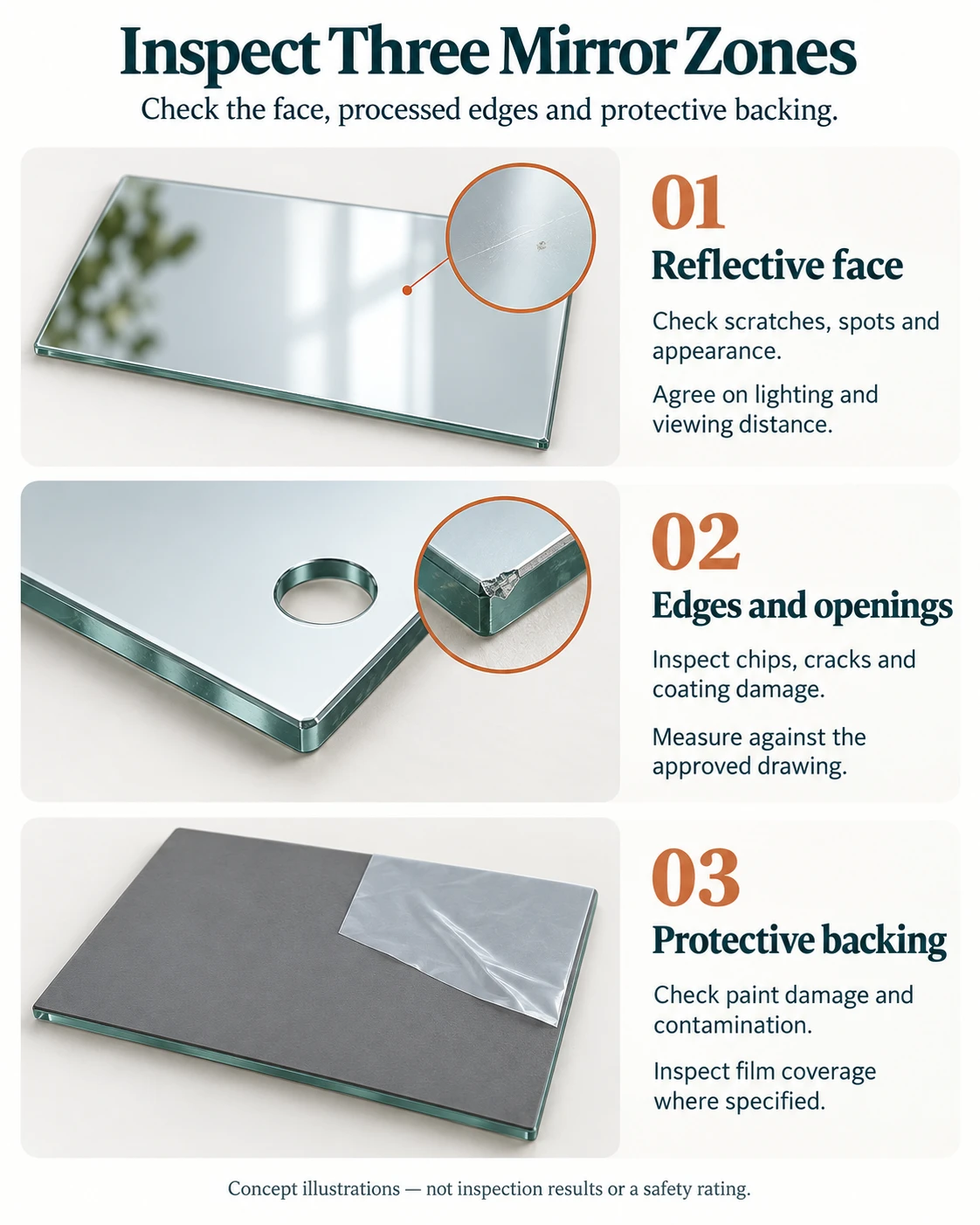
For corrosion testing, record specimen preparation as well as exposure conditions. A cut edge and a ground edge need not represent the same processing state. After exposure, assess edge attack, spots, backing-coating changes and reflective-layer changes separately, following the selected method. Do not replace those observations with a single photograph or an unexplained “Pass.”
How can a buyer verify a copper-free mirror?
Match the material declaration and technical sheet to the quoted product, review the scope of its test evidence, then approve a representative sample and lock the specification. Use the six steps below to keep those records connected through delivery.
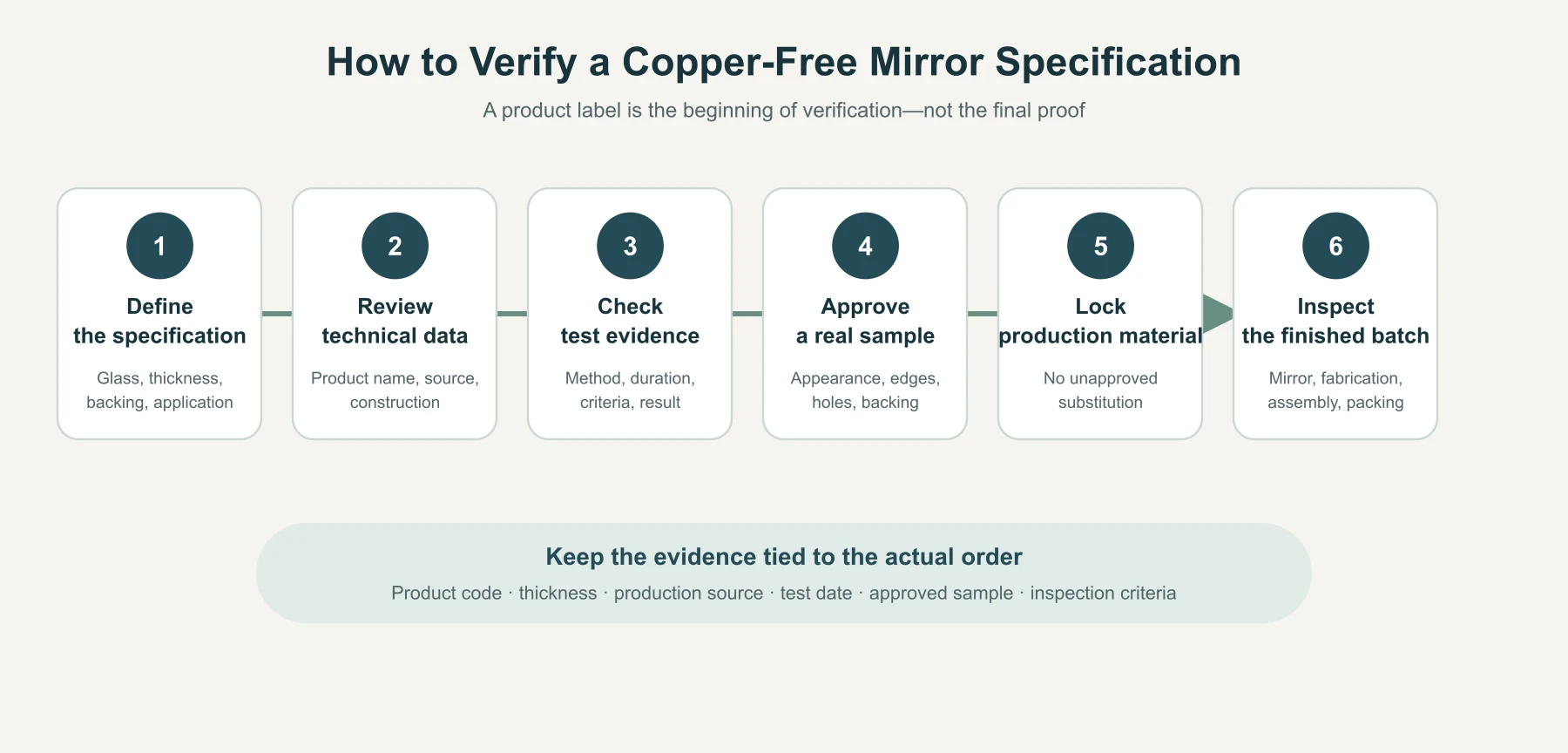
Step 1: Define the construction
State whether the project requires a copper-free silver mirror, the glass type and thickness, edge treatment, safety backing, and any separate lead-content requirement. Include the intended application and environment.
Step 2: Review the technical data
The technical sheet should identify the manufacturer or supplier, product name or code, production source where relevant, available thicknesses, construction, and referenced performance standards.
Step 3: Match the test evidence to the material
Check the product name, thickness, production location, test date, method, report number, and issuing organization. A report for a different material or factory may not represent the quoted product.
Read the measured results, not just the word Pass. “Salt-spray tested” is incomplete without the method, duration, acceptance limit, and result.
Step 4: Approve a production-representative sample
Review glass color, reflection, visible defects, edge quality, holes, cutouts, backing paint, and safety backing. For LED mirrors, inspect the de-silvered lighting area and completed assembly as well as the raw mirror surface.
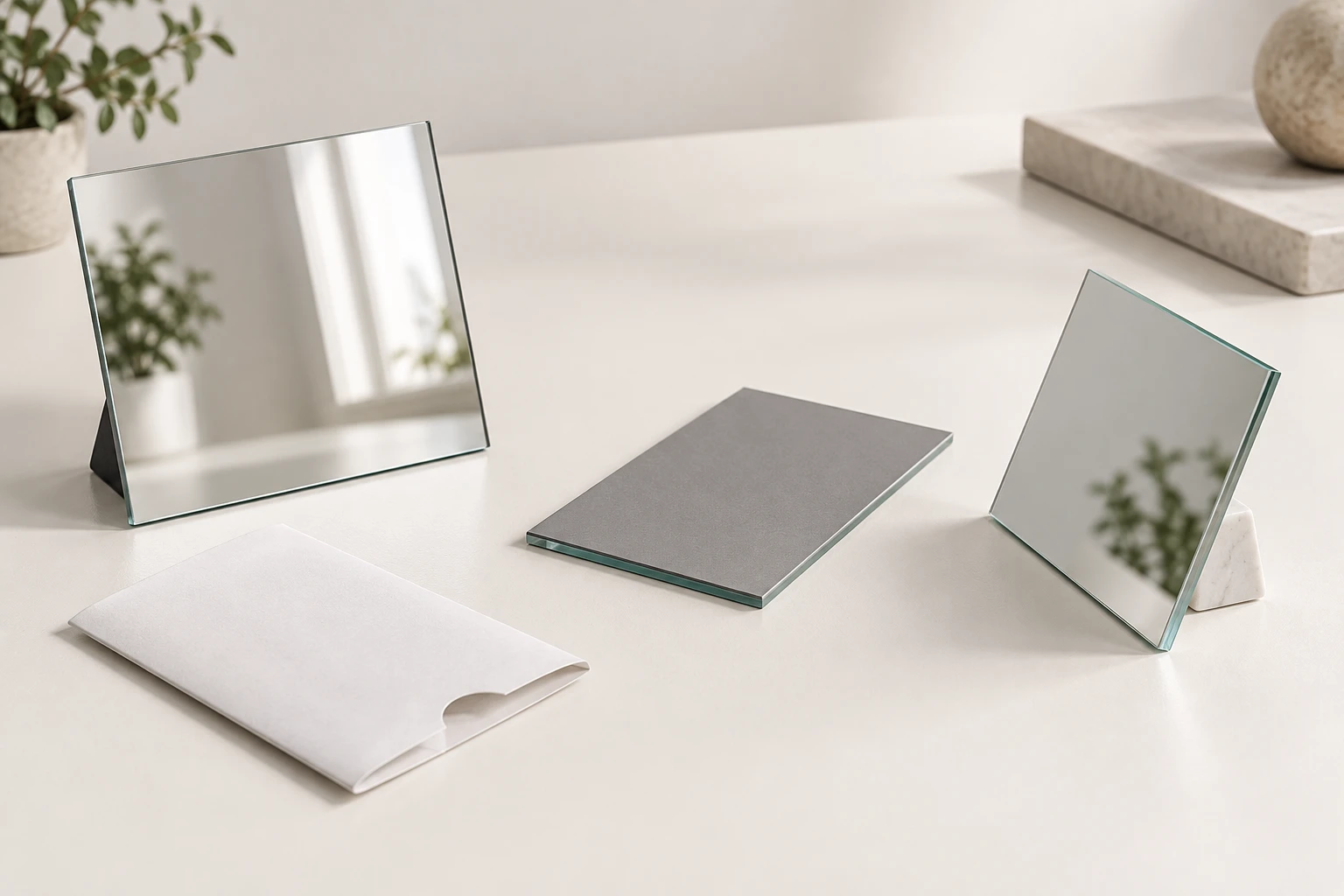
Step 5: Lock the approved specification
Record the approved material in the purchase documents. Define whether substitution is prohibited or subject to written approval and equivalent evidence. This prevents a good sample from being followed by an undocumented material change in mass production.
Step 6: Inspect the finished batch
Final inspection should cover more than whether the lights turn on. Mirror-surface defects, edge and hole quality, backing damage, reflection distortion, assembly contamination, safety backing, and packaging contact points all deserve attention.
Review OJMirror's mirror quality control process and agree which inspection points and records apply to your order before production.
Protect the approved material through processing and installation
Agree on the handoff conditions between operations. After edgework, remove processing residue using the material supplier's approved method and dry the mirror before backing, assembly or packing. Inspect openings and edges again rather than assuming the incoming sheet check covers them.
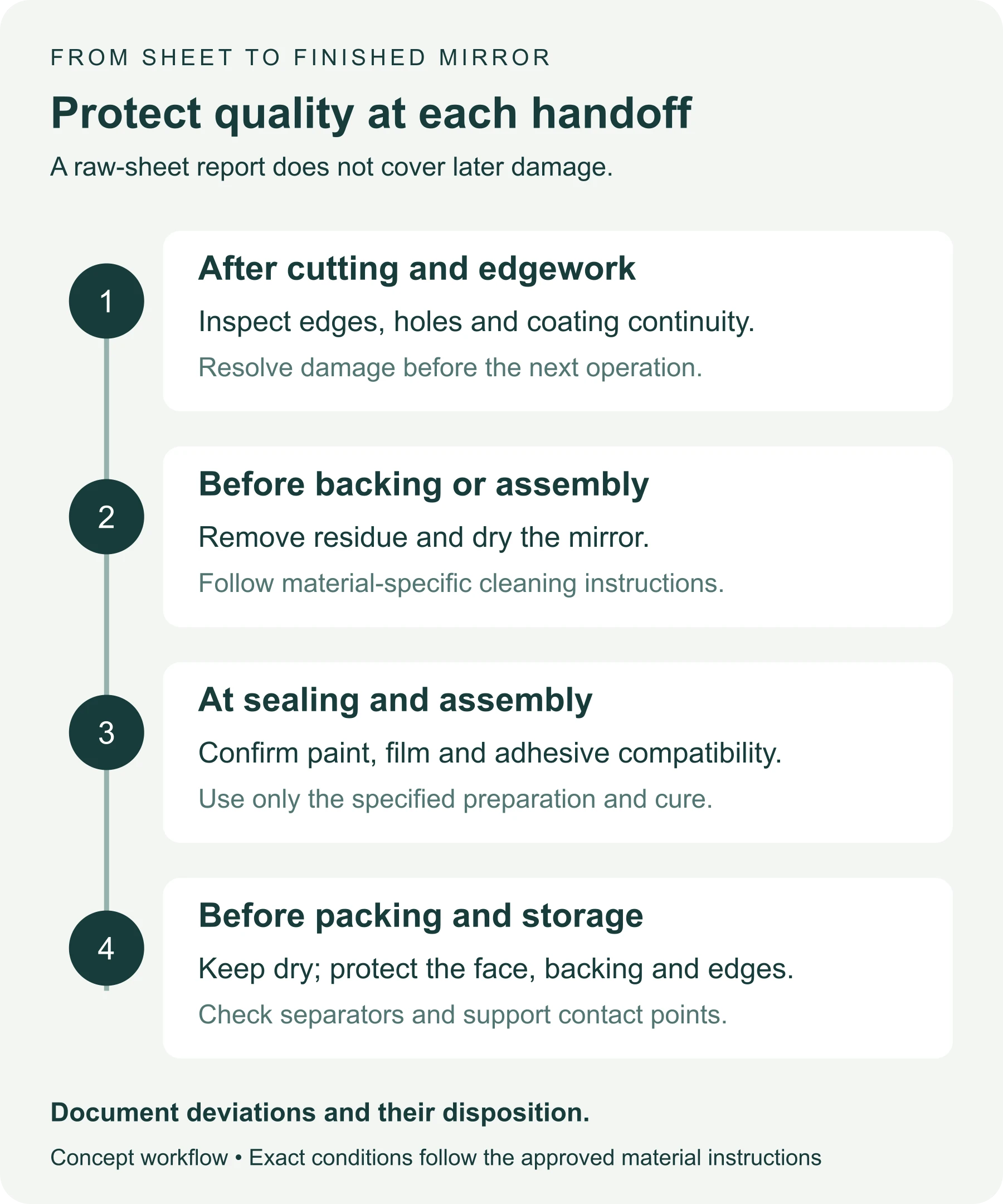
If an edge sealer, adhesive or backing film is required, confirm compatibility with the actual backing paint and follow the approved preparation and curing instructions. “Neutral cure” alone is not proof that an adhesive is suitable for every mirror. Mounting must also provide the required support and avoid trapping moisture behind the glass.
Before packing, check that the mirror is dry and that separators and supports will not scratch the coating or load a vulnerable edge. Keep wet or chemically contaminated material out of the packing area. Record any deviation and its disposition; a good raw-material test cannot compensate for damage introduced later.
Copper-free mirror RFQ checklist
Use this checklist to prepare the information for a quotation. The verification workflow above controls approval; this table defines what to send and agree.
| RFQ field | Information to provide or confirm |
|---|---|
| Application | Bathroom, hotel, residential, retail, medicine cabinet, or another use |
| Product format | Plain, framed, LED, or cabinet mirror |
| Dimensions | Width × height, shape, quantity by size |
| Glass substrate | Clear, low-iron, tinted, or open for review |
| Glass thickness | Project requirement or review request |
| Mirror backing | Copper-free silver mirror |
| Lead requirement | State separately if required |
| Edge treatment | Polished, beveled, framed, or drawing-defined |
| Holes and cutouts | Include dimensioned drawings |
| Safety backing | Required standard or project requirement |
| Corrosion test | Method, duration, and acceptance criteria if specified |
| Visual quality | Scratch, spot, edge, coating, and distortion limits |
| Installation | Mechanical mount, adhesive, cabinet assembly, wall condition |
| Exposure | Humidity, coastal conditions, cleaners, temperature |
| Destination | Country or market |
| Packaging | Surface, edge, carton, crate, or pallet requirements |
| Documents | Data sheet, declarations, test and inspection records |
| Change control | Material substitution and approval rule |
Questions to ask a mirror supplier
Use these questions to resolve gaps in a supplier's reply before approving a sample or quotation:
- Is this a copper-free silver mirror?
- What glass substrate and thickness are used?
- Is the backing also lead-free or low-lead, and what document supports that claim?
- Which technical data sheet identifies the exact material?
- Which corrosion test was performed?
- What were the test duration, acceptance criteria, and measured results?
- Does the report cover the same product, thickness, and production source?
- How are cut edges, holes, and illuminated areas processed and protected?
- Is safety backing required for this application or market?
- Can the approved mirror material be locked for mass production?
- What incoming and final inspection criteria will be used?
- How will the mirror surface and edges be protected during export shipment?
Testing questions
What is a CASS test?
CASS is a copper-accelerated acetic acid salt-spray test used to evaluate corrosion resistance under accelerated conditions. “Copper-accelerated” is part of the test method's name, not proof that the tested mirror has a copper backing. ISO 9227 specifies the procedure, but does not set a universal specimen size, exposure duration, or interpretation of results for every product.
Need copper-free mirrors for a commercial project?
Share your drawings, quantities and application requirements. OJMirror can review the proposed mirror configuration and confirm which supporting documents are available. Include:
- Product type: plain, framed, LED, or medicine cabinet
- Dimensions, shape, and estimated quantity
- Destination market and intended application
- Preferred glass type or thickness, if known
- Required test or documentation criteria
- Drawing, size schedule, or reference image
Request a Copper-Free Mirror Specification Review →
For design options, explore custom mirrors.
About the author
Kris Chou is a Product Manager at OJMirror and the author of this guide.
Selected technical references
-
BS EN 1036-1:2007: Mirrors from Silver-Coated Float Glass for Internal Use — BSI catalogue entry for definitions, requirements and test methods; confirm the applicable edition and full requirements for the project.
-
ASTM C1503-24: Silvered Flat Glass Mirror — public scope; consult the applicable full standard for purchase requirements.
-
ISO 9227:2022: Salt Spray Tests and Amendment 1:2024 — Footnote of Warning — consult the standard and applicable amendment when specifying new tests. The supplier report identifies the 2022 edition; this reference does not establish whether the amendment was applied to that test.
-
National Glass Association: Proper Procedures for Cleaning Flat Glass Mirrors (2019) — cleaning and edge-drying precautions; follow product-specific care instructions.
