

Remove the mirror from a salon station and more than the reflection disappears. The stylist loses a full-view reference, consultation becomes less visual, lighting is harder to judge, and the workstation loses its natural center. A salon mirror therefore serves six connected roles: it supports styling accuracy, client communication, color evaluation, workflow, comfort, and the salon’s visual identity.
In short: a salon mirror is both a working tool and part of the salon environment. Its value depends on how well it is planned with the chair, viewing distance, lighting, tools, wall, and electrical layout—not simply on its shape or frame.
Key Takeaways
- A salon mirror is part of the service system, not merely a decorative wall feature.
- Lighting quality and placement can matter as much as mirror size.
- The right mirror type depends on the service, layout, installation, and maintenance needs.
Table of Contents
- What Are the Six Main Roles?
- What Is a Salon Mirror?
- What Are the Different Types of Salon Mirrors?
- How Do You Choose the Right Type?
- How Do Different Services Change the Requirements?
- How Should Size and Position Be Planned?
- Does a Salon Mirror Need Integrated LED Lighting?
- What Makes a Salon Mirror Suitable for Professional Use?
- Common Selection and Positioning Mistakes
- Can OJMirror Customize Salon Mirrors?
- Salon Mirror Specification Checklist
- How Should a Sample Be Evaluated?
- FAQs About Salon Mirrors
- Conclusion
What Are the Six Main Roles of a Salon Mirror?
1. Helping Stylists Check Their Work Accurately
A stylist often works close to one part of the client’s hair, but the mirror provides a second view of the complete result. Stepping back and looking through the reflection makes it easier to assess the overall silhouette, proportion, left-to-right balance, layering, hairline, parting, and the way different sections connect.
This wider view is useful whenever small local changes affect the complete shape. A handheld mirror can reveal areas not visible from the front. The main mirror should also be flat and clear: visible waves can make straight lines appear uneven and proportions change between viewing positions.
2. Supporting Client Communication and Approval
The mirror gives the stylist and client something they can look at together. During the consultation, they can use the reflection to discuss length, shape, parting, hairline, volume, and other visible details. This is usually clearer than relying only on verbal descriptions such as “a little shorter” or “more movement around the face.”
During the service, the client can follow the change and ask for an adjustment before the work is complete. At the end, the main mirror and a handheld mirror provide a structured view of the front, sides, and back. Clients do not have to watch every step; the mirror simply makes a shared visual reference available when needed.
3. Supporting Lighting and Color Evaluation
A mirror does not create accurate color by itself. What the stylist and client see depends on the light source, its spectrum and color temperature, the amount and direction of light, surrounding surface colors, daylight, and reflections within the room.
This is particularly important for coloring, highlights, makeup, and skin-focused services. A flattering warm source may not be the best reference for subtle hair color, while a bright fixture can still perform poorly if it creates shadows or glare.
Color Rendering Index, or CRI, is one familiar way to describe how a light source renders colors. The U.S. Department of Energy's guidance on LED color characteristics explains why sources with similar headline values can still differ in spectrum, consistency, and color rendition. TM-30 provides a more detailed way to evaluate color rendition. Neither metric should be considered alone; color temperature, illuminance, spectrum, consistency, and the geometry of the light all affect the visual result.
For demanding color-matching tasks, set color-rendering and illuminance targets in the project brief and test them at the stations. Published professional-lighting guidance, including licht.wissen 05, can inform the discussion, but the appropriate target still depends on the service, room, market, and project. Do not use one numeric rule for every salon.
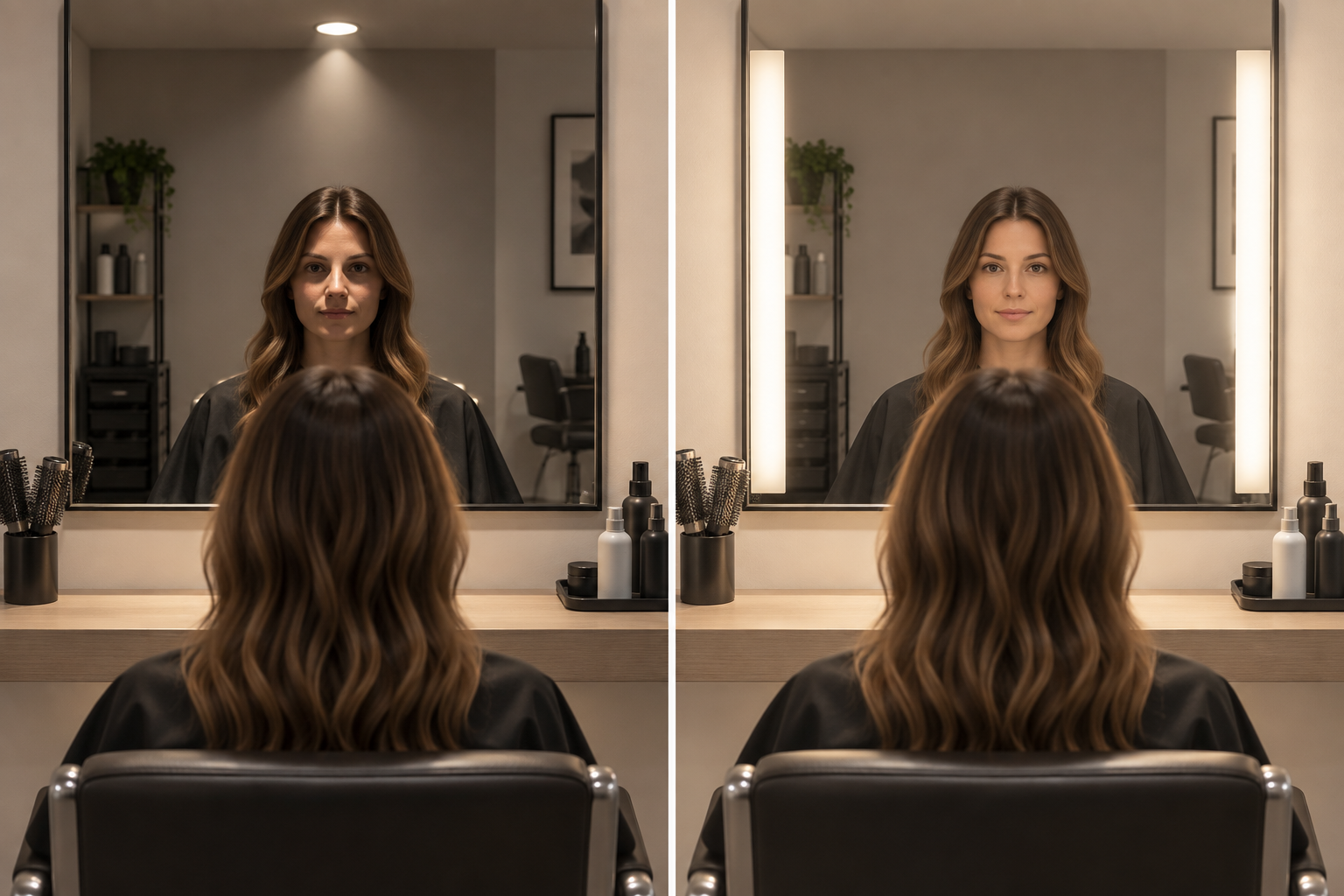
4. Improving Workstation Efficiency and Ergonomics
The mirror usually establishes the centerline of the styling station. The chair, counter, drawers, tool holders, electrical outlets, cables, trolley position, and adjacent workstations are then organized around it.
If the mirror is too high, low, or narrow, the stylist may need to move repeatedly or work from an awkward angle. The selected mirror type should also leave enough room for circulation, power access, tools, cleaning, and safe installation.
For multi-station projects, consistency also matters. Mirror centerlines, mounting heights, lighting appearance, switch positions, and visible finishes should be coordinated across the room.
5. Improving Space and Client Comfort
Mirrors reflect light and extend sightlines, which can make a salon feel brighter and more open. A large, well-positioned mirror may create a stronger sense of continuity than several small mirrors with gaps between them. This can be particularly useful in compact salons or private suites.
However, a mirror reflects whatever is placed in front of it. A beautiful mirror may still produce an uncomfortable experience if it reflects a cluttered storage area, a busy corridor, a strong window, or a bare light source. Mirrors facing one another can create repeated reflections that some spaces use deliberately but others may find visually distracting.
Clients may face the same mirror for a long appointment, so the reflected background, glare, privacy, and viewing angle deserve as much attention as the frame style.
6. Reinforcing Salon Design and Brand Identity
Because mirrors occupy a large part of the styling area, they strongly influence the room’s visual language. Shape, proportion, frame thickness, metal or wood finishes, edge treatment, and lighting can make a station feel minimal, industrial, traditional, soft, or highly decorative.
In a multi-chair salon, consistent mirror dimensions, finishes, lighting appearance, and mounting heights help create an orderly environment. Custom shapes or integrated millwork can provide a more distinctive result, but they also require earlier coordination among the mirror supplier, furniture maker, lighting designer, electrician, and installer.
How Do Different Salon Mirror Designs Affect the Space?
Mirror design changes how the workstation relates to surrounding furniture, lighting, circulation, and the salon's visual identity. The appearance should support the layout rather than compete with the practical work of the station.
| Salon design direction | Mirror direction | Main planning consideration |
|---|---|---|
| Modern minimalist | Large frameless rectangular mirror | Creates a clean visual field with fewer visible details |
| Luxury salon | Arched mirror with a decorative metal frame | Adds a strong focal point to an individual station |
| Industrial barbershop | Rectangular mirror with a dark metal frame | Coordinates with darker furniture, metalwork, and exposed finishes |
| Contemporary beauty studio | Front-lit LED mirror | Integrates lighting into a compact, modern workstation |
| Open-plan salon | Double-sided freestanding mirror | Supports island stations that do not rely on perimeter walls |
A large frameless mirror may help a compact salon feel more open, while a double-sided mirror can serve chairs positioned away from a wall. In either case, appearance should not override reflection quality, mounting safety, lighting performance, cleaning access, or maintenance.
A well-planned mirror area can support finished-work photography, although the background, exposure, white balance, camera processing, and light direction still determine the result.
Why this matters: the mirror, lighting, chair, and workstation form one visual system. Specifying any one of them in isolation increases the chance of mismatched heights, shadows, glare, obstructed access, or late electrical changes.
What Is a Salon Mirror?
A salon mirror is a professional mirror used at a hair, barbering, makeup, or beauty workstation. It may be wall-mounted, incorporated into a freestanding or double-sided station, fitted with integrated lighting, or paired with separate wall lights. A handheld mirror often complements the main mirror by showing the back and sides of a finished style.
Unlike a decorative mirror, it must support repeated close visual work. Its reflection, useful viewing area, position, lighting, counter, tools, sockets, and cleaning access all affect how well the station performs.
What Are the Different Types of Salon Mirrors?
| Mirror type | Main use | Best suited to |
|---|---|---|
| Wall-mounted mirror | Creates a fixed station while keeping the floor relatively open | Perimeter stations and compact salons |
| Freestanding mirror | Creates a station without relying entirely on a wall | Flexible layouts and open floors |
| Double-sided station mirror | Serves two chairs from one central unit | Island layouts and shared footprints |
| Full-length mirror | Shows the complete appearance and proportion | Consultations and final-look checks |
| Handheld mirror | Reveals the back and sides of finished work | Haircuts, fades, coloring, and approval |
| LED salon mirror | Combines the mirror with integrated front or ambient lighting | Stations with coordinated wiring and service access |
| Magnifying mirror | Supports close inspection of a limited area | Makeup, brows, lashes, and detail services |
| Integrated styling-station mirror | Combines mirror, storage, counter, or tool organization | Custom fit-outs and unified workstations |
Categories can overlap. A wall-mounted mirror may include LEDs, while a freestanding station may be double-sided. Selection should begin with the service and layout, then move to appearance.
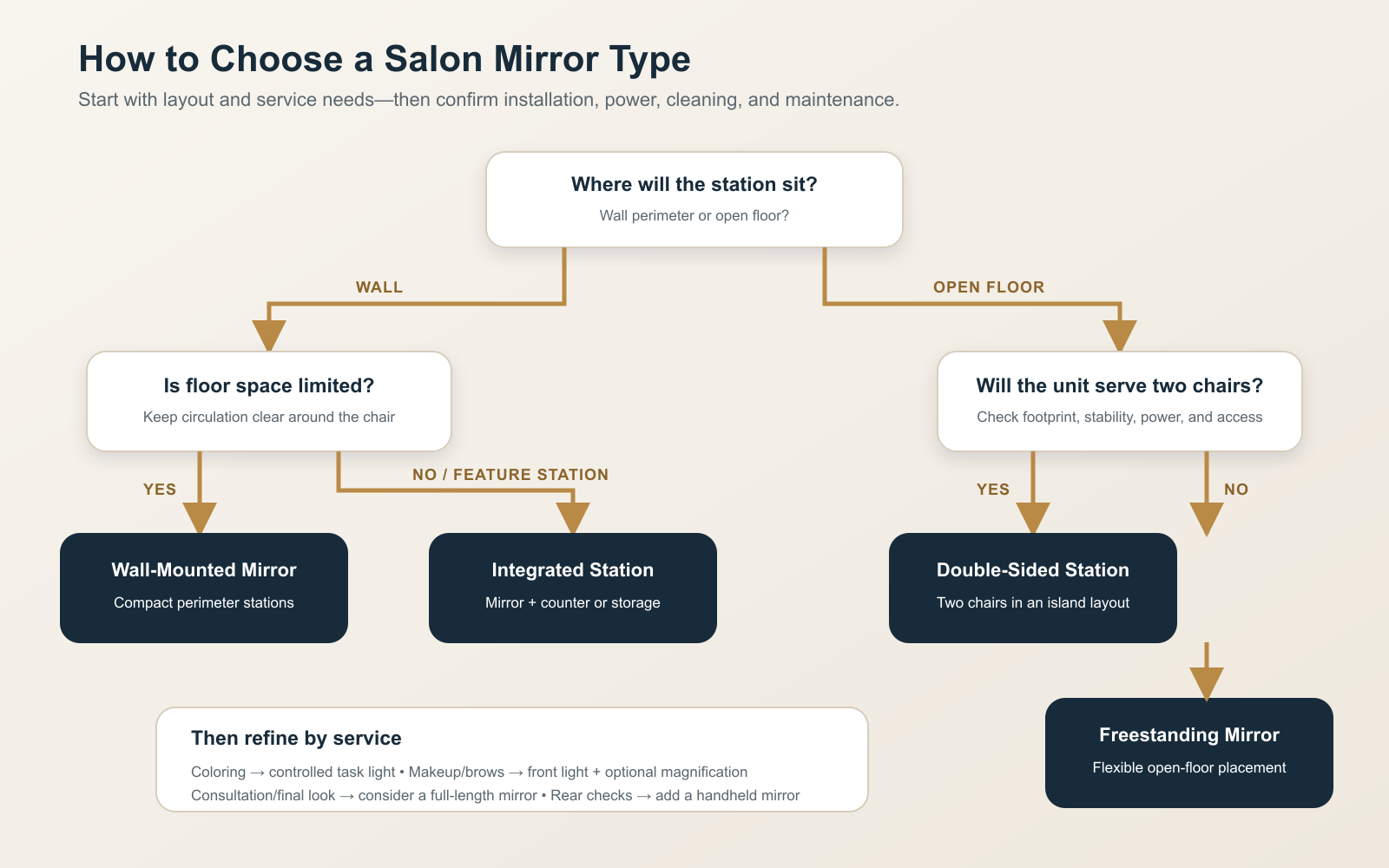
How Do You Choose the Right Type of Salon Mirror?
Start with the station rather than the mirror style. The layout determines whether the mirror can use a wall, must stand independently, or needs to serve two chairs. The service determines the required viewing area and the importance of facial lighting, color evaluation, or magnification.
| Project condition | Practical direction | Points to verify |
|---|---|---|
| Compact perimeter station | Wall-mounted mirror | Wall strength, usable width, counter depth, sockets, and reflected background |
| Open-plan salon | Freestanding mirror or island station | Stability, circulation, floor fixing, power route, and sightlines |
| Two chairs sharing one location | Double-sided station mirror | Footprint, cable routing, storage access, and user separation |
| Hair-coloring zone | Mirror with controlled task lighting | Color quality, daylight influence, glare, and station consistency |
| Makeup, brow, or lash service | Front-lit mirror with optional magnification | Even facial lighting, working distance, magnification, and cleaning access |
| Consultation or final-look area | Full-length mirror | Viewing distance, floor clearance, background, and privacy |
After choosing the basic type, compare how each option will be installed, powered, cleaned, serviced, and repeated. A design that works for one feature station may become unnecessarily complex when repeated across a full salon.
How Do Different Salon Services Change the Mirror Requirements?
The basic roles remain similar, but the required viewing area, lighting, and workstation configuration change with the service.
| Service | Primary role of the mirror | Main selection consideration |
|---|---|---|
| Haircut and styling | Check overall shape, balance, and layers | Useful viewing area, stable reflection, side and rear checks |
| Barbering and fades | Inspect outlines, graduation, and transitions | Close visual clarity, handheld mirror use, even task lighting |
| Hair coloring | Evaluate hue, lightness, texture, and sectioning | Reliable color rendering and consistent light between stations |
| Makeup | Check skin tone, blending, edges, and symmetry | Even facial lighting, glare control, optional magnification |
| Facial treatments | Support close inspection and final presentation | Easy cleaning, suitable angle, and local task lighting |
| Training salons | Allow instructors, students, and clients to observe | Double-sided or mobile layouts, durability, and consistency |
A multi-service salon should identify the most demanding visual task in each zone and verify that the mirror and lighting support it.
How Should Salon Mirror Size and Position Be Planned?
There is no universal salon mirror size because the correct viewing area depends on the chair, client position, stylist’s sightline, service, counter, and room. A more reliable method is to work outward from the seated client.
What Are Useful Salon Mirror Sizes for Planning Discussions?
Salon mirrors are available in many dimensions. The examples below can help a project team begin a layout discussion, but they are not universal industry standards, installation rules, or confirmed OJMirror stock sizes.
| Illustrative mirror size (W × H) | Metric equivalent | Potential application |
|---|---|---|
| 24 × 36 in | 610 × 914 mm | Compact individual styling station |
| 30 × 40 in | 762 × 1016 mm | Individual styling area with moderate wall space |
| 32 × 48 in | 813 × 1219 mm | Station requiring a taller viewing area |
| 36 × 48 in | 914 × 1219 mm | Wider professional styling station |
| Custom dimensions | Project-specific | Salon chains, fitted interiors, and specialized layouts |
Final dimensions should be checked against the seated client's reflection, the stylist's viewing positions, viewing distance, counter, frame, lighting placement, available wall area, and mounting conditions. For a commercial project, a full-size site mark-up or mock-up can reveal visibility and coordination problems before production drawings are approved.
Example: A salon considering a 30 × 40 in mirror should first confirm that the seated client's head and shoulders remain visible from the stylist's normal viewing positions. If the station needs more viewing height or width, the project team can compare a larger outline on the wall before approving the final drawing. This is a planning exercise, not a fixed recommendation for every salon.
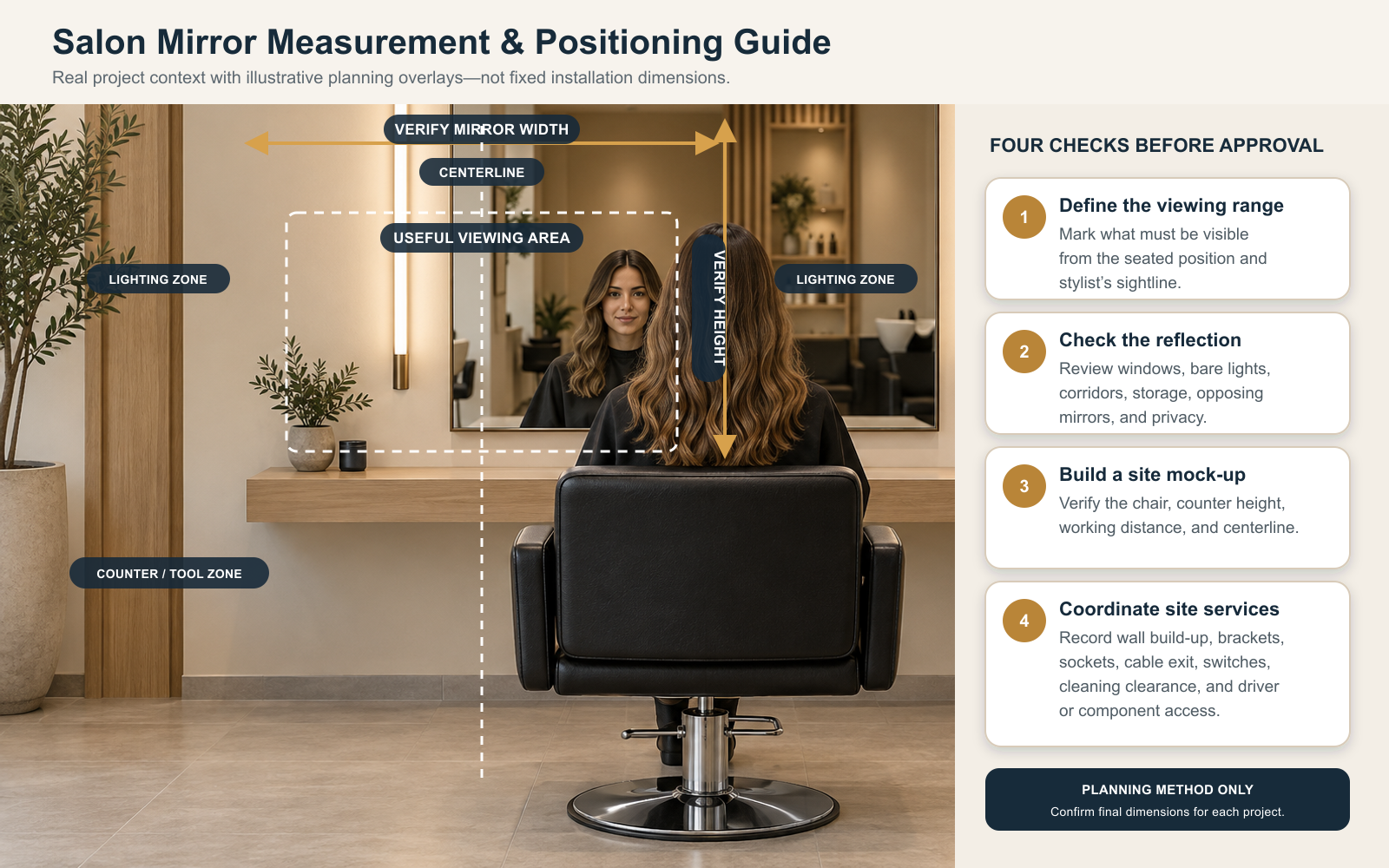
Start With the Required Viewing Area
Mark the range that must be visible when the client is seated, including the head, hair, shoulders, and any additional body area needed for the service. Check the view from both the client’s position and the stylist’s normal standing positions. A mirror can be large overall but still fail if the useful reflective area is blocked by a counter, shelf, frame, or lighting detail.
Coordinate the Centerline and Mounting Height
Align the mirror with the chair centerline unless the station design intentionally requires another relationship. Check the lowest and highest useful reflection points with the actual chair or a full-size site mock-up. This is more dependable than approving a mounting height from a drawing alone, especially when chair bases, seat heights, counters, and user distances vary.
Review the Surrounding Conditions
Confirm clearances for lighting, switches, sockets, tools, shelves, and cleaning. Stand at the proposed chair position and inspect what the mirror will reflect: windows, ceiling lights, corridors, other clients, storage, and opposing mirrors can all change the experience. Record the approved dimensions and centerlines on the drawing so installers do not have to interpret them on site.
Does a Salon Mirror Need Integrated LED Lighting?
Not necessarily. Integrated LED lighting can create a clean, coordinated workstation, but its performance depends on the position, diffusion, output, color quality, controls, and serviceability of the lighting system.
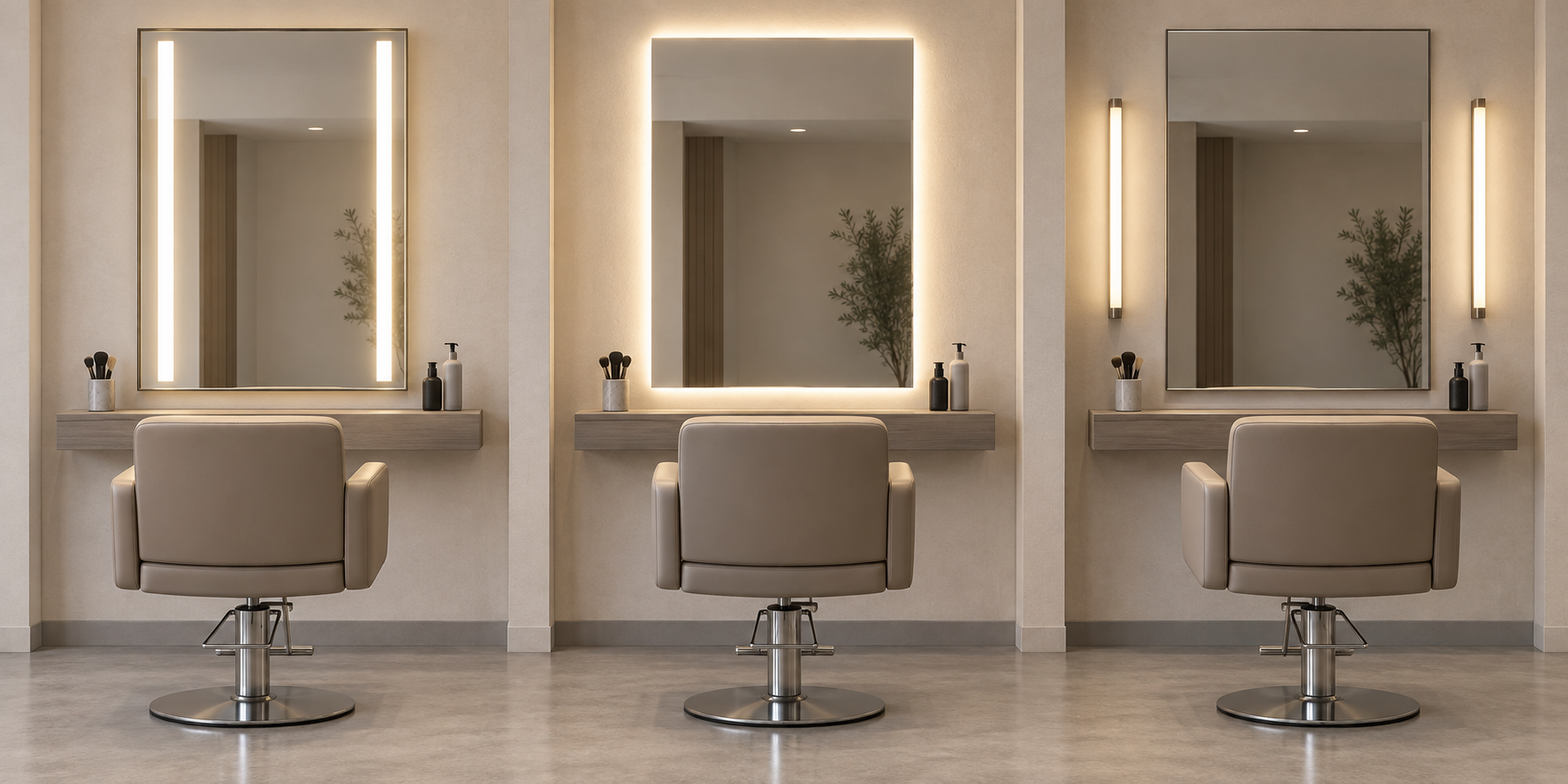
| Solution | Strength | Limitation |
|---|---|---|
| Front-lit mirror | Integrates the light with the mirror and keeps the station visually clean | Requires coordinated wiring, driver location, diffusion, and future maintenance |
| Backlit mirror | Creates a soft halo and adds depth to the wall | Primarily lights the wall and may not provide sufficient facial or hair task lighting alone |
| Plain mirror with side or front lights | Allows flexible fixture placement and separate replacement | Requires careful coordination of mirror width, fixture position, spacing, and electrical points |
| Tunable or multi-CCT system | Allows different color-temperature settings to be reviewed | Adds control complexity and requires consistency across stations |
The term “LED mirror” does not automatically mean suitable salon lighting. Evaluate color rendering, color temperature, illuminance, diffusion, glare, flicker, dimming, wiring, service access, and consistency between stations. The Department of Energy's LED Basics provides useful background on LED technology, but product suitability still has to be assessed in the application. Test the final configuration under conditions that resemble the real salon because daylight, colored walls, dark ceilings, and other fixtures can change its appearance.
What Makes a Salon Mirror Suitable for Professional Use?
Six practical criteria provide a useful starting point:
- Clear reflection: The mirror should provide a stable image without obvious waves or distracting distortion across the useful viewing area.
- Useful viewing area: Width, height, and mounting position should suit the chair, users, working distance, and services.
- Suitable lighting: Integrated or separate lighting should support the task without relying only on brightness. Color quality, direction, uniformity, glare, and controls all matter.
- Safe installation: Weight, wall construction, hardware, electrical connection, and service access should be coordinated.
- Practical maintenance: Glass, frames, joints, switches, and electrical components should tolerate routine cleaning and remain accessible when maintenance is required.
- Workstation compatibility: The mirror must fit the counter, tools, sockets, storage, chair, circulation route, and neighboring stations.
No single feature makes a mirror professional; suitability comes from the complete arrangement.
Manufacturer's Insight: From Drawing to Sample Approval
For a commercial salon mirror, the approved drawing should define more than the overall glass dimensions. It should also identify the visible reflective area, frame details, mounting points, cable exit position, lighting arrangement, controls, and applicable electrical requirements.
The sample review should then compare the finished mirror with those agreed details. Reflection quality, visible finish, lighting appearance, mounting compatibility, and maintenance access should be checked before one specification is repeated across multiple stations. The final acceptance criteria must follow the approved project documents and applicable requirements rather than a generic website checklist.
Planning multiple salon stations? Send OJMirror your floor plan, proposed mirror dimensions, quantity, lighting requirements, and mounting conditions. The team can review the configuration before quotation. Discuss your salon mirror project.
Common Mistakes When Choosing or Positioning Salon Mirrors
- Choosing by appearance alone: An attractive mirror can still provide an inadequate viewing area or conflict with the workstation.
- Planning lighting and wiring too late: Drivers, switches, outlets, cables, frames, and millwork may compete for the same space.
- Depending only on ceiling lights: Overhead-only lighting can create unwanted shadows around the face and hair.
- Looking only at brightness: More light does not automatically provide better color, uniformity, or visual comfort.
- Using one specification for every service: Coloring, barbering, makeup, and training areas may have different priorities.
- Approving a sample in the wrong environment: Daylight, wall colors, ceilings, and other fixtures can change the installed appearance.
- Ignoring the reflected background: Storage, circulation routes, windows, and exposed luminaires may dominate the client’s view.
- Skipping first-article approval: In a multi-station project, a first installed unit can reveal problems with height, wiring, finish, or light appearance before full production or installation.
Can OJMirror Customize Salon Mirrors for a Project?
Yes. OJMirror can customize salon mirrors for commercial projects. Because salon layouts, service types, lighting plans, and installation conditions differ, the process should begin with the project requirements rather than a standard retail size. Buyers can review the available custom salon mirror project directions before sending a brief.
For an initial review, send the available layout, dimensions, quantity, lighting direction, mounting conditions, finish references, destination market, and target schedule. OJMirror can use the brief to identify missing interfaces and prepare the next specification or quotation discussion. Final dimensions, lighting configuration, compliance requirements, pricing, MOQ, sample arrangements, and lead time should be confirmed for the individual project.
What Should a Buyer Send to a Salon Mirror Manufacturer?
A useful inquiry does not need to be a finished technical package. Start with the information already available and mark unresolved items for review. The example below is illustrative—not an OJMirror standard specification or a completed customer project.
| Brief item | Illustrative project input |
|---|---|
| Application | Hair styling stations |
| Quantity | 36 pieces |
| Target size | 800 × 1200 mm |
| Mirror direction | Front-lit, wall-mounted |
| Lighting reference | 4000 K, CRI 90+ requested for review |
| Project power | 120 V version requested for feasibility review |
| Frame direction | Brushed brass appearance |
| Destination | United States |
| Files available | Floor plan, station elevation, finish reference, and target schedule |
Treat requested values as inputs for feasibility, quotation, drawing coordination, and sample approval. They are not confirmed product specifications until both parties approve the project documents.
A Practical Customization Workflow
- Project brief: Share the plan, station quantity, service type, visual direction, destination market, and target schedule.
- Feasibility review: Check the proposed size, shape, lighting concept, mounting method, electrical conditions, and access for service.
- Drawing coordination: Confirm overall dimensions, visible glass area, frame details, light position, cable exit, switch or control method, and mounting points.
- Sample approval: Review appearance and function under conditions that resemble the intended salon. Finish samples, lighting samples, or a complete first article may be appropriate depending on the project.
- Production confirmation: Freeze the approved drawing, bill of materials, finish references, electrical requirements, labels, quantity, and packing method before production.
- Pre-shipment review: Check the agreed inspection points, documentation, identification, packing, and shipment details.
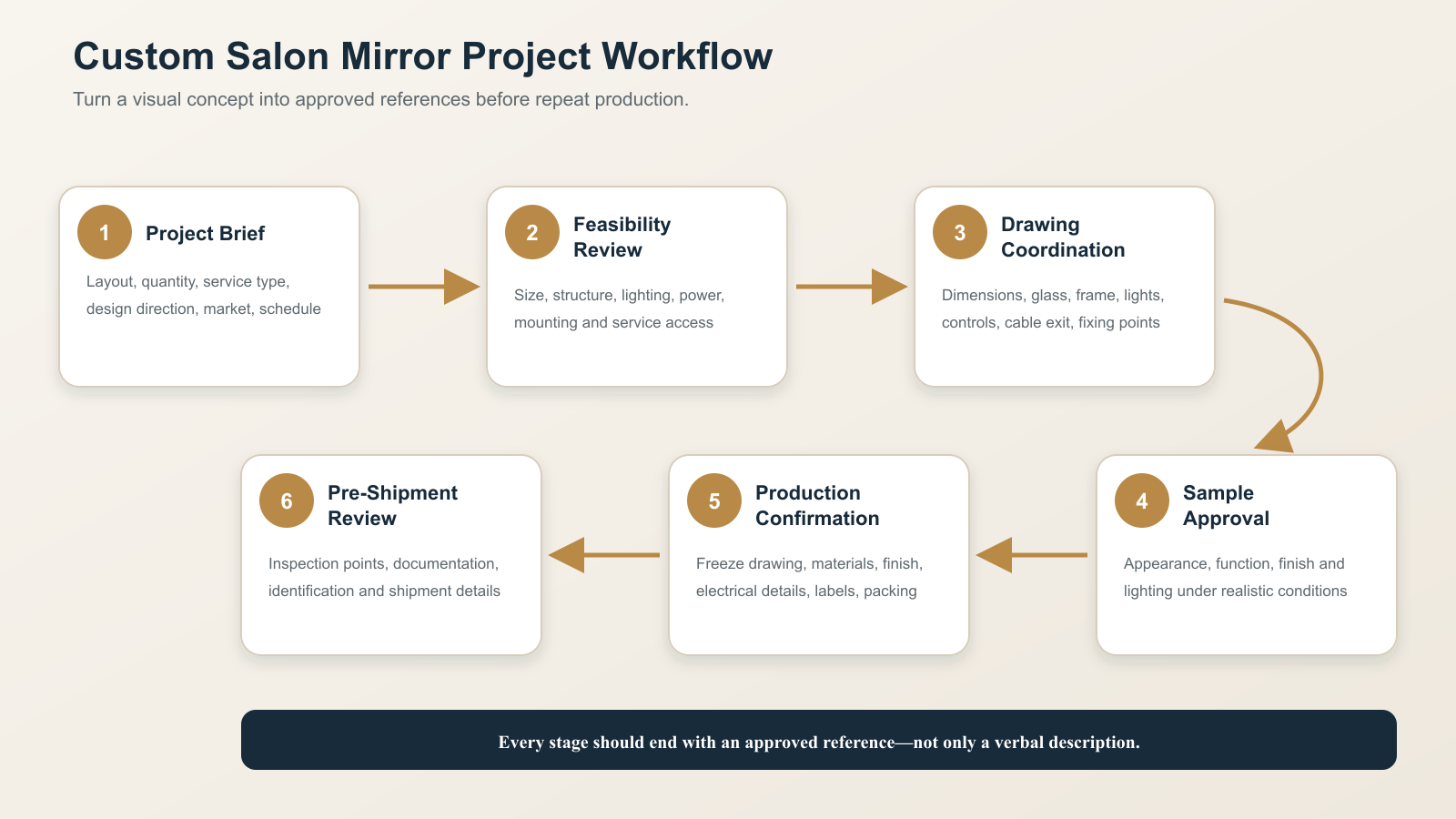
Each stage should produce an approved reference. Verbal descriptions such as “warm light,” “large mirror,” or “black frame” are not precise enough for repeat production.
A Short Salon Mirror Specification Checklist
Before requesting a quotation or approving a design, confirm:
- Service type
- Number of workstations
- Mirror size, shape, and orientation
- Chair position and required viewing height
- Integrated or separate lighting method
- Color-rendering and color-temperature requirements
- Voltage, controls, and wiring position
- Wall construction and mounting conditions
- Frame, finish, counter, and storage integration
- Drawing, finish sample, lighting sample, and first-article approval
These details allow the supplier, lighting designer, electrician, and fit-out team to review the same requirement before work begins.
How Should a Salon Mirror Sample Be Evaluated?
A sample is most useful when it is checked against the approved drawing and the actual application—not only photographed for appearance. The review should cover both the mirror and the surrounding installation assumptions.
| Inspection area | What to check |
|---|---|
| Reflection | Obvious distortion, waves, blemishes, scratches, edge quality, and useful viewing area |
| Dimensions | Overall size, glass size, frame dimensions, thickness, mounting locations, and cable exit |
| Finish | Color, texture, gloss, joint quality, exposed edges, and consistency with the approved reference |
| Lighting | Light distribution, visible hotspots, shadows, glare, color appearance, dimming, and station-to-station consistency |
| Electrical function | Switches, controls, connectors, driver access, cable length, and project voltage marking |
| Installation | Brackets, fixing points, wall clearance, leveling method, service access, and compatibility with the site condition |
| Identification and packing | Model or project labels, accessory list, installation information, surface protection, and package identification |
FAQs About Salon Mirrors
What is the best type of mirror for a hair salon?
There is no single best type for every salon. Wall-mounted mirrors suit many perimeter styling stations, while freestanding or double-sided stations can serve open-plan layouts. Full-length mirrors support overall styling checks, and handheld mirrors help clients see the back of a haircut. Start with the service, workstation layout, required viewing area, lighting, storage, and circulation—not shape or trend alone.
What size mirror is best for a salon styling station?
There is no universal salon-mirror size. The useful reflective area should show the seated client and the parts of the hairstyle the stylist needs to assess without forcing either person into an awkward position. Check the chair, eye level, working distance, counter, adjacent stations, wall area, lighting, and handheld-mirror use before fixing the width and height.
How high should a salon mirror be mounted?
Mounting height should be set from the seated client’s sightline and the stylist’s required viewing area, not from a generic floor-to-mirror measurement. Mark the proposed bottom edge, centerline, and top edge on site, place the actual chair in position, and test the view before drilling or approving production drawings.
Does a salon mirror need integrated LED lighting?
No. Integrated LEDs can create a clean, coordinated station, but a plain mirror with properly positioned separate fixtures may perform just as well or better. Compare the illumination reaching the client, glare, shadows, color rendering, controls, wiring, driver access, maintenance, and the room’s other light sources.
What is the difference between front-lit and backlit salon mirrors?
Front lighting directs more light toward the client and is generally more relevant to facial and hair visibility. Backlighting sends light toward the wall, creating a halo and adding ambient or decorative light. The labels alone do not prove task performance: light output, diffusion, position, room surfaces, and surrounding fixtures still need to be evaluated.
Is backlighting enough for salon work?
Backlighting mainly illuminates the wall and creates a halo. It may contribute ambient light, but it should not automatically be treated as sufficient lighting for cutting or color evaluation. Review the complete lighting plan, then measure and visually test the illumination, shadows, glare, and color appearance at the client position.
Why can hair color look different in a salon mirror and in daylight?
The mirror may be accurate while the lighting changes the apparent color. Differences in spectrum, color rendering, color temperature, intensity, daylight, surrounding finishes, and mixed light sources can all affect perception. Evaluate color under a controlled salon lighting condition and, when relevant to the service, compare it with daylight rather than assuming the mirror itself corrects color.
Can salon mirrors be custom-made for commercial projects?
Yes. Custom salon mirror projects can coordinate size, shape, frame direction, lighting concept, mounting, electrical interfaces, finish references, identification, and packing. The feasible combination depends on the drawing, quantity, destination market, installation conditions, and approval process. Review OJMirror’s salon mirror project page for the information needed to begin.
What information is needed to quote custom salon mirrors?
Start with the quantity, target dimensions, shape, salon layout, lighting direction, mounting condition, project voltage, finish reference, destination market, and required timing. A floor plan, station elevation, dimensioned sketch, or reference image helps identify missing interfaces. Final pricing, MOQ, sample plan, compliance route, and lead time follow the project review rather than a universal website promise.
Conclusion: Treat the Mirror as Part of the Workstation
A salon mirror is a working tool, a shared communication surface, and part of the salon’s lighting and spatial system. Wall-mounted, freestanding, double-sided, full-length, handheld, LED, magnifying, and integrated station mirrors solve different problems; their suitability depends on the service and the space around them.
Before ordering, document the services, workstation quantity, required viewing area, lighting, wiring, finishes, and mounting conditions. Then review the mirror with the chair, counter, tools, wall, and reflected background. This turns a visual purchase into a coordinated workstation decision—and reduces changes after production or installation begins.
