
By Kris Chou · Product Manager · Published by OJMirror · October 15, 2026
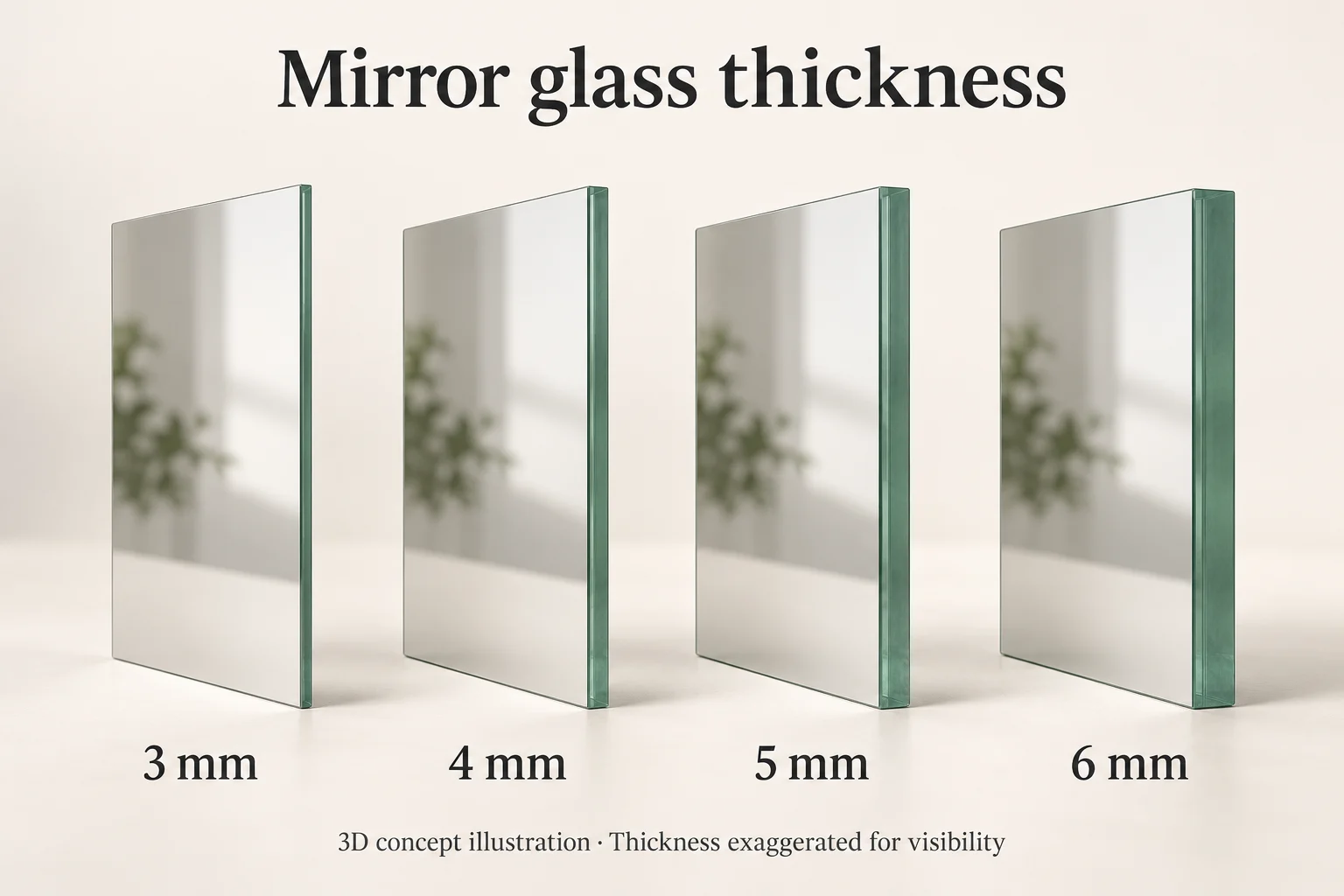
Table of Contents
What Is the Standard Mirror Thickness?
Mirror glass is available in nominal thicknesses such as 3, 4, 5 and 6 mm. There is no single standard thickness for every bathroom mirror. Use the application examples below to narrow your choice, then check the specified construction. For inch-based orders, see the inch and millimeter comparison; nominal descriptions and exact unit conversions are different things.
Mirror Thickness by Application: Quick Selection Guide
| Application | Thickness to compare | What determines the final choice |
|---|---|---|
| Small decorative mirror | 3–4 mm | Panel dimensions, frame fit and backing support. |
| Bathroom or vanity mirror | 4–5 mm | Complete mirror construction and mounting system. |
| Full-length mirror | 4–6 mm | Panel width and height, support and installation. |
| Large frameless wall mirror | 5–6 mm | Panel size, wall flatness, substrate and fixing system. |
| Gym or commercial mirror wall | Project-specific; evaluate 5–6 mm for larger panels | Individual panel size, wall support, mounting and specified safety construction. |
| LED bathroom mirror | Model-specific | Glass support, rear structure and complete assembly weight. |
| Medicine cabinet door | Model-specific | Door construction, hinges, glass retention and weight. |
These ranges are comparison starting points, not universal size limits or verified OJMirror model specifications. LED lighting and cabinet use alone do not establish a thickness requirement. Follow the selected assembly’s specification.
How to Narrow Down Your Mirror Thickness
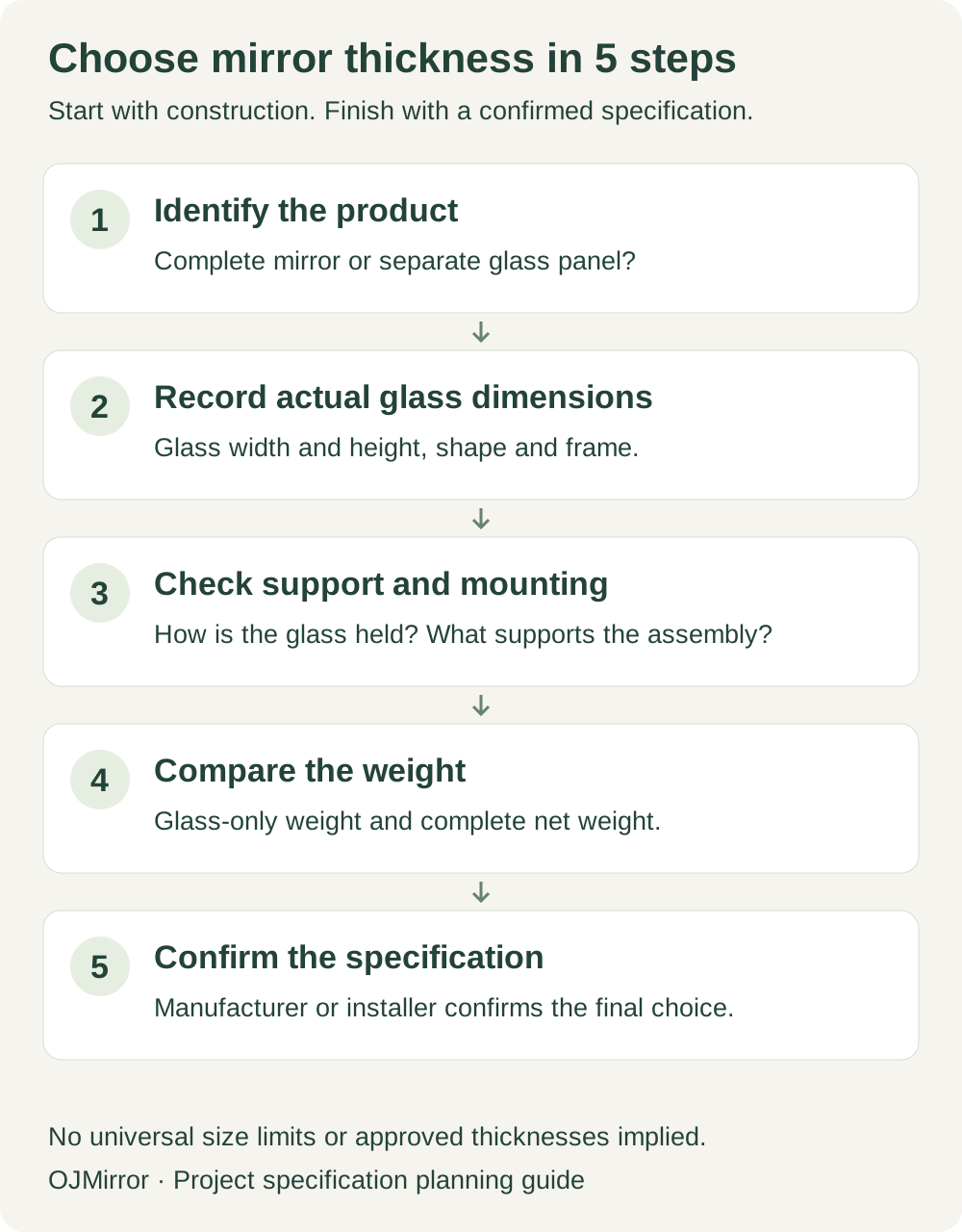
Identify the construction, record the actual glass width and height, then compare the options above against the support and mounting requirements. Use glass dimensions for weight calculations; outside frame dimensions may be different.
3mm vs 4mm vs 5mm vs 6mm Mirror Glass
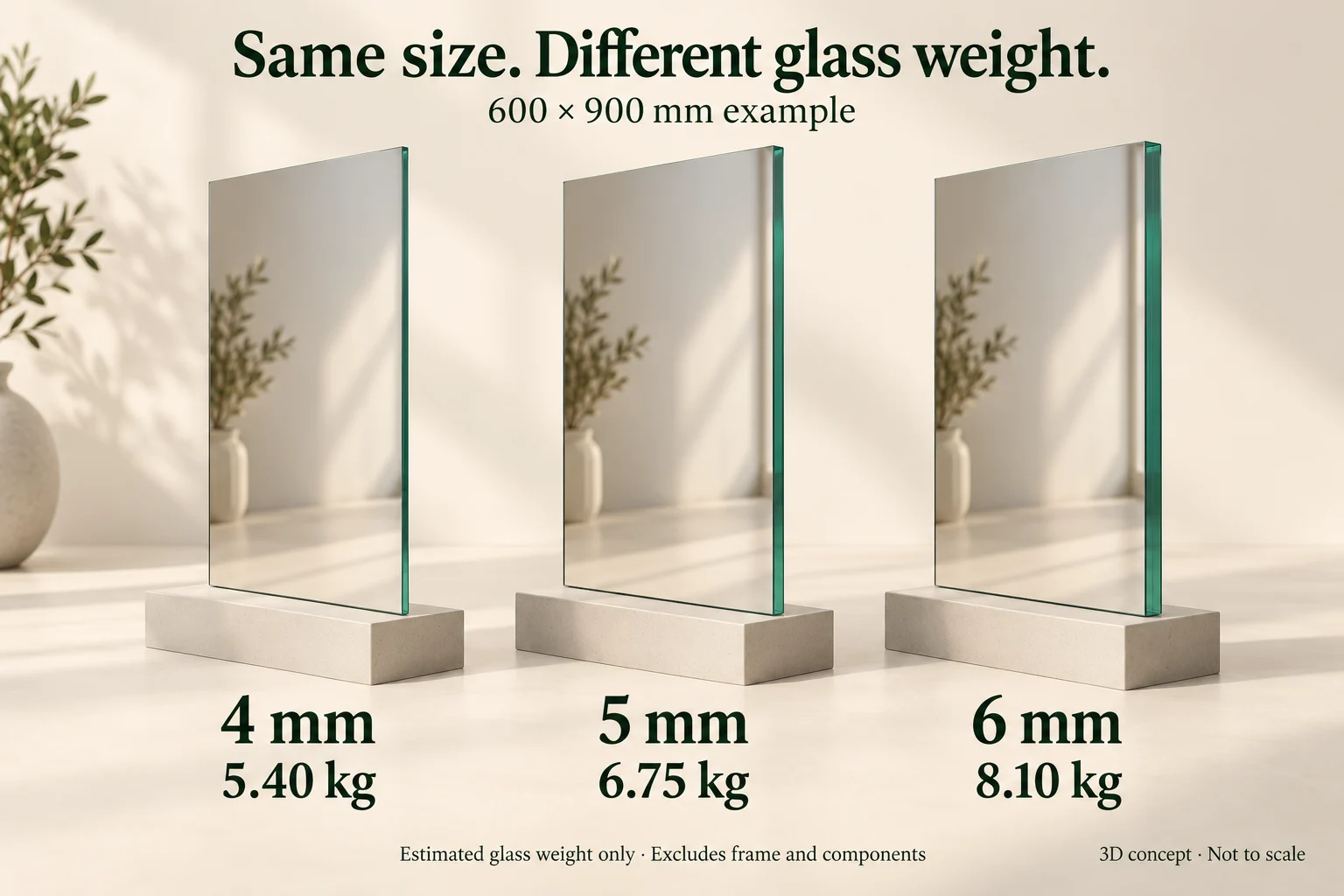
The clearest numerical difference is weight. Using an approximate glass density of 2,500 kg/m³ gives the glass-only estimates below. These are glass-only estimates, excluding frames, rear housings, lights, hardware and packaging.
| Glass thickness | Approx. weight per m² | 600 × 900 mm example | What to confirm |
|---|---|---|---|
| 3 mm | 7.5 kg | 4.05 kg | The selected size and support are suitable for this sheet. |
| 4 mm | 10 kg | 5.40 kg | The glass matches the specified assembly and fixing method. |
| 5 mm | 12.5 kg | 6.75 kg | The additional weight is included in the product specification. |
| 6 mm | 15 kg | 8.10 kg | The complete weight, support and handling arrangements are checked. |
The dimensions above are a calculation example, not an OJMirror model. Every row needs the same size, support and fixing checks; the final column highlights a consideration rather than a separate approval rule.
Glass weight estimate: width (m) × height (m) × thickness (mm) × 2.5 = weight (kg).
Mirror Thickness in Inches and Millimeters
Keep the nominal size in your purchasing brief. Decimal inches below are rounded to three places; the fraction-to-millimeter values are exact arithmetic conversions.
| Metric thickness | Decimal inches (rounded) | Fraction reference—not an equivalent |
|---|---|---|
| 3 mm | 0.118 in | Near 1/8 in = 3.175 mm |
| 4 mm | 0.157 in | Near 5/32 in = 3.96875 mm |
| 5 mm | 0.197 in | Near 3/16 in = 4.7625 mm |
| 6 mm | 0.236 in | Near 1/4 in = 6.35 mm |
An inch label may also be a traditional nominal designation rather than an exact measured value. The National Glass Association’s 2019 manual lists nominal designations separately from thickness tolerance ranges. [3] Confirm the supplier’s nominal specification and applicable tolerance before approving a substitution; do not reject or accept a sheet based on unit conversion alone.
Nominal Thickness vs Actual Glass Thickness
Nominal thickness identifies the specified thickness category. An actual measurement can vary within the applicable manufacturing tolerance. Record the agreed standard, tolerance and measurement method in the order; a single reading is not enough to establish compliance without those criteria. This guide does not set OJMirror production tolerances.
4mm vs 5mm vs 6mm: What Changes for Buyers?
How much weight does thicker glass add?
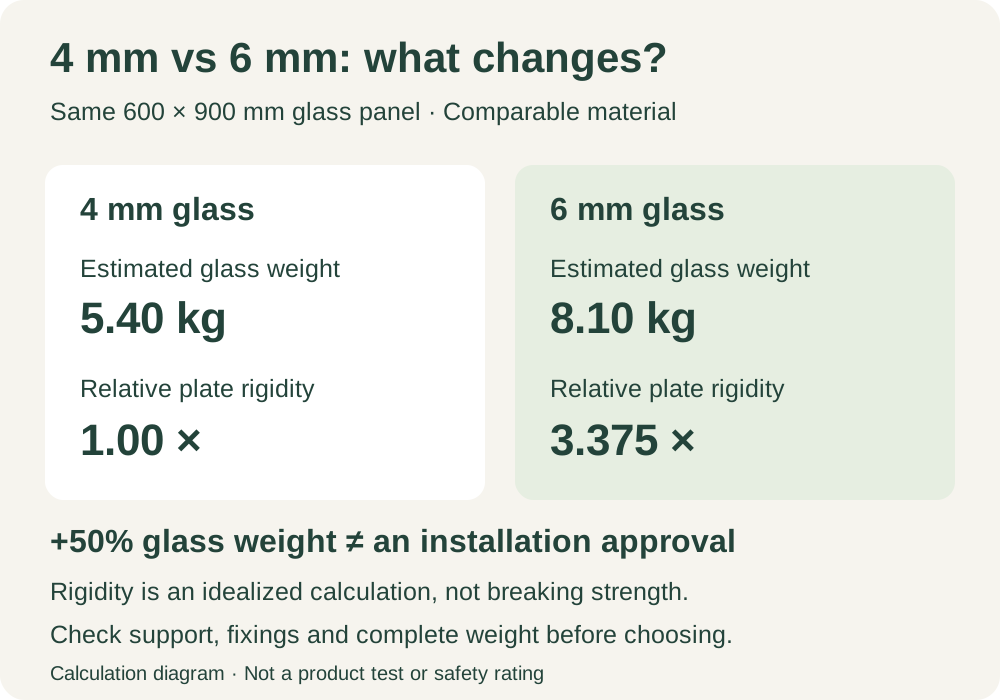
For the same 600 × 900 mm panel, moving from 4 to 5 mm adds approximately 1.35 kg of glass; moving from 4 to 6 mm adds approximately 2.70 kg. Relative to 4 mm, that is a 25% or 50% increase in glass weight—not in the complete mirror’s weight.
4mm vs 6mm Mirror: Which Should You Choose?
Compare 4 mm for a supported assembly specified for that thickness; evaluate 6 mm when the panel design calls for greater bending rigidity. For the same glass area, 6 mm weighs 50% more than 4 mm. With otherwise comparable glass, its idealized plate bending rigidity is (6 ÷ 4)³ = 3.375 times as high. This is not a breaking-strength or impact-performance rating. Neither number approves an installation: check dimensions, support, mounting and complete product weight. [2]
Does 5mm mirror glass offer more rigidity than 4mm?
Yes, for otherwise comparable flat glass. Classical thin-plate theory gives bending rigidity as D = Et³ / [12(1 − ν²)]. With the same elastic modulus E and Poisson ratio ν, the thickness term is cubed: (5 ÷ 4)³ ≈ 1.95. This compares idealized plate bending rigidity—not breaking strength, allowable load or tested mirror performance. Actual behaviour also depends on dimensions, edge conditions, support and installation. [2]
What does that change in the order?
Ask for the revised complete net weight and confirm the frame fit, retaining parts, rear structure and mounting arrangement. For a mirror cabinet door, include the door assembly and hinge compatibility. These checks are especially useful when a quote changes thickness after a drawing or sample has already been approved.
Does Thicker Mirror Glass Cost More?
At the same panel area, thicker glass uses more material and weighs more. The final price difference also depends on glass type, edge processing, dimensions, quantity, packaging and the complete mirror construction. Compare quotations for the same finished specification before attributing a price difference to thickness alone.
Compare packing and freight on the same basis. More glass weight may affect handling or shipment calculations, but the effect depends on the packing design, shipment dimensions and charging method. Do not assume a 50% increase in glass weight means a 50% increase in product price or freight.
When is a thicker sheet worth evaluating?
Revisit thickness when the panel dimensions, support arrangement, fixing method or project requirements change. If an existing 4 mm assembly is specified for the intended use, thickness alone is not a reason to replace it. If a reflection looks distorted, investigate the glass and installation before treating an upgrade as the solution.
How to Choose Mirror Thickness by Size and Support
Bathroom and vanity mirrors
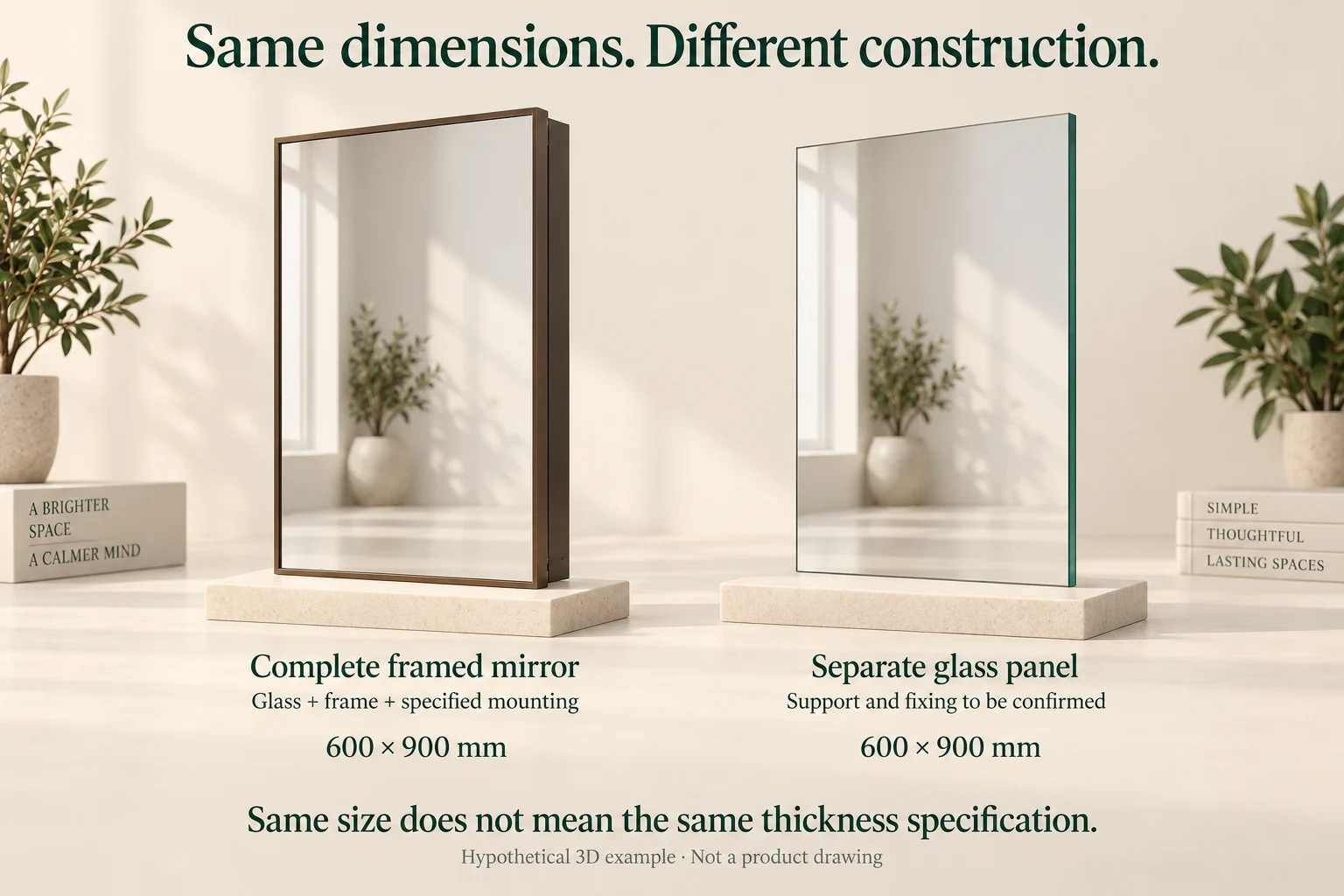
“Bathroom mirror” describes the location, not the construction. A framed ready-made mirror and a frameless sheet bonded on site may need different checks even when they have the same outside dimensions.
For a complete bathroom mirror, look for the model’s glass specification, complete weight and mounting instructions. For a separate panel, confirm its dimensions, the wall condition and the proposed fixing system. For repeat-room hotel bathroom mirrors, keep the approved glass specification, complete weight, mounting details, drawing revision and packing requirements together in the room schedule. A change in thickness should trigger a review of those connected details before a repeat order.
Large wall and full-length mirrors
Look at the actual panel size. A narrow full-length mirror and a broad wall panel are different design situations, even though both may show a person from head to toe.
For a large frameless mirror, discuss wall flatness, panel support, compatible fixing materials and access for handling. The substrate and fixing arrangement should support the specified weight without forcing the mirror to curve. Adding thickness does not eliminate those checks.
Gym, Salon and Commercial Mirror Walls
For gym wall mirrors or a salon mirror wall, record each glass panel’s dimensions as well as the overall wall. Coordinate panel joints and sight lines with the proposed wall layout. Evaluate 5–6 mm options for larger panels with the supplier and installer; this is not a minimum thickness rule for commercial use. Confirm panel joints, wall flatness, fixing materials, edge protection and any required safety construction. Thicker glass alone does not establish impact performance or make an unsuitable mounting arrangement acceptable.
Example: Choosing for a 600 × 900 mm Mirror
For a 600 × 900 mm panel, compare the 4 mm and 5 mm options against the support design first; include 6 mm if the proposed construction calls for evaluation. The earlier table gives glass weights of 5.40, 6.75 and 8.10 kg respectively, but these numbers do not approve any thickness. Consider a hypothetical pair at this size: one is a complete framed mirror with specified glass and mounting hardware; the other is a separate frameless panel for site installation. Their outside dimensions match, but their frame, backing support and fixing arrangements may differ. They should not automatically receive the same thickness recommendation. Confirm the construction before choosing or changing the glass.
Does an LED Bathroom Mirror Need Thicker Glass?
Not necessarily. Adding LED lighting does not, by itself, establish a required glass thickness. Choose against the complete mirror design: panel dimensions, rear structure, glass support and mounting system. Review glass thickness, overall depth, complete net weight and the approved drawing separately. A deep housing does not tell you how thick the glass is.
Mirror cabinet doors
For a door in mirrored medicine cabinets, ask the supplier to confirm the complete door construction and its hardware compatibility. A thicker replacement can change the complete door weight and its fit in retaining parts. Confirm the hinge specification, door construction and opening clearances against the selected model and drawing before approving a substitution.
Does a Thicker Mirror Give a Better Reflection?
Thickness alone cannot guarantee a better reflection. Brightness, colour appearance and the straightness of reflected lines are different aspects of what you see.
The National Glass Association explains that distortion can originate in the glass or be increased by installation. An uneven wall or a fixing arrangement that forces the mirror to curve can affect the reflected image. Viewing distance and angle can also make distortion more apparent. [1]
If an installed mirror looks wavy, ask the supplier or installer to assess the glass and mounting conditions before ordering a thicker replacement. Do not assume that changing from 4 mm to 6 mm will resolve the cause. For dark edges or spots rather than wavy reflections, use the mirror desilvering guide to assess coating-related symptoms.
Glass Thickness vs Overall Mirror Depth
A specification that says “5 mm mirror glass” does not mean the finished LED mirror projects only 5 mm from the wall. Read the drawing for three separate measurements:
- Glass thickness
- The thickness of the glass sheet itself.
- Overall product depth
- The front-to-back envelope of the complete product, as defined on its drawing. Check which projections and mounting parts are included.
- Installed projection
- The distance from the finished wall surface to the frontmost point of the installed mirror.
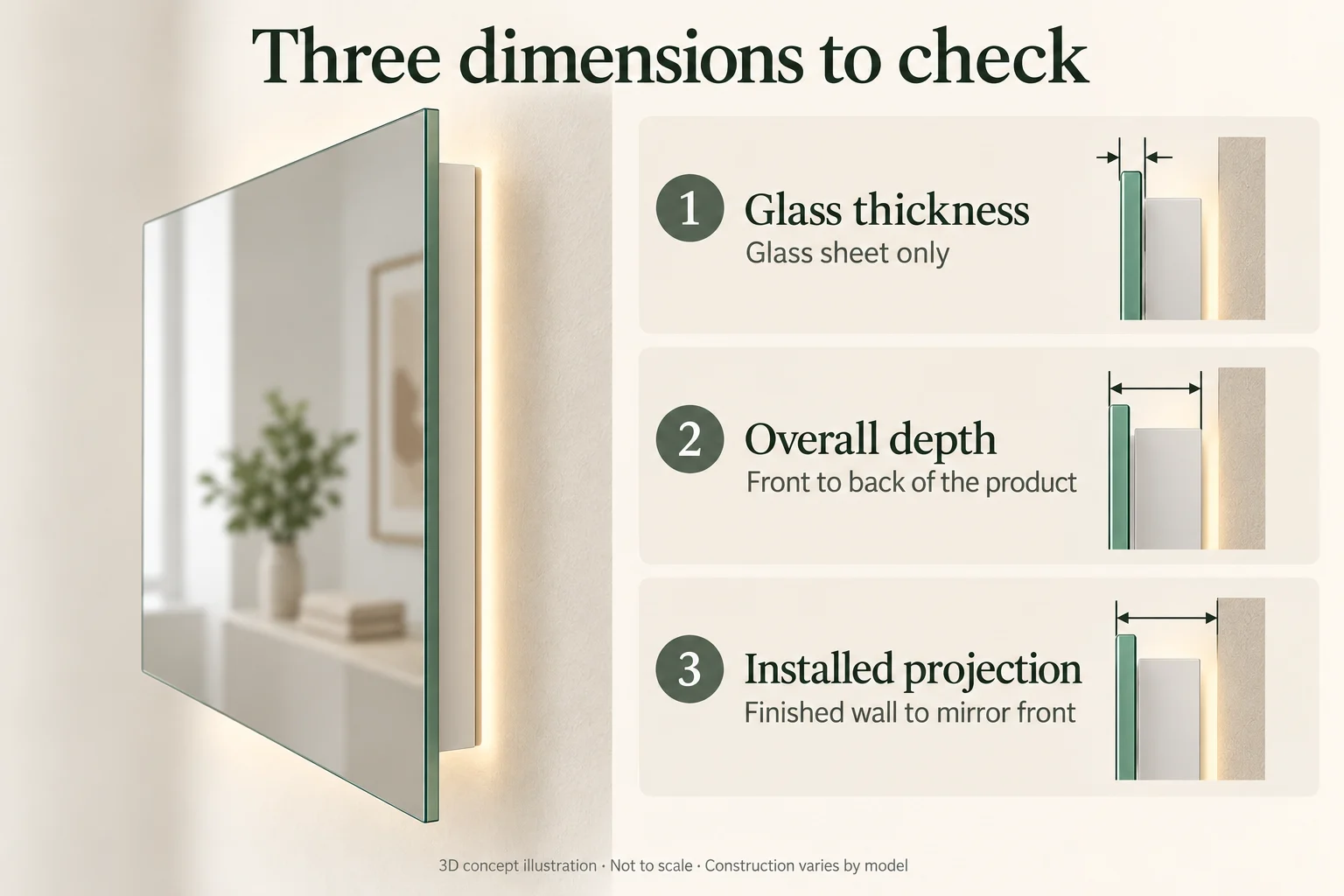
Do not add dimensions from different drawings without checking their start and end points. A mounting component may already be included in the stated product depth. Use the installed section drawing when checking clearance from taps, shelves or adjacent fittings.
What to Check Before Ordering Mirror Glass
Keep glass specifications and complete-product specifications separate when comparing quotations. A short written record makes it easier to see whether two offers describe the same mirror.
| Check | Record or request |
|---|---|
| Dimensions | Actual glass width × height, shape and orientation; record outside frame dimensions separately. |
| Glass | Nominal thickness, applicable tolerance, glass type and any specified safety construction or supporting documentation. |
| Edges and cut-outs | Agreed edge finish, corner treatment, holes and cut-outs, matched to the drawing. |
| Backing and support | Any required safety backing, frame, rear structure and glass support, identified separately. |
| Complete product | Model reference, overall depth and complete net weight. |
| Installation | Fixing method, wall requirements and who confirms the site conditions. |
| Cabinet doors, where applicable | Complete door weight, retaining parts, hinge compatibility and opening clearances. |
| Approval reference | The relevant drawing revision, sample or product instructions. |
For hotel and commercial mirror orders, include the quantity, destination market and project requirements. Request the applicable glass specification, nominal thickness tolerance and any required supporting documentation before approving the construction. Record the selected drawing revision and resolve missing information before comparing offers. Use OJMirror’s mirror glass quality inspection overview to discuss the checks needed for your order; request the agreed acceptance criteria and relevant records for the selected product.
If you are replacing an existing mirror, add the original frame or fixing details. A thicker sheet should not be treated as a direct replacement until its fit and weight have been checked.
Planning a hotel, apartment or commercial mirror project? Share actual glass dimensions, estimated quantity, intended application, preferred thickness if specified, and mounting requirements. Include a drawing or model reference where available. Ask OJMirror to review the proposed specification and identify details to confirm before quotation.
Frequently Asked Questions
Is 4mm or 6mm better for a bathroom mirror?
Use the thickness specified for the complete mirror. At equal area, 6 mm glass is heavier and more resistant to bending than 4 mm, but it is not automatically the better choice. See the comparison above, then confirm the support and mounting requirements.
Is 6mm mirror glass the same as 1/4 inch?
Not as an exact conversion: 1/4 inch equals 6.35 mm. Suppliers may use nominal metric and inch descriptions, so confirm the stated thickness and applicable tolerance before substituting one specification for another.
Can I replace a mirror with thicker glass in the same frame?
Only after checking the fit and the complete support arrangement. Confirm the available channel or rebate depth, retaining parts and added weight with the supplier or installer. Matching the width and height is not enough.
How can I find the thickness of an existing mirror?
Start with the model information, invoice or drawing. If a bare glass edge is safely accessible, a suitable measuring tool can help identify its thickness. Measure the glass itself, not a bevel, backing board or frame. Do not pry a mounted mirror away from the wall just to measure it.
Does safety backing count as part of the glass thickness?
Glass thickness describes the glass sheet; a backing film is a separate layer. For a laminated or other composite construction, ask whether the quoted figure describes one glass layer or the total build-up. Have the supplier identify each layer in the specification.
Technical References
Technical references checked 14–15 October 2026. General guidance does not establish OJMirror product specifications or certifications.
- National Glass Association — Understanding Reflective Distortion in Mirror Installations, FB58-15 (2023).
- Georgia Tech — Plate Theory lecture. Classical plate rigidity relationship; not a mirror product test.
- National Glass Association — Engineering Standards Manual (2019), section D.2.1. Nominal thickness designations and tolerance ranges; historical technical reference, not an OJMirror acceptance standard.
